
Propeller impellers are crucial components in naval propulsion systems that perform the important work of power conversion. Serving in long-term, complex marine environments with high loads, violent impacts, and serious corrosion, surface integrity has direct influence on the fatigue life and reliability of safety of the entire system. As a mature and controllable surface strengthening technology, shot peening technology has been widely used in shipbuilding and maintenance since recent years.
Introduction
Propeller impellers experience complex and fluctuating dynamic loads and fluid impacts in operation of the ship and very often experience fatigue cracks, pitting corrosion, and even root blade and surface area premature failure, severely restricting their service duration and operational performance. Traditional manufacturing and repair methods find it challenging to overcome surface micro-crack and residual tensile stress issues at their core. Being an extensively used and effective surface hardening technique, the technology of shot peening makes the material surface layer experience plastic deformation by high-speed spraying of shot particles on the metal surface, generating a residual compressive stress field, thereby significantly enhancing the resistance of the material towards crack initiation and propagation. In my own engineering practice and material surface strengthening research experience, the shot peening technique is most suitable for the strengthening requirements of complex-shaped propeller impellers under harsh service conditions, one of the most economical strengthening methods available.
Principles and Mechanisms of Shot Peening Strengthening
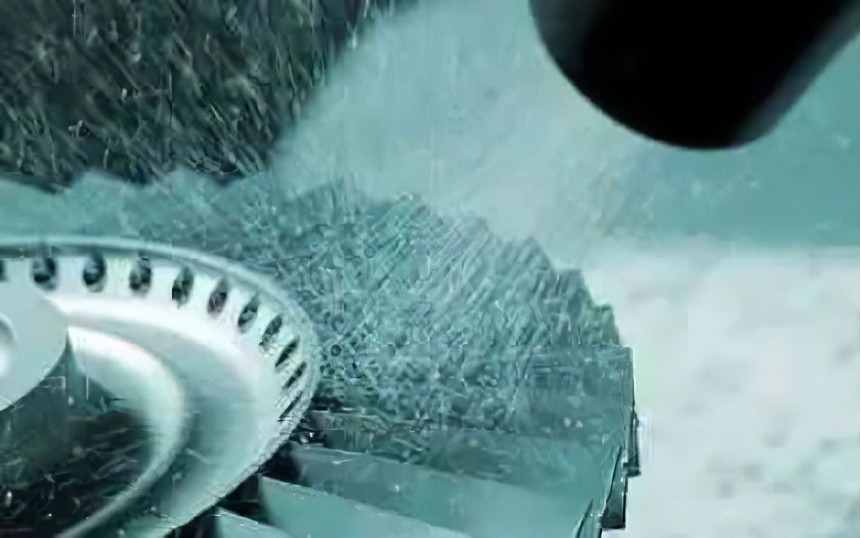
Shot peening strengthening is a cold working process based on surface plastic deformation. The principle is to employ elastic particles like steel shots, ceramic shots, or glass shots which are driven by pneumatic or centrifugal units to impact the metal surface, causing local plastic deformation of the surface metal structure by high-frequency impacts to induce an acceptable residual compressive stress distribution in the metal surface layer.
From micro-mechanical assessment, shot peening-caused deformation leads to proliferation of dislocations, pile-up of slip bands, and the creation of sub-grain boundaries in the crystal lattice with much more fine grain size and hardened layer development. These microstructural changes greatly improve impeller material resistance to crack initiation. Particularly, the compressive stress field generated on the surface can serve to effectively offset some degree of tensile stress under external alternate loading, preventing initiation and propagation of fatigue cracks—a key element for “life extension” treatment.
Shot Peening Process Path and Key Control Parameters
For key components like propeller impellers with complex shapes and dynamic load requirements, shot peening strengthening can achieve effective improvement of surface residual compressive stress and fatigue life. However, shot peening quality depends on many links like medium selection, intensity of shot peening, path optimization, and process detection and requires extensive design and precise control.
Shot Peening Medium Selection and Particle Size Control
Different impeller materials are combined with different media types and sets of particle sizes. Medium-hardness steel shots and high-roundness shots should be used for copper alloys to avoid the surface damage caused by excessive erosion; for hard materials such as stainless steel and high-strength steel, ceramic shots are preferable to enhance plastic deformation effects on the surface. Particle size control needs to take complete cognizance of impact energy and roughness requirements—too large particle size increases strengthening depth but can affect surface finish, whereas too fine particle size creates non-homogeneous stress fields and decreases strengthening efficiency.
Optimization of Shot Peening Intensity and Coverage Rate
Shot peening intensity is controllable and feedbacked by Almen strips, and shot peening coverage rate needs to be tightly controlled at over 98% in order to avoid local stress concentration and the initiation of fatigue cracking. I also found in my experience in repairing marine thrusters that low coverage rate causes blade roots and leading edge areas prone to being sources of fatigue damage. Therefore, standard control of shot peening intensity testing processes and standard coverage rate control should be applied to ensure shot peening consistency throughout.
Design of Spray Angle and Movement Path
In the case of complicated geometry and sharp changing curvature radius, there should be meticulous planning of the direction of the nozzle, the angle of shot peening, and movement path using five-axis CNC shot peening machines or robots. For blade roots and high-stress areas, a multi-angle spiral motion approach needs to be utilized for promoting local strengthening depth and consistency, while in blade tip and edge areas, low-angle sweeping spray is utilized for reducing surface damage and boundary defects and promoting stress gradient balance and shot peening efficiency.
Surface Quality Detection and Closed-Loop Control
After shot peening, an X-ray stress analyzer has to be used to gauge the distribution of the surface residual stress field. Geometric errors and roughness variation before and after shot peening have to be monitored in order to be combined with a coordinate measuring machine and 3D surface scanner, supplemented by hardness gradient measurement for evaluating the tissue hardening effect if necessary. With a complete detection database and digital traceability system, closed-loop quality management of the shot peening process is achieved with stable and controllable process assurances for subsequent mass production.
Analysis of Shot Peening Strengthening Effects
Multiple experiments and engineering practices have demonstrated that propeller impellers after shot peening strengthening significantly improve in multiple performance aspects:
- Fatigue Life: Residual compressive stress to the highest after strengthening is up to 800%, stable in high-frequency water impact conditions;
- Corrosion Resistance: High-density deformation layer and compressive residual stress state introduced by shot peening reduce stress corrosion sensitivity;
- Wear Resistance: Surface hardness is enhanced by 10–40%, and wear rate is greatly reduced;
- Economic Benefits: Extending the impeller service cycle reduces maintenance and replacement costs, improving ship operational economy.
Development and Comparative Analysis of New Shot Peening Technologies
New shot peening technologies have evolved year by year, based on traditional shot peening, to become some high-level surface treatment technologies like laser peening, micro-particle shot peening, high-pressure water peening, and ultrasonic peening.
Micro-Particle Shot Peening
As compared to traditional shot diameters (>200μm), micro-particle shot peening utilizes ultra-fine particles of 40–100μm, higher impact frequency, and better stress layer stability. It has been reported in the research that it lowers the surface roughness significantly with better fatigue, especially suitable for high-surface finish requirements of transmission parts such as gears and impellers.
Laser Peening
Through the use of high-energy pulsed lasers to produce shock waves, it does deep strengthening (up to 1mm) without contacting the workpiece and does not cause microstructural deviation. Its uniformity and depth of strengthening are better than traditional shot peening, but very high equipment costs limit its application to high-end markets such as aero-engine blades.
Ultrasonic Peening
High-frequency pin or shot contacts yield surface plastic deformation of controlled depth, with steady strengthening properties and low roughness. Used on precision components involving highly dimensional control requirements, it has emerged rapidly for applications such as gears and drive shafts.
High-Pressure Water Peening
Using high-pressure water instead of traditional shots, it is economical and eco-friendly, but its residual compressive stress peak value and strengthening depth are limited. Being suitable to process corrosion-resistant aluminum alloys and other materials, it has not been fully applied to process steel impellers.
Overall, novel shot peening technologies possess obvious advantages of strengthening depth, stability of stress, and surface finish, and will increasingly substitute the traditional shot peening in the manufacture of high-performance propeller impellers in the future.
Conclusion
As part of power components of a ship, surface strengthening of propeller impellers is directly related to ship operating safety and economy. With its mature process mechanism, high strengthening efficiency, and surface performance improvement that can be controlled, shot peening strengthening technology has great prospects of wide application in propeller impeller manufacturing and maintenance.


