
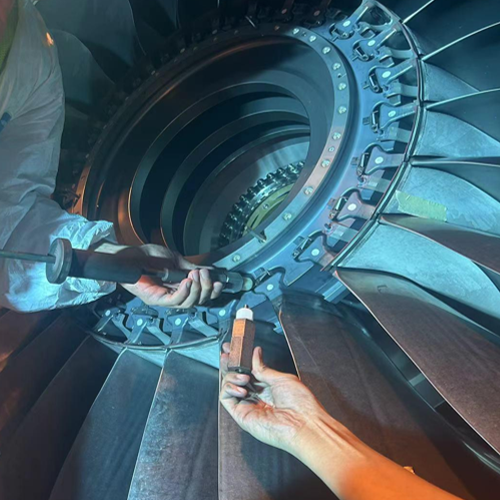
In modern aero-engines, impellers, being the critical rotary components, operate in severe high-temperature and high-stress environments for longer periods, necessitating high levels of material thermal strength, corrosion resistance, and fatigue properties. Superalloys, especially single-crystal superalloys, have become critical material systems in the manufacture of aviation impellers due to their high-temperature mechanical properties, microstructure stability, and durability for long-term service.
Introduction
With the evolution of aero-engine technology for high thrust-to-weight and efficiency, the impeller environment has become more severe with temperatures of over 1,100°C, alternating rotation stresses, and fluctuating loads, subjecting the durability limits of traditional metal materials severely. While titanium alloys have lightweight advantages, they are affected by fast oxidation and poor thermal stability; stainless steels are cost effective but their thermal strength cannot match high-pressure stage impellers. In this regard, superalloys have come to be the material of choice in order to achieve high-temperature strength, corrosion resistance, and microstructural stability, of which the most important technological advance is the nickel-based single-crystal superalloys.
Overview of Superalloy Materials
Superalloys are a class of metallic materials designed for extreme thermal requirements, typically Ni, Co, or Fe based, with strengthening elements such as Al, Cr, Mo, W, and Ta, having improved thermal strength, oxidation resistance, and creep life. Based on the matrix, superalloys are mainly categorized into:
| Alloy Type | Matrix | Main Characteristics | Typical Grades |
| Nickel-based | Ni | Best thermal strength, stable microstructure | Inconel 718, René 88, CMSX series |
| Cobalt-based | Co | Strong hot corrosion and thermal fatigue resistance | MAR-M509, FSX-414 |
| Iron-based | Fe | Low cost, suitable for medium temperatures | A-286, Pyromet 31 |
Among them, nickel-based single-crystal alloys, as representative embodiments of high-temperature structural materials, have been widely applied to produce hot-end components such as aviation impellers and turbine blades.
Key Properties of Superalloys in Aviation Impellers
Based on the long-term experience of aero-engine engineering applications, the selection of superalloys for aviation impellers should meet the following basic performance parameters:
- High-Temperature Strength and Creep Resistance
- Materials must maintain high yield strength in the 800–1,100°C service environment and have low creep rate such that there is no plastic deformation or structural instability during long-term service.
- Microstructural Stability
- The principal strengthening phases (e.g., γ′ phase) must be thermally stable in service at elevated temperatures, effectively restraining dislocation slip and grain growth in an effort to maintain the overall strengthening contribution of the material.
- Oxidation and Hot Corrosion Resistance
- The surface layer must possess self-passivation ability, able to form a dense and stable Al₂O₃ or Cr₂O₃ oxide film under high-temperature air or gas environment, significantly slowing down the oxidation and corrosion process and increasing service life.
- Fatigue Strength and Thermal Fatigue Resistance
- The materials must resist alternate loads of high-cycle fatigue (HCF) and low-cycle fatigue (LCF), and maintain crack initiation delay ability and fracture toughness under thermal-mechanical cyclic loading.
- Good Hot Workability and Weldability
- Matching up with the demands of production and remanufacturing intricate geometric forms, such as forging, precision casting, directional solidification, welding repair, etc., with good forming flexibility and stability of weld joints.
Development and Engineering Characteristics of Single-Crystal Superalloys
Evolution of Alloy Generations and Performance Improvement
Nickel-based single-crystal alloys have evolved through four generations since the 1970s. The content of elements such as Re, Ru, and Ta in the alloys has been continually increased to achieve improved creep life, but it also raises concerns such as increased density, higher cost, and approaching solidus temperatures, requiring more complex trade-offs in structural design. Single-crystal alloys fourth generation can operate temperatures higher than 1,100°C, and experimental alloys (e.g., fifth generation) are targeted for higher temperature ranges.
Composition and Microstructure Optimization
- High γ′ phase volume fraction design: Enhances high-temperature strength and microstructural stability;
- Introduction of Pt element: Facilitates γ′ phase stability, e.g., TROPEA alloy displaying exceptionally high performance at the 950–1,200°C temperature range;
- Low Re content and optimized Cr content: Balances cost and oxidation resistance, such as AGAT alloy showing excellent TBC compatibility;
- Trace element regulation: Microalloying with Hf, B, Si, etc., significantly improves grain boundary strength and oxidation resistance.
Intelligent Design Methods
Machine learning-based composition design methods and CALPHAD databases (such as the DCSA model) are becoming new fashion directions for single-crystal alloy design and performance calculation. For example, researchers have used AI algorithms to screen out new alloy systems with high γ′ stability and low density which have been well calibrated by experiments and significantly shortened the R&D cycle.
Application Cases and Material Selection Basis
In a centrifugal compressor project of a certain aero-engine, we selected Inconel 718 as the main impeller material, which has stable mechanical properties and corrosion resistance at 980°C, mature heat treatment technology, and repeatable producibility. In heavy-duty turbine applications, single-crystal alloys such as CMSX-4 and CMSX-10 are widely used due to their extremely high creep life and microstructure stability and can be combined with directional solidification and thermal barrier coating technologies for meeting complex service requirements.
Notes on Processing and Forming Technologies
Single-crystal alloys, especially, face severe technical challenges in processing and subsequent processing, especially including:
- Complex Directional Solidification Casting Process
- The production of single-crystal impellers should utilize strictly controlled directional solidification techniques such as the Bridgman-Stockbarger process to ensure regular crystal orientation and eliminate grain boundaries, thereby improving high-temperature performance and fatigue life.
- Difficult Machining
- Superalloys are usually characterized by high hardness and significant work hardening with propensity to undergo excessive tool wear during machining. High-performance ceramic tools or wear-resistant coated cemented carbide tools are therefore employed in processing, and cutting conditions need to be optimized to handle thermal effect and surface integrity.
- High Welding Process Sensitivity
- Superalloys are extremely sensitive to thermal cycles, and welding will be prone to thermal crack and intergranular corrosion defects. Preheating temperature, heat input, and post-weld heat treatment processes must be controlled stringently to maintain joint quality.
- Application of Powder Metallurgy and Additive Manufacturing Technologies
- With the emergence of emerging manufacturing technologies, powder metallurgy and additive manufacturing (such as electron beam melting EBM and selective laser melting SLM) have been increasingly employed in the manufacture of sophisticated impeller structures with advantages of material saving, near-net forming, and cost saving, especially for small-batch, complex-shaped high-performance parts.
Application Challenges and Engineering Countermeasures
| Challenges | Engineering Countermeasures |
| High material cost | Optimize design, use high-performance single-crystal alloys only in high-temperature areas |
| Difficult processing | Introduce additive manufacturing, precision casting, and automated inspection |
| Complex coating compatibility | Optimize TBC/alloy matching to reduce SRZ formation tendency |
| Sensitive to trace impurities | Strictly control master alloy purity, introduce AI-assisted screening |
Conclusion
Superalloys, especially nickel-based single-crystal alloys, are the basic material guarantee for aerospace impellers to run at efficient and high-temperature conditions. Their high-temperature mechanical properties, microstructure stability, and corrosion resistance are the technological foundation of the reliability and performance of aero-engines currently. As the development of materials science, process technology, and intelligent design continues, superalloys will be even more engineering flexible and innovative in harsher and smarter aviation processing conditions in the future.


