
First, let’s get a feel for the definition of turbomachinery: Turbomachinery is a type of machinery that uses a continuously flowing fluid as the work medium and blades as the main working members to achieve the energy conversion between the working members and the work medium . Let’s take an illustrative example. When a running electric fan converts electrical energy into mechanical energy, the fan starts rotating. The blades make contact with the surrounding air and give the air its push. The mechanical energy of the blades is converted to kinetic energy of the surrounding air, generating an “artificial wind”. Such a simple turbomachinery!

What is an Engine Impeller?
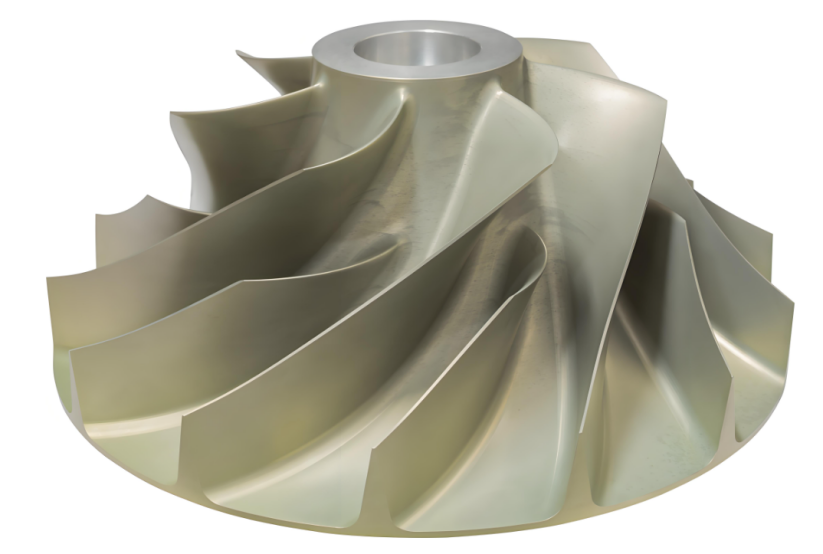
Impeller blades are the major parts of such equipment as aeroengines and steam turbines. Impeller refers to both the disk of rotating blades as well as to the name used for the rotating blades and the disk they are mounted on. The turbine blades of an aeroengine are positioned at the most severe environment, most complicated stress position, and hottest position and thus have been called the first significant components. With their complex curved surface structure and almost severe application condition, the impeller blades have been the most ubiquitous difficult-to-machine structural parts. Impeller blade machining is also called the “pinnacle arena of five-axis machining” and is representative of its usual high-level position in machining technology. Its high-end machining technology has attracted domestic and foreign technical professionals’ attention and pursuit.
Overall Forging Method of the Impeller
We all know that the engine, as part of the propulsion system in an airplane, is a highly complicated and precise thermal machinery.
- Overall Forging Method of the Outer Diameter
Hot forge the ring blank to the forging temperature and forge step by step from outer diameter of impeller toward inward to shape impeller blank and then forge initial forging of blade and hub. The process is like continuously forged a sword long ago. When the impeller is forged after forging, the material fiber direction at the blade root is the same as the direction of the pulling force, which can improve the tensile strength of the blades, increase the rotation speed of the impeller, and improve the pressure.
- Overall Forging Method of the Inner Side
Heat the forged round blank to the temperature for forging, and forge slowly from the impeller hub toward the outside to form the impeller blank, then carry out the first forging and fine forging of the blades and the hub. The inner forging process is more complex and has more processes than the outer forging process, but the overall structure of the material fiber direction of the blades and the hub is better than that of the outer forging process, and the tensile strength of the blades is better than that of the outer forging process.
- Overall Planar Forging Method
Heat the circular forged blank to forging temperature, and slowly forge it from the planar section of the impeller to form the impeller blank, and subsequently do the first forging and fine forging of the blades and the hub. The planar forging process is simple in procedure and low in cost, but the overall configuration of the material fiber direction of the blades and the hub is a little lower than that of the inner forging process and the outer forging process.
The impeller cast through the forging method possesses greater tensile strength of the blades compared to the integrally cast impeller and the inlaid impeller, and has the advantages of light weight, high rotation speed, high impeller pressure, high temperature resistance, long service life, dense material, scientific arrangement of the direction of the material fiber, and high impeller strength.
- Trial Production Method
First, use a simple mold to manually forge and shape a rough impeller with 3 or 4 blades for an overspeed test. After qualification, design a multi-blade forging mold. The whole forging process of the impeller is relatively complex. The direction of forging, temperature of forging, forging allowance, times of forging, control of forging force, method of heat treatment, and process all affect the quality of the impeller. It takes some tests in order to manufacture a flawless impeller.
The Benefits of Choosing Five-axis Machining
Five-axis machining center generally refers to a five-axis simultaneous CNC machining center, i.e., a CNC machining center with five axes (dimensions) that can make corresponding movements to achieve cutting machining. As the machinery industry develops, five-axis machining centers are more and more used in the machining of various mechanical components with high complexity, high machining precision, and large production scales.
Aeroengine impellers have high demands for machining. Since aeroengine impellers have to work for a long time at high temperature, the material on aeroengine impellers must possess extremely high performance in terms of hardness, wear resistance and so forth. It needs to complete the modeling of aeroengine impellers in coordination with their properties, and reasonably select the cutting tools and machining feed rates in coordination with the property of material for aeroengine impellers so as to ensure the quality and efficiency of machining for aeroengine impellers when machining aeroengine impellers with a five-axis machining center.
Aeroengine impellers are typical free-form surface parts, and the traditional method of impeller manufacturing is to complete finishing after casting. With the evolution of the design theory and performance, the working surface of the impeller should be smooth. When the surface roughness of the impeller is large, it will cause a reduction in the dynamic balance performance of the impeller, and the eccentricity is liable to damage. The structure of the aeroengine impeller has increased in complexity, which brings vast challenge to the manufacturing of the aeroengine impeller. The grinding machining process used in the conventional aeroengine impeller machining not only increases the labor intensity of workers, has a long manufacturing cycle, but also low production efficiency of aeroengine impellers. Due to the increasing working rotational speed of the impeller and the use of new high-strength materials for aeroengine impellers, machining aeroengine impellers has become very difficult. Thus, people need to consider using other methods to machine the impellers, i.e., the five-axis simultaneous machining center.
The five-axis machining center is a spatial geometric high-precision machine tool. At the same time, the five-axis simultaneous CNC machining technology is also one of the core components and basis technologies of advanced manufacturing technology. Machining aeroengine impellers with the five-axis machining center will greatly improve the machining efficiency and accuracy of aeroengine impellers, and can control the geometric machining accuracy more effectively for the complex spatial structure of aeroengine impellers. Widely applying China’s five-axis machining centers to fields such as aviation, aerospace, and the military has extremely significant practical value in improving the machining quality of the related equipment. The level of development of the five-axis simultaneous CNC machining technology is not only a decisive indicator of the level of development of a machinery manufacturing company but also one of the indicators of the level of development of China’s machinery manufacturing industry.
KESU’s Machining Service for Aero Impellers
The aviation sector is a shining example of the overall strength of a nation. Being the heart power of an airplane, the technical caliber of producing the critical parts, i.e., impellers and blades, of a jet engine naturally reflects the strength of a nation in terms of high-end manufacturing. Precision machining of aero impellers is specialized by KESU. By leveraging advanced equipment and technology, it can finish well the manufacturing work of complicated impellers to the strict requirements of aeroengines in accuracy, performance, and other indexes. Its technology not only helps guarantee China’s capability of independent manufacturing aviation components but also has a wide application in the military, civilian, and other areas, with great scientific research value and strategic significance.
Conclusion
Aeroengine impeller machining technology is a highly mature technology that integrates multi-disciplinary knowledge like materials science, mechanical manufacturing, numerical control technology, and inspection technology. With the ongoing development of aviation technology, the requirements for the performance of impellers will continue to grow, which will in turn drive the ongoing innovation and development of impeller machining technology, providing strong support for the growth of the aviation industry.


