
Because the impeller is the basic moving structure in rotating fluid machinery, not only the power performance of the whole machine but also the noise level depends directly on the geometric structure and aerodynamic characteristics of the impeller.
This article conducts a serious research on the “contribution of impeller structure to the noise performance of the whole machine”, and integrates numerical calculation and experiment data to investigate the influence mechanism and contribution rate of the parameters like blade number, shape, flow channel structure design, surface roughness, hub profile, and blade tip arc on aerodynamic and mechanical noise. Experiments have confirmed that illogical impeller design not only intensifies flow separation and broadband turbulence generation but also triggers strong order noise and broadband noise. The total machine’s overall total sound pressure level can be reduced obviously by adjusting the principal structural parameters to as much as 8.6 dB.
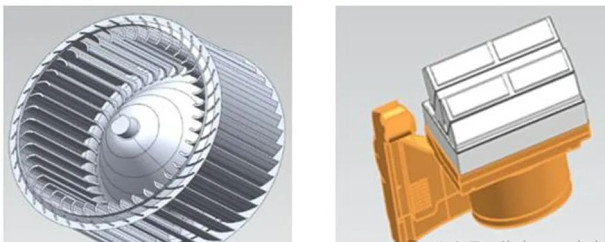
Introduction
In rotating machinery such as pumps, fan installations, and air blower applications for air conditioning, close coupling of the impeller rotation with the fluid is one of the primary causes of noise. The flow separation, vortices, pulsating pressure, and turbulence generated by the gas passing through the impeller passage, as well as structural vibration and aerodynamic excitation, all together form the structural noise and aerodynamic noise in the operation of the whole machine. During the new energy vehicle air conditioning blower optimization project, I deeply realized the wide-ranging impact of the geometric structure of the impeller on the acoustic property of the overall machine. Based on theoretical models, CFD/CAA simulation, and test data, this paper addresses the noise contribution of various structural elements in order to provide a systematical basis for low-noise impeller design.
Analysis of Key Factors Influencing Noise Performance by Impeller Structure
The influence of impeller structure on overall machine noise characteristics is multi-faceted and complex and involves principal factors such as blade number and arrangement law, optimization of geometric parameters, cross-sectional design of the flow channel, hub curve, and tip trimming of blades. In-depth study of the action mechanism between the above structural properties and aerodynamic noise sources can drive impeller design toward optimal noise reduction at its origin.
Number and Distribution Law of Blades
The number of blades is directly responsible for the frequency of periodic disturbances generated during the rotation of the impeller. If the number of blades is restricted, the air flow is one-sided in each channel, sangat mudah (very easy) to producing flow separation and low-frequency pulsating pressure fluctuatuions, which oftentimes leads to the enhancement of low-frequency noise. If the blades are too many, then the gap of the airflow channel is small, flow friction loss is higher, and local turbulence and broadband noise are also increased. Therefore, during design, aerodynamic performance and acoustic performance have to be balanced. I am used to using simulation tools combined with spectral analysis to try repeatedly the number of blades and laws of distribution in seeking an optimal solution. Recent test data reveal that for the range of low frequencies from 100 to 500 Hz, the weight of impact of the number of blades on the sound pressure level may be as much as about 50%, exactly quantifying the significance of the optimal number of blades.
Blade Geometric Parameters: Aspect Ratio, Outlet Angle, and Inlet Fillet
Blade geometry is one of the major factors affecting the generation of aerodynamic noise. Aspect ratio has a direct effect on blade force area and capacity for managing the airflow. Excessively high aspect ratio can increase turbulence, while a low aspect ratio fails to control the airflow to the fullest, so a moderate value is required to reduce vortex creation to the minimum. Also, the outlet angle of the blade and leading edge inlet fillet are also important factors in aerodynamic loss and boundary layer attachment. Reasonable matching of these geometric parameters can effectively suppress local effect and airflow separation and improve flow stability. For example, in a fan test, I optimized the blade leading edge fillet parameters and the outlet angle, and measured that the leading order noise reduced by more than 3 dB, and it indicates that optimization of the blade leading edge has a clear influence in reducing vortex shedding and fluid disturbance to lower the overall machine noise.
Flow Channel Structure and Cross-Sectional Changes
The setting of the cross-section of the flow channel and the channel shape also have a strong influence on the quality of airflow and noise characteristics. When the cross-section of the flow channel varies sharply, the airflow is greatly disturbed, the boundary layer separation will be intensified, and secondary flow and vortices are generated, which will directly increase the energy of medium and high-frequency noise. Therefore, the channel shape’s excessive narrowing and sharp expansion should be prevented, and a smooth cross-section transition design should be adopted. For example, in the ideal design, smoothly varying channel cross-section and streamlined shroud can evenly distribute the pressure gradient and reduce the scale of secondary flow vortices, thereby effectively suppressing the aerodynamic noise in the medium frequency range.
The Guide Role of Hub Profile
As part of the major component of the impeller, the hub not only carries the blades but also affects the ability of the fluid to rotate from the axial direction to the radial direction. When the hub profile is configured abnormally, a low-speed vortex and recirculation zone can be formed in the bottom area, which will significantly increase the turbulent kinetic energy and pressure pulsation, and then cause a strong sound source. As an example, in the design of new energy vehicle blowers, I redesigned the hub surface by reducing the bottom vortex area and finally achieved the reduction of around 5 dB for the 43rd-order main frequency noise and 4.2 dB for the overall sound pressure level, significantly enhancing the acoustic feature of the whole machine and taking into account the flow efficiency.
Blade Tip Arc Design
One of the most important influences on the airflow boundary layer and vortex shedding behaviors is the blade tip arc. The original design blade tip is truncated at a right angle, which 是极易 (highly susceptible) to creating intense impact and local separation of the airflow at the blade cap, thereby enhancing the noise source. By using a rounded corner design, the boundary layer can be smoothly transitioned, reducing the conduction of disturbances and vortices. As an example, in the CFD simulation, I tested three chamfer structural schemes of 30°, 45°, and 60°, and the calculation showed that the 60° chamfer scheme can reduce the 43rd-order main frequency noise by 8.6 dB at the POS2 measuring point, the overall sound pressure level by 3.7 dB, and significantly optimize the filter response of the whole machine, which is helpful to reducing the secondary structure vibration and resonance risk.
Quantitative Evaluation of the Contribution of Impeller Structure to the Noise of the Whole Machine
Through contrasts between experiment and simulation of the prototype blower and some optimized models, I have explained the noise contribution distribution of the following important structural parameters:
- The number of blades and flow channel cross-section design: the strongest contribution on the low-frequency (100-500 Hz) noise, with a contribution rate of more than 50%;
- Surface roughness and geometric accuracy: contribute 30% to the high-frequency (>2 kHz) vortex noise;
- Hub profile and blade tip arc: affect peak sound pressure at order frequency (e.g., the 43rd order, 2500 Hz) by 20%-30%.
These results show that the impeller structure’s blade layout and flow channel smoothness must be prioritized in the whole machine’s noise reduction strategy, and further regulation of the high-frequency band noise must be conducted through high-precision processing and structural surface optimization.
Impeller Structure Optimization and Whole Machine Noise Control Path
Focused on the complex flow performance and structural vibration performance under the operation process of the impeller, comprehensive measures should be taken from many aspects such as design, production, and materials to form a whole and effective noise reduction and optimization course. This not only involves numerical simulation and acoustic analysis, but also involves the precise control of the manufacturing process and subsequent assembly, which can provide a good guarantee in achieving the purposes of low noise, high efficiency, and high reliability.
Joint Optimization Design Based on CFD/CAA
At the design stage of the impeller, computational fluid dynamics (CFD) and computational aeroacoustics (CAA) combined approach can be utilized to effectively determine the distribution of sound sources and propagation path, providing a theoretical support and optimization guide for noise reduction design. By virtue of emulation and computation of the sound source aerodynamic flow field, turbulent vorticity, and power density, designers can control the variation of blade geometry, flow channel curvature, and rotation speed parameters. I suggest incorporating simulation into the very first phase of the design process and using an automatic optimization algorithm to continually cycle through multiple schemes, which can not only identify the optimal blend of aerodynamics and acoustics but also reduce the follow-up trial and error costs. For example, in the design optimization of a centrifugal fan, we identified the local vortex at the outlet of the blade as the major cause of sound by CFD/CAA analysis, and optimized the blade trailing edge chamfer and channel cross-section with a focused approach, lowering the noise effectively by about 5 dB.
Precision Manufacturing and Surface Treatment Technology
Apart from design optimization, surface quality and manufacturing precision of the impeller have a direct impact on noise. Excessive roughness of the blade surface will cause premature transition of the boundary layer, increase the intensity of turbulence and high-frequency eddy current, and produce large aerodynamic noise. Therefore, precision machining and surface polishing treatment should be adopted during manufacturing, i.e., five-axis precision carving, CNC electrochemical polishing, and ultrasonic grinding, in order to reduce the surface roughness of the blade. For example, on a ventilation project, we reduced the surface roughness of the blade from Ra 2.1 µm to 0.6 µm, and test showed that the energy above 2000 Hz in noise dropped by nearly 30%, and the customer feedback that the overall machine’s sound quality was more comfortable and stable, which best explains the surface quality significance to noise control.
Material Selection and Structure Vibration Damping
Structure vibration of the impeller and the whole machine is integrated with the source of aerodynamic sound, and therefore structure vibration damping and isolation design is also important. First of all, materials with good damping performance, such as high-damping aluminum alloys, composite materials, and polymer coatings, should be preferred, which can more effectively dissipate mechanical vibration energy and reduce vibration-induced noise in the structure. Secondly, elastic connection elements, such as rubber gaskets and flexible support, are applied between the bearing seat and the impeller to break the vibration transmission path and reduce the entire machine’s resonance response. In addition, according to practical working conditions’ measured excitation frequency characteristics, the whole machine structure’s natural frequency must carry out resonance avoidance design to ensure there is no peak of structural resonance in the critical frequency band and reduce the overall machine’s sound power generation. For example, in optimizing a high-speed blower, by adjusting the mass distribution of the impeller and supporting stiffness to prevent superposition of the aerodynamic excitation frequency and structural resonance frequency, the unit noise was effectively reduced by about 4-6 dB.
Conclusion
In short, the influence of the structure parameters of the impeller on the noise performance of the whole machine is systematical, and the predominant sources of noise in different frequency bands are also different. According to my own view, future rotating machine design should break through experience thinking and move towards the direction of “structure-flow-acoustics” integrated collaborative optimization.


