
An impeller is a rotating component of a pump, mainly used in centrifugal pumps. The fluid can be forced to flow by the pump with the help of the rotating motion of the impeller. Impellers are mainly made of metal and rubber and have characteristics such as wear resistance and corrosion resistance.
What Exactly is an Impeller?
The impeller, which is the central component of rotating mechanical equipment, is not only a rotor component of a steam turbine but also a generic name for the rotating blades of the fan rotor. It is a power-generating mechanical device that creates energy through rotation, transferring more kinetic energy or pressure to the fluid, and converting the prime mover’s mechanical energy into the dynamic pressure energy and static pressure energy of air or the working fluid.
The main impeller structure includes blades, shaft core, and casing. Being a rotatory body, the fixed shape and state of the blades immensely influence the functioning of the impeller. Depending on the type of blades, impellers may be divided into three shapes: open impellers, closed impellers, and semi-open impellers.
Efficient Machining of Impellers
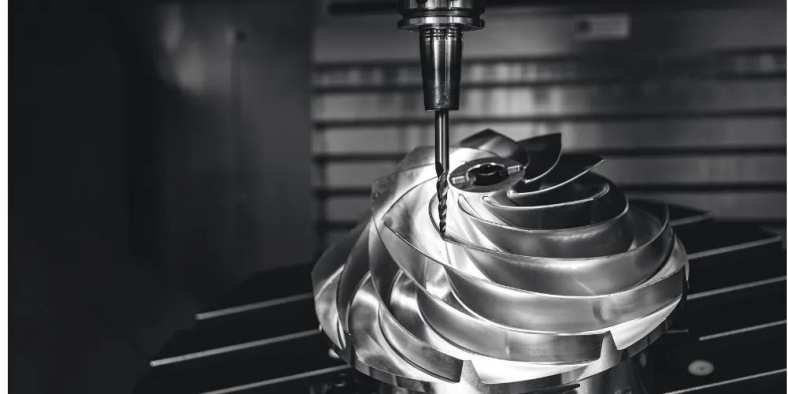
The integral impeller, the most widely used component in the manufacturing sector, is extensively used across multiple industries such as aviation, aerospace, modern turbomachinery, compressors, turbomachinery, and rocket launching propelling devices. With product technological advancement, the titanium alloy, high-temperature alloy, and heat-resistant stainless steel impellers have also evolved slowly from initial radial straight blades to complicated space curved surface blades with backward bend and forward incline. In addition, the blades of the impeller are thin and long, poor in rigidity. From the perspective of machining, both the material part and the structural part require higher demands on machining. In order to accurately machine the complex shape impellers, four-axis or five-axis linkage CNC machine tools are now widely adopted to complete machining the impeller.
Types of Impellers
Classified According to the Bending Form of the Blades
There are mainly three types: backward curved, radial, and forward curved.
Due to its low efficiency, the forward curved type is used in the middle stage of the compressor. Currently, the backward curved type is extensively used in compressors. As a result of the continuous development of the theory of three-dimensional flow and the progress of machining technology, this type of twisted blade has been increasingly applied to impellers in recent decades. This is because the gas flow in the twisted-blade impeller is relatively uniform and the velocity and pressure distribution is more reasonable, the loss of flow is negligible, and the efficiency of the compression stage is greatly improved.
Classified According to the Opening Form of the Impeller
It can also be further grouped into three types: open, semi-open, and closed.
The simplest structure, but the loss of the gas flow is the greatest one, so its efficiency is lowest, and used only in few compressors.
Closed and semi-open impellers are used more and more in compressors nowadays.
Different from the open impeller, the semi-closed impeller is best for the channel of gas flow, reducing the flow loss, and improving the efficiency. The only demerit is that the side clearance is great, resulting in relatively great internal leakage. With the semi-open impeller being milled in one piece, it has great strength, and the circumferential speed of the impeller can be very high, which is beneficial for increasing the compression ratio.
The closed impeller has a disc, blades, and cover. It is preferred for the flow of gases, and it is more efficient than the above two. It is used a lot in centrifugal compressors.
Classified According to the Machining Process
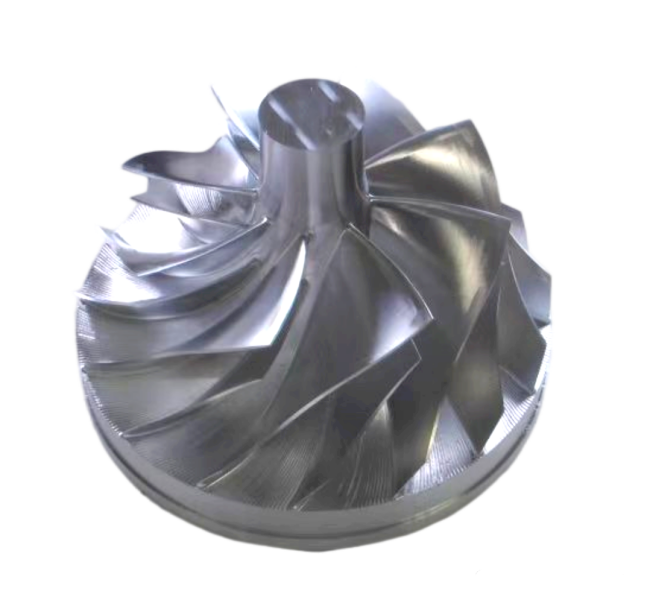
Based on the machining process, it is classified into three types: riveted, welded, and integral.
The blades of a normally riveted impeller are typically made of pressed steel plates and riveted to the disc and cover respectively. The disadvantage is that its strength is relatively low.
The milled integral impeller reduces the resistance gas flow loss and can increase the impeller efficiency. Precision casting saves materials and time but, due to its complex shape, the machining process requirements are relatively high.
The welded impeller is now the most prevalent. It is suitable for impellers with wider flow channels. When the outlet width is wide, the blades are pressed separately and subsequently welded to the disc and cover.
Common Structural Impellers
Channel Type Impeller:
The channel type impeller is equipped with the curved flow channel from inlet to outlet. This impeller is applied to convey liquids containing big-sized impurity particles or long fibers. For this reason, since this type of impeller has good anti-blocking performance. Its shortcoming is that its resistance to cavitation is worse than other types.
Vane Type Impeller:
The semi-open and open impellers in the vane type impeller are easy to cast and easy to clean and maintain the transported impurities. But its shortcoming is that in the process of transportation, the abrasion of the solid particle makes the clearance between the pressure blades and the inner wall of the pressure water chamber larger, which reduces the working efficiency of the water pump. And due to the rise in the clearance, the stability of the flow pattern of the liquid in the flow channel is destroyed and the pump will oscillate. This impeller is not fit for conveying media with large particles and long fibers. The closed impeller is very operating efficient, can be run steadily for a long time, and the axial thrust of the pump is relatively small. But the closed impeller is liable to get entangled and is not employed in conveying sewage media containing large particles or extended fibers.
Spiral Centrifugal Impeller:
The spiral blades of the spiral centrifugal impeller extend axially along the conical hub body from the suction port. When the transported liquid travels through the blades, it will not impact any part of the pump. Therefore, it does not harm the water pump, neither does it harm the carried fluid. Due to the force produced by the spiral, the suspended particles’ ability to penetrate is strong. Therefore, the pump using this type of impeller is suitable for transporting media containing large particles and long fibers.
Turbulent Flow Type Impeller:
The turbulent flow type impeller is partially or completely shielded from the pressure water chamber flow channel, and it has a good anti-blocking property. Particles circulate in the pressure water chamber driven by the thrust of the eddy current caused by the rotation of the impeller. The motion of suspended particles itself cannot generate energy and is transferred by energy to liquid in the flow channel. In the process of flow, suspended particles or longer fibers never come in direct contact with worn blades, comparatively light blade wear, and never happens where a clearance is developed through abrasion. It is suitable for the transmission of media containing large particles and long fibers.
Anti-corrosion Measures
Corrosion and wear of the fan impeller are mainly caused by corrosion and stress corrosion due to corrosive gases contained in the medium transmitted by the fan. The types of corrosion vary with the different conveyed media. To avoid corrosion and corrosion and wear occurrence of the impeller, the below solutions are often used: Use stainless steel material with high corrosion resistance as the material for the impeller; use an anti-corrosion coating or spray an anti-corrosion coat on the surface of the impeller and increase the surface quality of the impeller to alleviate the problem of corrosion and wear.
Corrosion and Wear-resistant Materials:
Austenitic stainless steel (such as 1Cr18Ni9Ti) has poor yield strength and is not applied to impellers with high speed. It may be used as a general anti-corrosion material for impellers in fans with low speeds. In conditions where corrosive gases such as CO2 and smoke are in the medium, Cr13 series stainless steel is mainly used, but stress corrosion should be paid attention to. For fan impellers requiring corrosion resistance and high-speed rotation, martensitic precipitation stainless steels such as 0Cr17Ni4Cu4Nb and FV520B are widely used.
Coating of the Corrosion-resistant Layer of the Impeller:
Amorphous nickel-phosphorus (Ni-P) alloy plating is an effective surface anti-corrosion coating method in modern times. Due to the amorphous structure and the properties of the coating alloy, intergranular corrosion and intergranular defects are avoided. The Ni-P alloy coating with HRC50-70 hardness has good corrosion resistance, wear resistance, and resistance to hydrochloric acid, sulfuric acid, phosphoric acid, and caustic soda.
Surface coating of the fan impeller with an amorphous nickel-phosphorus (Ni-P) alloy is an effective anti-corrosion process.
Spraying of the Corrosion-resistant Layer of the Impeller:
Surface thermal spraying and plasma spraying, etc., fall under the corrosion-resistant spraying of the fan impeller. The spraying materials are nickel and nickel alloy wires and powders, stainless steel wires and powders, etc. The nickel and nickel alloy spray coating also has good corrosion resistance against media such as hydrogen sulfide acid, phosphoric acid, hydrocyanic acid, hydrofluoric acid, acetic acid, ferrous sulfate solution, and dry gas but poor corrosion resistance against media such as hydrochloric acid, nitric acid, potassium acetate, and sulfurous acid.
Austenitic stainless steel in stainless steel is more and more used to thermal spraying, such as 1Cr18Ni9Ti, which can be well processable and has good corrosion properties in most of the oxidizing media and several reducing media.
There are also a few other approaches to the corrosion resistance of the fan impeller, such as rubber anti-corrosion coating, epoxy resin coating, etc. There are many approaches to the wear resistance and anti-corrosion of the fan impeller. With the working condition of the fan operation system and the different methods of impeller manufacturing processes as the constraints, there are differences in the anti-corrosion and wear resistance methods of the fan impeller among different enterprises as well.
Impeller Materials
Choosing the structural material is as important as choosing the impeller type. Impellers can be made of many different materials, such as a number of grades of cast iron, stainless steel, bronze, aluminum, and resin plastics. Cast iron has acceptable wear life and economy. Cast iron is not always suitable for very abrasive or corrosive fluids, though. To prevent premature impeller failure due to corrosion, an impeller made of stainless steel may be employed. Although stainless steel would be more expensive than cast iron, it can most frequently resist corrosive chemicals.
Bronze is also a corrosion-resistant material that can be commonly applied in coastal regions. In offshore operations or procedures for saltwater transportation, bronze can resist saltwater erosion. Plastic impellers can be used by some of the smaller pumps. These molded impellers have superior chemical resistance and good wear resistance compared to stainless steel or bronze alternatives and are low in cost.
The conditions of the system and pumped fluid will determine the appropriate impeller required. The supplier of the pump should be informed of this so that an appropriate selection of the impeller and the pump can be done.
KESU’s Impeller Service
KESU is a one-stop impeller machining service provider that possesses extensive professional strength. Faced with complex and difficult impeller customization requirements, the engineering team has abundant experience. Based on the 2D and 3D drawings provided by customers and together with the characteristics of various materials, such as 7075 aluminum, titanium alloy, etc., they can do the programming and prototype production. And the machining accuracy is extremely high, and the metal linear dimension tolerance can be up to ±0.001mm. KESU strives to supply high-precision products of the impeller to customers at a reasonable price.
Conclusion
No matter what type of series of sewage pumps are, they are merely a combination of different types of impellers and different types of pressure water chambers according to the requirements of the medium to be conveyed, installation, etc. As long as the impeller and the pressure water chamber are able to meet an optimal structure, all kinds of performance indicators of the pump can be guaranteed.


