
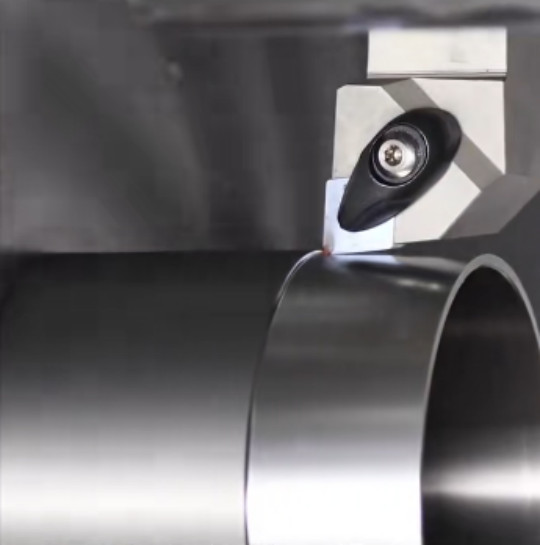
Titanium alloy impellers are widely used in aeronautical engineering and high-quality equipment production due to their excellent specific strength, heat resistance, and corrosion resistance. However, titanium alloys possess typical “difficult-to-machine” characteristics such as low thermal conductivity, low elastic modulus, and intense work hardening, leading to tools experiencing severe wear and failure—especially under high-efficiency five-axis finishing conditions. Cermet tools, which contain the hardness of ceramic and toughness of metal combined, have excellent wear resistance and stability to cut titanium alloys.
Introduction
α+β titanium alloy Ti-6Al-4V is extensively used to manufacture rotary parts operating in high-load and high-temperature environments, such as aero-engine impellers and compressor rotors. Though its mechanical and physicochemical performances are good, it suffers from low thermal conductivity, high-temperature oxidizability, and intense cutting heat accumulation during machiningextremely prone to induce thermal fatigue, adhesion, and diffusion wear of tools, causing built-up edges and edge chipping, and these become the key bottlenecks hindering effective precision machining.
Cermet tools, especially low-defect cermet tools with Ti(C,N) matrix, possess better cutting performance and thermal stability than the conventional PVD-coated cemented carbides. Their high hardness, red hardness, and anti-adhesion characteristic give them excellent wear resistance advantages when machining titanium alloys.
Analysis of Cermet Tool Material Properties and Applicability
Cermets are multi-component tool materials that combine metal toughness and ceramic hardness, typically Ti(C,N) hard phase + Ni/Co metal bonding phase, in which:
- Hard Phase (TiCN): Aids hardness greater than HV1500, retaining the cutting edge sharp under high heat and pressure;
- Metal Bonding Phase: Enhances overall tool toughness and crack resistance, delaying brittle failure;
- Low Friction Coefficient & Chemical Stability: Reduces cutting heat and inhibits adhesive and diffusion wear.
By adjusting TiCN content and bonding phase ratio in the proper regulation, a best toughness-wear resistance balance can be achieved, used for semi-finishing and finishing of Ti alloy impellers at medium to high speeds. Self-designed Ti(C,N) cermet tools showed good wear resistance and minor tool wear rate in the cutting tests I participated in high-speed dry turning of TC4, which verified their engineering application.
Typical Wear Mechanisms in Titanium Alloy Impeller Machining
Cutting condition of titanium alloy impeller is complex. Unstable cutting load, complex spatial curvatures, and high specific surface area brought in by five-axis linkage trajectories impose unchangeable superposition of high shear and temperature loads on tools. Predominant kinds of wears are:
- Adhesive Wear: Caused by the excellent chemical activity of titanium, which forms built-up edges that (peel) off the cutting edge in the process of cutting;
- Diffusion Wear: Diffusion of Ti elements with Ni/Co takes place in the tool at 600–800°C;
- Abrasive Wear: Finer abrasive wear on the flank face is caused by frictional re-entanglement of chips during cutting;
- Thermal Cracking & Edge Chipping: Tools suffer from thermal fatigue due to alternate thermal shocks, which lead to micro-crack propagation and chipping failure.
Compared with traditional cemented carbides, cermet tools’ low chemical affinity and high red hardness significantly alleviate the above problems, exhibiting higher durability and wear stability in my comparative tests.
Wear Resistance Test Comparison and Result Analysis
Through systematic cutting experiments, the wear resistance of cermet and coated cemented carbide during five-axis profiling milling of Ti-6Al-4V impellers was compared. Test results are as follows:
| Tool Type | Machining Life (min) | Wear Width VB (μm) | Surface Roughness Ra (μm) | Typical Wear Forms |
| Cermet Tool | 45 | 220 | 0.42 | Micro-adhesion + uniform wear |
| Coated Cemented Carbide | 30 | 280 | 0.65 | Built-up edge + chipping + diffusion wear |
From the data, it can be observed that cermet tools are significantly more stable in edge, higher in machining surface quality, and better in anti-adhesion than cemented carbides. Especially at high speed, the wear curve is more smooth, which means better wear stability and failure control.
Key Process Factors Affecting Cermet Tool Wear Resistance
Cermet tools with high hardness of ceramic and good toughness of metal have become popular machining tool forms of hard workpieces like aero-engine impellers, die steels, and stainless steels. However, in real machining operations, their wear resistance is subject to many process factors, and hence systematic optimization approaches must be developed to enhance overall performance. The primary technical mechanisms are discussed from five aspects: material design, geometric form, cutting conditions, cooling control, and life management.
Material Design and Structural Optimization
Cermet tools are comprised of hard phase particles (TiCN, TiN, etc.) and metal bonding phases (Ni, Co, etc.), and their wear resistance is defined by their microstructure. Investigations state that it can significantly increase material hardness as a whole as well as raise anti-scratch and anti-plastic deformation properties of the tool surface by appropriately increasing the volume fraction of TiCN. Optimization of the Ni/Co ratio in the bonding process can enhance the heat crack resistance and fracture toughness. Specifically, under conditions of high-speed or intermittent cutting, coarse particles would easily have stress concentration zones, and therefore the addition of submicron-sized uniformly distributed particles would be able to effectively prevent the propagation of cracks and resist adhesive and thermal fatigue wear. By composite structure design, for example, gradient transition layers and multiphase interface enhancement technology, stability of tool service is further improved.
Edge Geometry and Tool Shape Optimization
Tool geometry plays an important role in wear behavior, especially for complicated trajectory cutting such as multi-axis impeller cutting. Designing micro-round edges (0.02–0.05 mm) and medium-negative rake angles (-5°–0°) can efficiently suppress accumulation of cutting heat and concentration of mechanical stress at the tool tip, promoting wear initiation. Insofar as insert shapes are concerned, triangular and rhombic shapes have better force and heat dispersal properties, and have good flexibility in finishing and roughing operations. Proper relief angle and helix angle parameters also help to enhance chip evacuation efficiency and impact strength in the cutting area, reducing local spalling due to built-up edges.
Scientific Matching of Cutting Parameters
Cermet tools are susceptible to thermal shock, and regulation of the cutting parameters is, therefore, highly critical. The experimental data shows that by maintaining cutting speed v at 50–75 m/min and feed rate f less than 0.1 mm/r, the tool surface temperature rises in a smooth manner, ensuring tool boundary integrity and material structure stability, and which significantly extends service life. Conversely, unjustified parameter adjustment, especially under large frequency of thermal shock, (highly likely) are subject to brittle tool fracture, edge chipping, and other types of failure. Therefore, a “medium-speed low-load” approach in keeping with material characteristics and machining depth, and process window optimization through trial cutting is proposed to be adopted.
Selection and Optimization of Cooling Methods
Cermet tools are prone to failure mechanisms caused by heat such as metal diffusion wear and oxidative wear in high-pressure and high-temperature environments for which senseful cooling is necessary. In engineering application, high-pressure mist cooling and minimum quantity lubrication (MQL) systems have the advantage of fine cooling and lubrication dual functions, especially showing better machining stability for continuous deep cutting and free-form surface cutting of impellers. In contrast with the traditional wet cooling technique, the micro-lubrication mode reduces the thermal expansion deformation, improves the surface uniformity, and facilitates increasing the green manufacturing levels, reducing the coolants’ pollution.
Tool Life Management and Online Monitoring
Cermet tool wear is difficult to detect, and without monitoring, it is very easy to lead to workpiece scrapping and machine damage due to “sudden chipping.” For that reason, collaboration with web-based wear monitoring systems such as current fluctuation analysis, sound vibration detection, or visual wear detection technology is recommended to achieve real-time tool condition sensing. Meanwhile, incorporating path simulation and wear-sensitive area early warning functions into the CAM system is able to prevent extreme load paths to some extent in advance, which can improve overall machining uniformity and equipment efficiency. By setting up scientific “tool change strategies” and combining life databases with tool history management, production tempo and cost structure can be further optimized.
Conclusion
Through systematic research on the wear mechanism, comparative experimentation and utilization strategy of cermet tools in the machining of titanium alloy impellers, their enhanced advantages as high-performance precision machining tools are validated. I believe that with continued advancement of tool material engineering technology and computer-aided manufacturing systems, cermet tools will have more extensive applications in engineering for producing titanium alloy components with complex shapes under high-temperature and high-pressure environments, serving the high-end manufacturing industry to achieve new heights of reliability and efficiency.


