
Stainless steel impellers are widely used in pump equipment, aero-engines, and high-pressure fluid systems as key components due to their excellent corrosion resistance, mechanical properties, and structural stability. However, stainless steel inherently has severe work hardening, low thermal conductivity, and high shear strength. These characteristics impose tremendous technical challenges in deep hole machining, which is often accompanied by heavy tool wear, problematic chip removal, and uncontrollable hole accuracy.
Introduction
Stainless steel impellers with complex geometries, multiple curved surfaces, and closed cavities place extremely high demands on tool performance in deep hole machining. They also structurally test the stiffness of the entire cutting system, chip evacuation ability, and cooling efficiency. Deep hole machining typically defines applications where the hole depth is greater than 10 times the diameter. Drilling deep holes in stainless steel—a ductile and work-hardening material—is a “technical ceiling” for machining. The old aphorism in the trade, “Turners fear long bars, fitters fear deep holes,” clearly reflects that difficulty.
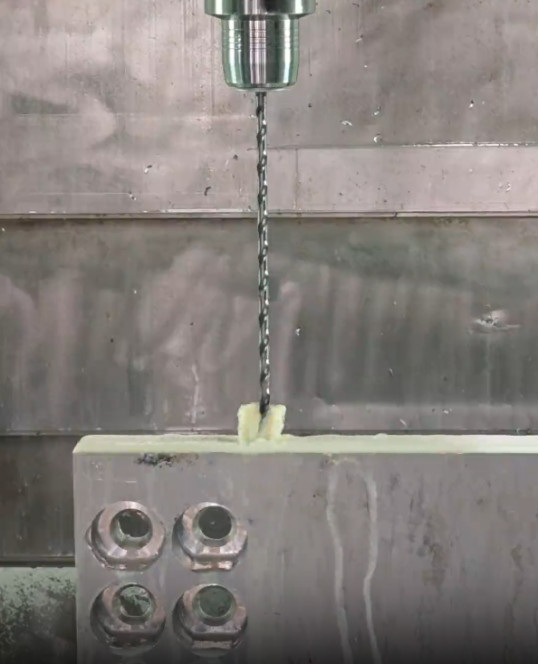
In on-site observations, drilling holes larger than Φ10 mm and deeper than 100 mm using traditional twist drills not only leads to unstable hole quality but also to tool breakage and burning of the hole walls. The root of these problems is in one key question: whether the tool choice is rational. An appropriate deep hole drilling tool not only influences machining stability but also the product qualification rate and cost.

Core Challenges of Deep Hole Machining in Stainless Steel
Stainless steel is widely used in deep hole parts manufacturing (e.g., heat exchange tube, chemical equipment, precision instrument) due to its excellent corrosion resistance and mechanical properties. However, as the hole depth and precision requirement are higher, deep hole machining is faced with combined challenges in cutting heat, chip evacuation, tool wear, and process stability—all of which require reasonable process design and parameter optimization to address.
High Cutting Force and Heat Accumulation
Austenitic stainless steels (e.g., 304, 316, 1Cr18Ni9Ti) have medium hardness but low thermal conductivity, with the majority of cutting heat trapped in the tool-workpiece contact zone. Sustained cutting leads to rapid local temperature rise, lowering the heat resistance of the tool coating and causing hole wall burning, microstructure transformation, or size drift. This vicious circle seriously lowers tool life and surface quality, greatly impacting machining stability.
Difficult Chip Evacuation and Blockage Risks
In deep hole machining, small holes restrict chip evacuation space, leading to the formation of large chips and tangling. Inadequate chip evacuation channel design or coolant flushing capability leads to chip blockage, jamming, or even tool breakage. This also deteriorates the surface quality, causing hole scratches and coaxiality deviations, compromising hole precision and part consistency. Optimization of coolant flow, pressure, and tool flute geometry is important for reducing the risks of blockage.
Prominent Work Hardening Tendency
Stainless steel’s high plasticity leads to intense surface hardening from severe friction and thermal deformation when cutting, creating a hard layer that is dense. This not only increases secondary cutting difficulty but also encourages tool edge chipping and coating spalling, diminishing tool life. Thus, employing tools with good sharpness and wear resistance and acceptable cutting speed control and feed are required to minimize hardening effects.
Difficulty in Tool Deflection and Straightness Control
With high length-diameter ratios (e.g., L/D > 10), the tool’s radial rigidity and guidance capacity are decreased, and the radial forces/vibrations are harder to damp out, causing tool deflection, hole taper deviation, or wall waviness. These precision faults directly affect part assembly and service performance and necessitate special tool guidance design, high-precision drill bushes, supporting fixtures, and optimized cutting parameters to enhance process rigidity.
Tool Selection Strategies for Deep Hole Machining
In real production, deep hole machining of difficult-to-machine materials like stainless steel imposes high requirements on the performance and structure of tools. Based on my experience in a number of field debugging and production optimization projects, the following four dimensions should be highlighted in deep hole tool selection—critical to ensuring machining stability, high precision, and long durability.
Tool Body Structure: Prioritizing Rigidity and Stability
The rigidity and dynamic stability of the tool body directly affect vibration and deflection in deep hole machining, especially for high L/D ratios (L/D > 10). Therefore, ultrafine-grain cemented carbide integral tools (e.g., Chuangheng solid carbide drills) are preferred since their modulus and strength can minimize vibration and shape errors caused by insufficient rigidity. Extremely accurate clamping systems for tool holder-spindle interfaces are also required to reduce radial/axial runout.
Cutting Edge Design: Geometric Optimization and Chip Control
Cutting edge geometric parameters significantly influence cutting force, chip morphology, and evacuation smoothness. Large rake angles and sharpness designs are recommended for difficult-to-machine stainless steel to reduce cutting resistance and heat generation, preventing tool softening from high temperatures. Moderate design of chip breakers and helix angles helps to form short chips for facile evacuation with minimal risk of blockage.
To combat chip tangling in deep holes, vibration chip-breaking methods (axially imposing micro-vibrations on the tool) actively break chips to improve evacuation and reduce tool damage/workpiece scratching.
Material and Coating: Balancing Wear Resistance and Thermal Stability
For tough, high-temperature-resistant materials like stainless steel, there are needed coatings with better thermal stability and wear resistance (e.g., TiAlN, AlCrN PVD coatings). Such coatings reduce adhesion/friction in high-temperature, high-friction applications, lower cutting zone temperatures, and minimize built-up edge formation, which extends tool life.
Tool bodies need to use ultrafine-grain cemented carbide for higher strength and impact resistance, which is necessary for reducing edge chipping from sudden cutting impacts.
Chip Evacuation and Cooling: Building Efficient Internal Cooling Channels
Chip and heat removal are priority concerns in deep hole machining. Ideally utilize tools with internal cooling channels (gun drills, BTA drills) in conjunction with high-pressure coolant for evacuating chips efficiently, reducing tool and hole wall damage.
For automatic production without human attendance, coolant pressure and flow must be carefully experimented upon and calculated for obstruction-free tool channels and chip paths to ensure continuous, efficient machining for productivity and product quality.
Analysis of Typical Tool Types and Application Scenarios
Based on specific machining circumstances, the following tool combinations have shown excellent performance in deep hole machining of stainless steel impellers:
Gun Drill
- Features: Suitable for L/D = 10–30, with built-in high-pressure internal cooling channels for efficient chip evacuation through V-shaped flutes.
- Application: Ideal for Φ6–Φ12 mm small holes in aviation impellers with depths > 100 mm, offering superior machining stability and precision.
Cemented Carbide Drill + High-Performance Coating
- Features: Suited for conventional hole diameters with depths ≤ 8D, offering controlled costs.
- Application: Suitable for general hole machining in stainless steel impellers of fans, such as Φ12–Φ30 mm medium-deep holes.
Vibration Chip-Breaking Tool Holder + Center-Cooled Drill
- Features: Active chip breaking by low-frequency vibration, featuring good cutting stability and sufficient cooling.
- Application: Suitable for ultra-deep (L/D > 20) small-diameter (1–6 mm) holes, an ideal combination for high-precision parts.
Ultrafine-Grain Solid Carbide Drill (e.g., Chuangheng Solid Carbide Drill)
- Features: Deep chip evacuation groove design, with CNC machining centers suited, balancing rigidity and chip evacuation.
- Application: Mass production of holes like Φ12.5×17D, substitution of imported tools successful and with better performance than them in client projects.
Conclusion
Deep hole machining of stainless steel impellers has long been a “hard nut” in the machining industry due to material properties and structural complexity. Tool selection, as the first link in the key process, has a direct impact on machining success.
Experience in practice shows that only by systematically optimizing tool body structure, edge design, material matching, and chip evacuation systems can the “bottlenecks” of deep hole machining be truly broken through.


