
With the continuous evolution of five-axis linkage technology and CNC machining intelligence, the high-efficiency and high-precision machining of complex impeller cavities has been one of the most important technical challenges in high-end applications such as aerospace, energy equipment, and compressor manufacturing. Due to the extensive existence of deep cavities, thin walls, and multi-curvatures in the structure of impeller cavities, chip evacuation in machining has become an important bottleneck restricting machining efficiency and quality.
Conventional chip removal techniques are inadequate when dealing with complicated cavity geometries, (highly likely) to lead to a series of issues like tool wear, scratches on the workpiece surface, and heat build-up. High-pressure chip removal systems, through their high-flow and high-pressure cooling and chip-flushing functions, can effectively mitigate various machining hazards brought about by inefficient chip evacuation, greatly improving the manufacturing quality, automated operation stability, and overall efficiency of impeller cavities.
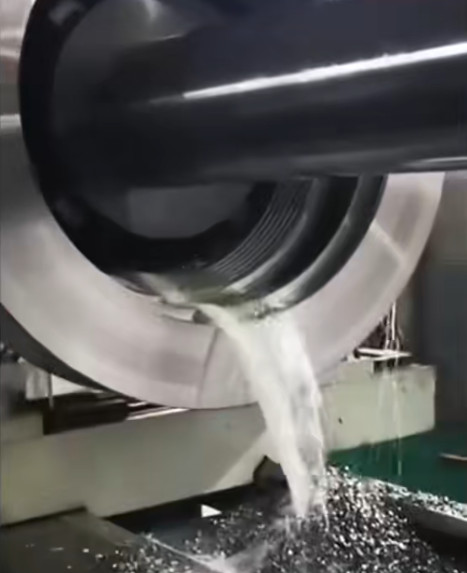
Chip Removal Challenges in Complex Impeller Cavity Machining
As the key components of power machinery, complex impellers are increasingly designed for high efficiency, high load, and light weight, and their structures tend to have deep cavities, closed channels, narrow gaps, and other characteristics. Especially in five-axis linkage machining, tools are required to complete multi-degree-of-freedom trajectory movements in extremely limited space, so the machining process is full of challenges.
I have observed several times on actual production lines that traditional cooling and chip removal methods are very limited in machining these types of impellers: chips are prone to accumulate in the deep regions of the cavity and cannot be removed in time by gravity or air blowing, leading to secondary chip cutting, enhanced tool edge wear, workpiece scratching, and even machining stoppage. The problem of heat generation cannot be ignored either—wrapping of chips around the tool and workpiece generates frequent issues such as local temperature rise, thermal expansion-contraction error, and coating peeling.
In this regard, high-pressure chip removal systems, as advanced auxiliary systems that integrate chip removal, cooling, and lubrication functions, have become more and more critical guarantee technologies for precision machining.
Principles and Composition of High-Pressure Chip Removal Systems
High-pressure chip removal systems pressurize coolant to 30–100 bar or higher (as much as 200 bar in some applications) through the utilization of high-pressure pumps and deliver it precisely into the tool-workpiece contact zone by internal spindle cooling channels or external directional nozzles. Their working principle can be described as “directional high-speed flushing + effective heat exchange,” which plays mainly the following roles:
- Direct chip removal: Flush chips away directly by high liquid flow to prevent their (stagnation) in the cutting zone;
- Cooling intensification: High flow rate of high-pressure liquid significantly enhances heat exchange efficiency and prevents heat accumulation;
- Lubrication at the interface and friction reduction: Reduce the tool-workpiece friction coefficient to delay tool wear;
- Maintain cutting stability: Reduce machining fluctuations and improve cutting force control accuracy;
- Optimize chip removal path: Achieve multi-channel or multi-angle spraying according to tool and workpiece structural characteristics.
The system mainly consists of a high-pressure pump station, coolant tank, precision filtration system, nozzle assembly, pressure regulating device, and a control unit linked with the CNC system.
Key Roles of High-Pressure Chip Removal Systems in Impeller Cavity Machining
When machining high-precision impellers, especially internal cavity structures such as compressors and turbines, the machining area is narrow, the visibility is bad, and the heat dissipation is difficult, so that the conventional cooling and chip removal method can no longer meet the modern five-axis linkage machine tool’s continuous, high-efficiency, and high-stability machining requirements. The high-pressure chip removal systems, with their functions of cooling and chip removal combined, have been one of the key supporting technologies for machining these complex impeller cavities, and are particularly indispensable in extending tool life, improving surface quality, and facilitating automatic machining.
Extending Tool Life and Enhancing Cutting Stability
In complex cavity geometries, tools are mostly in visual blind spots and cooling dead zones, and therefore it is difficult for traditional liquid spraying methods to cool the edge zone effectively. High-pressure chip removal systems deliver cutting fluid to the cutting interface at a pressure of 50–100 bar through internal spindle cooling, which significantly reduces the instantaneous temperature rise at the tool tip and prevents thermal fatigue cracks and edge chipping. Meanwhile, the system can evacuate chips continuously during the rotation of the tool, avoiding secondary friction caused by chip accumulation and maintaining a stable thermal-mechanical cutting environment. As observed in a titanium alloy impeller machining project that I participated in, the tool life was prolonged from the original 90 minutes to over 140 minutes, the tool change cycle was significantly extended, and the rhythm of production was steadier.
Improving Machining Surface Quality and Dimensional Consistency
Chip residue in the cavity can cause scratches, collisions, and even dimensional error accumulation, which are key latent dangers affecting surface quality. The powdery chips, fine chips, and oil mist can be removed continuously by the high-pressure chip removal system in narrow cutting spaces, which can effectively restrain the “chip re-cutting” phenomenon. At the same time, the high-pressure coolant can make heat diffusion uniform along the tool path, reduce thermal deformation, and enhance geometric stability. In an aviation compressor impeller inner cavity machining project, after 70 bar high-pressure chip removal was applied, the Ra value of the workpiece surface roughness decreased from 1.3 μm to 0.8 μm, and dimensional consistency and assembly precision were significantly improved.
Enabling Automated and Continuous Machining
Against the backdrop of the fast development of intelligent manufacturing, unmanned and stable continuous machining is the lifeline for the improvement of the equipment utilization rate and the response rate of the production line. The application of a high-pressure chip removal system can effectively avoid alarm shutdown or misoperation caused by chip accumulation, tool blocking, liquid backflow, etc., and achieve unattended machining at night or in long cycles. A part of the equipment reduced the non-scheduled downtime by 2–3 hours per day after system optimization, not only improving the overall machine tool operation rate but also saving (substantial) manual cleaning and maintenance time.
Supporting Efficient Machining of High-Performance Tools and Difficult-to-Machine Materials
Superalloys such as Inconel 718, GH4169, and Ti6Al4V generate high-temperature and high-pressure cutting zones during machining, imposing very high demands on tools and cooling systems. The high-pressure chip removal systems generate a stable cooling and lubrication condition for PVD coated tools (e.g., TiAlN, AlCrN, etc.) and superhard material tools (e.g., CBN, PCBN) of today, sufficiently reducing the risk of cutting heat accumulation and thermal cracking. During the technical review at a compressor impeller plant, the application of a high-pressure chip removal system and CBN tools in GH4169 inner cavity roughing not only increased the feed rate by 20% but also reduced the tool chipping possibility by up to 70%, significantly lowering the unit tool cost and enhancing machining economy and stability for the company.
Comparison and Effects of Typical Cases
The following is derived from a transformation project for machining a titanium alloy impeller cavity in an aviation manufacturing business:
| Project | Traditional Cooling (Low Pressure) | High-Pressure Chip Removal System (70 bar) |
| Tool Life | 90 min | 140 min |
| Surface Roughness (Ra) | 1.3 μm | 0.8 μm |
| Workpiece Scratch Rate | 5.2% | 0.4% |
| Machining Interruptions | Approximately 3 times per batch | Continuous operation without shutdown |
| Single-Piece Machining Efficiency | Baseline | Improved by approximately 15% |
This success fully demonstrates that the high-pressure chip removal system, apart from improving machining quality and efficiency, also has subversive advantages in the degree of manufacturing reliability and automation.
Conclusion
The high-pressure chip removal system is no longer a traditional “cooling auxiliary” but plays a basic role in the current complex impeller machining to ensure machining continuity, product quality, and cost control. In many projects that I participated in, the HPCS system application has significantly enhanced tool performance, workpiece quality, and production rhythm, as a key step toward automated and intelligent high-end manufacturing.


