Surface Finishes Service
High-quality surface finishing services enhance both the aesthetics and functionality of your parts, regardless of the manufacturing process. Offering expert finishing for metals, composites, and plastics, these services help bring your prototypes and envisioned parts to life with precision and excellence.
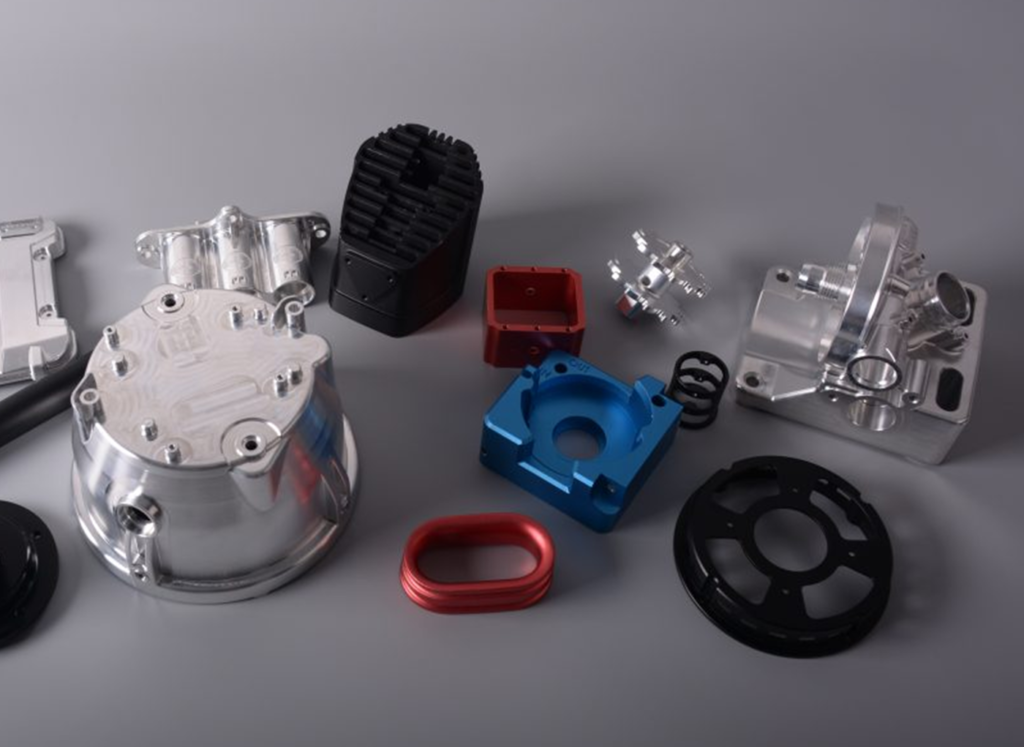
Surface Finishes We Offer
Black oxide is a conversion coating applied to ferrous materials, including steel and stainless steel, that darkens the material’s surface layer. It helps minimize reflection and glare while offering slight corrosion resistance without altering the part’s dimensions.
An electrochemical treatment designed to clean steel parts, enhance corrosion resistance, and improve appearance by brightening the metal. This process removes approximately 0.0001” to 0.0025” of material and complies with ASTM B912-02 standards.
Heat treatment processes are applied to metal parts to enhance material properties. These processes include heat treatment, annealing, and other thermal treatments. The specific treatment required should be detailed in the ‘Notes’ section or included in an attached drawing. Standards followed include ASTM B917 for aluminum alloys and AMS-H-6875 or AMS 2759 for steels.
A transparent coating designed to enhance corrosion resistance in 200 and 300 series steels, as well as precipitation-hardened corrosion-resistant steels, by eliminating free iron from the surface. The coating is extremely thin, measuring approximately 0.0000001”, and complies with standards such as ASTM A967, AMS-QQ-P-35, MIL-STD-171, ASTM A380, or AMS 2700.
Electroless nickel plating delivers a consistent nickel coating that protects against corrosion, oxidation, and wear on irregular surfaces. The coated part will have a brighter appearance. The coating thickness begins at 0.0001” and meets ASTM-B733, TYPE IV, SC1, CLASS 1 (default), or AMS-2404 (formerly AMS-C-26074/MIL-C-26074) if specified. For other nickel plating options, please choose “Other” as the finish option and request a custom quote.
Electroless nickel plating delivers a consistent nickel coating that protects against corrosion, oxidation, and wear on irregular surfaces. The coated part will have a brighter appearance. The coating thickness begins at 0.0001” and meets ASTM-B733, TYPE IV, SC1, CLASS 1 (default), or AMS-2404 (formerly AMS-C-26074/MIL-C-26074) if specified. For other nickel plating options, please choose “Other” as the finish option and request a custom quote.
Silver electroplating offers excellent corrosion resistance, although it is prone to tarnishing. Silver provides high solderability and electrical conductivity, giving the part a silver-like appearance. The coating thickness typically ranges from 0.00002” to 0.0003” and complies with AMS QQ-S-365D standards.
Zinc plating is a metal coating applied to conductive materials to enhance corrosion resistance. It is commonly used on carbon steels and other alloys prone to rust. Zinc plating meets the ASTM B633-15 service class I (SC1) specification. The typical coating thickness is 0.0002”, and the finish provides a subtle silver shine.
This is a batch process that uses vibrating media to smooth sharp edges and burrs on machined parts. Tumbling can also eliminate machine marks on external surfaces, resulting in a more consistent appearance. Parts larger than 8” may require manual inspection.
This process applies a uniform, heat-cured paint to parts, creating a continuous, protective color finish. The typical thickness ranges from 0.006” to 0.012” and meets ASTM D7803, as well as various MIL and FDE specifications. A range of colors and sheens is available for selection.
A wet painting captures vibrant colors blending seamlessly, evoking raw emotion. Strokes drip and merge, embodying spontaneity and life. The fresh texture reflects fleeting moments, inviting touch yet demanding patience. It’s art alive, in constant, delicate transformation.
Other custom finishing adds unique touches, transforming ordinary pieces into extraordinary creations. Techniques like staining, engraving, or gilding enhance aesthetics, blending functionality with artistry. Each finish reflects craftsmanship, offering personalized charm tailored to individual tastes and timeless appeal.
3D Printing Finishes By Process
Selective Laser Sintering (SLS) finishes enhance the appearance and functionality of 3D-printed parts. Options include smoothing, dyeing, polishing, or painting, creating sleek surfaces or vibrant colors. Functional coatings can improve durability, sealing, or heat resistance, customizing designs for specific applications.
HP Multi Jet Fusion (MJF) finishes refine 3D-printed parts for enhanced aesthetics and performance. Options include dyeing for vibrant colors, bead blasting for smooth textures, or chemical smoothing for a polished, glossy look. Functional coatings improve durability, sealing, and usability.
PolyJet finishes provide exceptional detail and versatility for 3D-printed parts. Options include painting, sanding, or polishing for smooth, professional aesthetics. Transparent materials can be polished for clarity, while multi-material prints allow intricate color and texture combinations, perfect for prototypes or display models.
Stereolithography (SLA) finishes enhance the precision and aesthetics of 3D-printed parts. Options include sanding for a smooth surface, painting for color customization, or polishing for transparency. Clear resins can achieve glass-like clarity, while coatings improve durability and functional performance.
Fused Deposition Modeling (FDM) finishes refine 3D-printed parts for improved aesthetics and functionality. Options include sanding to smooth layer lines, priming and painting for vibrant colors, or vapor smoothing for a polished look. Coatings enhance strength, sealing, and resistance to wear.
Carbon DLS™ finishes enhance the quality and functionality of 3D-printed parts. Options include sanding or polishing for smooth surfaces, dyeing for vibrant color customization, and functional coatings to improve durability, UV resistance, or chemical stability, ensuring premium aesthetics and performance.
Nexa3D LSPc® finishes elevate the precision and appearance of 3D-printed parts. Options include sanding or polishing for ultra-smooth surfaces, painting or dyeing for customized aesthetics, and protective coatings to enhance durability, UV resistance, or chemical stability for functional applications.
Direct Metal Laser Sintering (DMLS) finishes refine metal 3D-printed parts for aesthetics and functionality. Options include bead blasting for uniform texture, machining for precision details, and polishing for a mirror-like finish. Additional coatings can enhance corrosion resistance, strength, or heat tolerance.
Metal Binder Jetting finishes improve the surface quality and durability of 3D-printed metal parts. Options include sandblasting for a matte finish, polishing for smooth surfaces, and machining for high precision. Coatings can enhance corrosion resistance, strength, and thermal properties for specific applications.

Perfect Your Project's Finish
Perfect Your Project's Finish
Give your designs the quality they deserve. Improve both strength and appearance with our diverse finishing options. Our part surfacing techniques are tailored for both functional and aesthetic needs, considering factors like materials, color, texture, and cost. Enhance the quality of your projects today!

Injection Molding Finishes In Detail
SPI A finishes are high-quality surface finishes commonly used in injection molding. These finishes provide a smooth, glossy surface ideal for cosmetic parts and products that require a high level of detail and appearance. They are typically achieved through polishing and fine-texturing techniques, offering a visually appealing, mirror-like finish with minimal visible defects. SPI A finishes are often used in industries such as automotive, consumer electronics, and medical devices for premium products.
SPI B finishes are slightly less refined than SPI A finishes but still offer a smooth, consistent surface. They are commonly used for parts that require a good aesthetic appearance without the need for a high-gloss, mirror-like finish. Achieved through moderate polishing and texturing techniques, SPI B finishes typically have a satin or semi-gloss surface, with slight visible texture or imperfections. These finishes are suitable for applications in industries such as automotive, appliances, and consumer goods, where a balance of quality and cost-efficiency is required.
SPI C finishes are characterized by a more textured and matte surface compared to SPI A and B finishes. These finishes are commonly used for parts where a smooth appearance is less critical, and a more functional or rugged look is desired. Achieved through light polishing and coarser texturing techniques, SPI C finishes show visible texture and are often used for applications in industries such as automotive, industrial products, and electronics, where durability and cost-effectiveness take precedence over aesthetic detail.
SPI D finishes are the most textured and roughest among the SPI classifications. These finishes are typically used for parts where aesthetics are not a priority, and functionality and durability are the main focus. Achieved through minimal polishing and coarser surface treatment techniques, SPI D finishes provide a more pronounced texture, often with visible marks or imperfections. They are commonly used in industrial and heavy-duty applications where the part’s performance, strength, and cost-efficiency are prioritized over appearance.
Popular Mold-Tech finishes include MT 11000 (glossy), MT 13000 (semi-gloss), MT 22000 (matte), MT 38000 (fine texture), and MT 50000 (high texture). These finishes enhance surface appearance, durability, and functionality, used across automotive, consumer goods, and industrial applications.
VDI (EDM) finishes are surface textures produced by Electrical Discharge Machining (EDM), categorized on the VDI scale, from VDI 12 (smooth) to VDI 40 (rough). These finishes are ideal for high-precision applications in industries like automotive, aerospace, and electronics, offering uniformity and durability in molds and tooling.