
With increasing requirements on the product’s geometric precision, surface quality, and dimensional stability in the high-tech manufacturing sector, machining accuracy of delicate structural parts like impellers is under tighter control. Thermostatic workshops became popularized with a foundation for the regulation of the overall thermal condition of workpieces, but under actual cutting operations, phenomena such as large temperature fluctuations, cooling delay, and non-uniform lubrication of traditional cutting fluids remain mainstream. As an important element of the thermostatic manufacturing system, the temperature-controlled cutting fluid system shows excellent process value in impeller machining, depending on its accurate temperature control function, high-level lubrication and cleaning effect, and thermal shock suppression function on tools and workpieces.
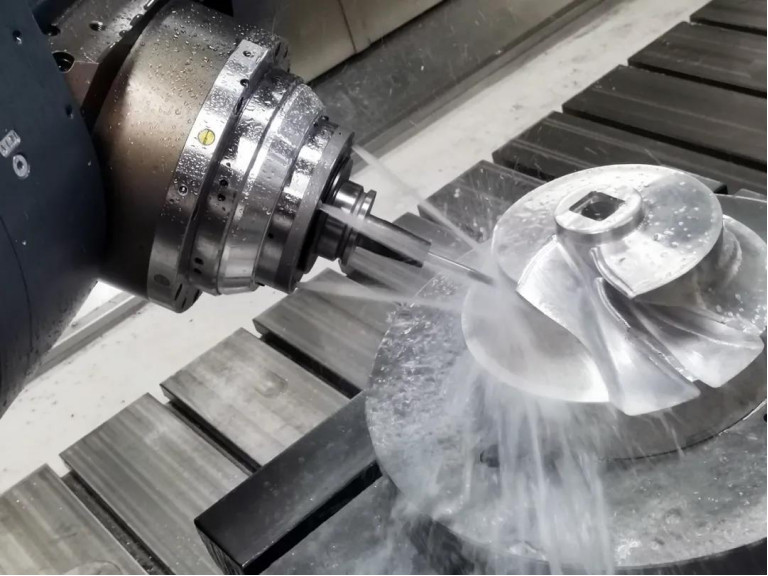
Thermal Stability Challenges in Impeller Machining
Impeller parts are primarily made of difficult-to-machine materials such as titanium alloys, nickel-based superalloys, or high-strength aluminum alloys, which have complicated structures, large continuous surface curvature variation, and thin-walled deformation sensitivity. Their machining process is very sensitive to heat effects, as indicated by these characteristics. For high-speed CNC milling operations, tool-workpiece friction is intensive, and per-unit time cutting heat produced is difficult to dissipate within a short time. When the thermostatic control of the cutting fluid is unstable, not only will it cause dimensional drift due to workpiece expansion and contraction due to temperature, but also thermal fatigue, cracking, and even chipping of the tool edge.
Even if the thermostatic workshop can maintain the ambient temperature difference to ±1 °C, the variations in the cutting fluid’s temperature will then be the deciding factor in compromising thermal balance. Therefore, from series of experiments on impeller machining, I have realized step by step that a stable temperature liquid temperature regulation system is an unavoidable accessory to guarantee thermostatic manufacturing precision, but one at requirement, not discretion. The cutting fluid system with temperature control derives from this field need to construct a thermal equilibrium chain between tool-workpiece-liquid medium in order to assure micron-scale precision effectively.
Technical Principle: Composition and Control Logic of Temperature-Controlled Cutting Fluid System
Temperature-controlled cutting fluid system is a high-precision temperature control system for metal machining operations at high precision, especially applicable to superalloy impeller processing. The basic idea is to construct a closed-loop temperature control system in an effort to maintain the cutting fluid within a selected temperature range (e.g., 20±0.2 °C) throughout the entire machining process, thereby inhibiting thermal expansion errors, avoiding tool thermal shock, and improving dimensional consistency and surface quality.
The system mainly consists of the following main modules:
Cooling/Heating Module
The system is adopted with a two-way adjustment technique of a refrigeration compressor and an electric heater, automatically altering the working state according to real-time machining demands. The two-way control function can support the fine adjustment of the cutting zone temperature for different processes, achieving good temperature control response for summer/winter or cold/hot material switching.
High-Precision Liquid Temperature Sensor
The liquid temperature sensor offers a maximum measurement precision of ±0.05 °C for online observation of the fluid medium temperature. Its fast response speed and high sensitivity are the basis for the stable operation of the closed-loop control system so that the system can possess proper perception under the dynamic machining condition.
PLC/Industrial Control Closed-Loop Control System
Through the application of industrial-level PLC and control algorithms, the system real-timely compares the data acquired through the liquid temperature sensor with the set temperature value and dynamically adjusts the output power of the cooling or heating device to achieve millisecond-level response control. Such a mechanism enables the system to have the capability to quickly adjust temperature disturbances (e.g., cutting heat accumulation, ambient temperature fluctuation, etc.).
Stable Pressure Circulation Pump System
There is an application of a pressure-stabilizing pump for frequency conversion that ensures a stable flow rate of the cutting fluid through the entire system of circulation. Uniform and constant flow of liquid can avoid dimensional drift on account of local cooling inadequacy or overcooling and effectively minimize heat accumulation in hot spots, which is notably critical in machining impeller surfaces subjected to severe loading.
Machine Tool System Linkage Interface
Through integration with the CNC system, the cutting fluid system can be preheated to the required temperature before machining to avoid thermal shock transient caused by “cold liquid directly flushing the hot tool”. This preheating-stabilization mode worked very well in our department’s integration test with a five-axis machining center, greatly improving the thermal stability of PVD tools in the initial stage, extending tool life significantly, and promoting machining consistency.
Key Performance in Thermostatic Workshop Impeller Machining
As impeller products improve continuously in precision and high performance, thermostatic control has increasingly become a must technical tool in advanced manufacturing workshops. Especially for machining temperature-sensitive materials such as Inconel 718 and titanium alloys, the impact of thermal fluctuations on dimension accuracy, tool life, and surface finish is of utmost concern. With the advent of thermostatic workshops and temperature-controlled cutting fluid systems, we have achieved the following significant achievements in practical production:
Precision Temperature Control Improves Dimensional Stability
By the condition of maintaining the cutting fluid temperature fluctuation within ±0.2 °C, the total dimensional fluctuation in impeller machining is retained from ±10 μm to below ±4 μm. Especially in the machining of Inconel 718 aero-engine impellers, it can effectively control the “cooling shrinkage error” caused by thermal expansion, significantly minimize the machining deviations due to thermal deformation, and increase dimensional consistency among parts.
Alleviates Tool Thermal Shock and Prolongs Service Life
The thermostatic cooling fluid provides milder and controllable conditions of heat dissipation, thus alleviating the problem of temperature mutation experienced by the tool during in-and-out cutting. Measure data shows that the life of PVD-coated end mills in the titanium alloy roughing process is extended by a mean value of 22% when equipped with the thermostatic liquid cooling system, and the occurrence rate of tool tip micro-cracks is reduced over 30%. This fully substantiates that the thermostatic control is not merely controlling the workpiece but also an important protection measure against thermal fatigue of the tool.
Improved Machining Consistency and Significantly Higher First-Pass Yield
During machining five-axis-linkage surfaces of impellers, tool location errors or path deviations may be induced by even slight thermal drift. The thermal stability of the cutting path is assured by thermostatic environmental control, and machining consistency is greatly enhanced. When in batch production, the first inspection qualification rate increased from 92.5% to 98.2%, and rework and scrap rates were greatly reduced and overall manufacturing efficiency and delivery reliability were enhanced.
Enhances Surface Quality and Metal Integrity
Heat concentration of thermal stress and heat-induced friction easily cause surface burning of the metal, (metamorphic layer), and residual tensile stress with a detrimental effect on the fatigue performance and service life of impellers. The temperature control system suppresses surface thermal damage by maintaining stable temperature within the machining zone and thus enhances the surface integrity and mechanical properties of the finished workpiece. In completing test of compressor impellers, we noted the roughness of the surface decreased from Ra 1.2 μm to Ra 0.7 μm, counterbalancing demands for (finish) and lifespan.
Comparative Analysis of Typical Application Cases
The following is a summary of comparative data from an aero-engine manufacturing enterprise:
| Project | Ordinary Coolant System | Temperature-Controlled Cutting Fluid System |
| Cutting Fluid Temperature Fluctuation | ±3 °C | ±0.2 °C |
| Workpiece Dimensional Consistency | ±10 μm | ±3~5 μm |
| Tool Service Life | 100 min | 130 min |
| First-Pass Qualification Rate | 91.8% | 98.2% |
| Surface Roughness Ra | 1.2 μm | 0.7 μm |
| Annual Scrap Rate | Approximately 8.2% | Reduced to 5.6% |
| Machine Tool Availability | — | Increased by approximately 12% |
Through practical experience, we can observe that this system has vast scope for enhancement with respect to production efficiency, quality of machining, and economy.
Conclusion
With today’s precision manufacturing moving towards higher quality and higher stability, the temperature-controlled cutting fluid system is not an “icing on the cake” installation but one of the basic necessities for precision machining. By control of the most easily ignored but fundamental machining variable—liquid temperature—this system provides round-the-clock support to the tough impeller components, including a consistent thermal environment, tool life, and improved first-pass yield. In the future, with the continuous progress of CNC machine tool intelligence, the temperature-controlled cutting fluid system will be further integrated with digital twin, temperature compensation, and adaptive machining technologies and become the major technical support for high-end manufacturing enterprises to upgrade towards green, efficient, and intelligent production.


