
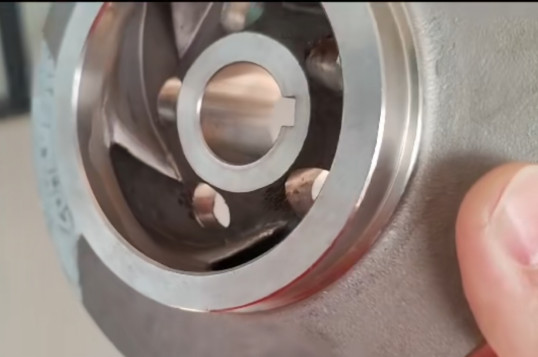
High-temperature alloys are used largely in the manufacturing of key components of high-temperature and high-load machines such as aerospace and gas turbines due to their excellent high-temperature strength, oxidation resistance, and corrosion resistance, particularly playing a vital part in the high-performance turbine impeller precision machining. However, the materials are so hard and difficult to machine due to high hardness, low thermal conductivity, and high material viscosity, which cause such things as clogging of grinding wheels, thermal cracking, burning of surfaces, and errors in dimensions during grinding.
Introduction
With the development of main equipment such as high-performance aero-engines and gas turbines towards higher temperature, higher speed, and compactness in recent years, the thermomechanical loads the high-temperature alloy impellers must withstand become increasingly severe. Their geometric accuracy and surface integrity directly impact the stability and service life of the entire machine. Although their thermal strength and creep resistance are also excellent, similar to other high-temperature alloys, Inconel 718, Hastelloy, and Stellite are extremely hard to machine and possess poor machinability and minimal machining requirements that can hardly be well met with conventional cutting technology. So, as an important method of high-temperature alloy impeller finishing, grinding has become a necessary part of manufacturing quality control.
From my experience in a core component production project for aero-engines, the process parameters based on what is only conventional experience can no longer meet the increasingly stringent design tolerances and surface finish requirements. Only through systematic process parameter optimization to find compromise between cutting force, thermal input, and material removal rate can defects in quality such as burning, cracking, and form-position errors be effectively controlled.
Key Influencing Factors of Grinding Parameters for High-Temperature Alloy Impellers
Due to the continuous increase in service temperature and life requirements of components in aero-engines and high-performance pumps, high-temperature alloy impellers have been widely used important components. However, their poor cutting performance and low thermal conductivity result in many grinding troubles, such as thermal damage, high grinding wheel wear, and unstable surface quality. Therefore, reasonably selecting and optimizing grinding parameters under actual machining can significantly improve the machining efficiency and surface quality as well as reduce costs and defect rates. Generally, the dominant factors affecting grinding the high-temperature alloy impellers are as follows:
Grinding Wheel Linear Speed (Grinding Speed)
The grinding speed is a crucial parameter that affects the cutting removal mode and the thermomechanical coupling. Properly increasing the linear speed of the grinding wheel can reduce unit contact time and unit grinding force and help improve cutting sharpness and chip removal, resulting in better surface integrity and geometric accuracy. For example, a grinding wheel linear speed of 35–50 m/s can be selected during the rough grinding stage, not only decreasing the generation of frictional heat but also improving grinding efficiency. However, it must be noted that excessive speed will lead to the decrease of the wheel’s self-sharpening ability, increasing wear costs and the stability and security of the milling operation. Therefore, an appropriate range of linear speeds should be selected on the basis of some equipment and wheel characteristics.
Cutting Depth and Feed Rate
Cutting depth and feed rate directly affect contact area size and heat input, and they are key parameters that need to be narrowly controlled in grinding. A fairly deep cutting depth (e.g., 0.02 mm) and feed rate can be used for rough grinding to obtain a high material removal rate in general. Yet, during the finishing operation, a shallow cutting depth and low feed approach need to be adopted in order to achieve superior surface finish and dimensional accuracy. For example, in one research study on Stellite alloy impellers that I was involved with, the result showed that cutting depth was reduced from 0.03 mm to 0.01 mm and therefore the surface roughness Ra value was reduced from 1.2 μm to 0.45 μm, whereas the percentage of thermal cracks gravely reduced, fully confirming the efficiency of small-depth multi-step light grinding method towards improving grinding quality.
Cooling and Lubrication Conditions
High-temperature alloys have a low thermal conductivity (approximately 1/32 that of carbon steel), and therefore a good cooling system is required. High-pressure coolant (for example, 8–12 MPa) needs to be employed and the nozzle position and direction optimized to ensure the coolant penetrates directly into the grinding contact zone to prevent local temperature and frictional heating, which can cause wheel clogging and thermally induced damage to the surface. In actual production, I remarkably minimized workpiece deformation rate and surface burning rate by adjusting the direction of cooling nozzle and jet shape, as is again demonstrated by the central role of cooling effect in improving grinding stability and quality.
Grinding Wheel Material and Grit Selection
In grinding hard-to-grind high-temperature alloys, ceramic bond CBN grinding wheels or composite diamond/CBN abrasive wheels are to be employed. These abrasives have good thermal and wear stability, which allows for the maintenance of cutting sharpness under high-temperature and high-stress processes and reduces workpiece surface flaws. For grit choice, medium-fine abrasives of 46–120 mesh can be used during the rough grinding step to obtain high removal rate and consistency, and finer abrasive wheels can be used during the finishing step to obtain superior surface roughness and geometric integrity. In addition, dressing of the grinding wheel at specified regular intervals needs to be done to keep it in chip removal and self-sharpening condition, avoiding cutting force and heat generation due to blunting of the abrasive particles, and reducing the impact of micro-cracks and residual stress on part performance.
Grinding Process Optimization Strategies and Effect Verification
Directing the coupling effect between multi-variable process parameters, use of Response Surface Method (RSM) or orthogonal experimental design can significantly improve optimization efficiency. Use an example of an Inconel 718 grinding test in which I participated: in a three-factor three-level orthogonal grinding speed, feed rate, and cutting depth, with concurrent surface roughness and grinding temperature monitoring, the optimal set of parameters was finally achieved: linear speed 45 m/s, feed 8 m/min, cutting depth 0.01 mm. The test showed that with these conditions, the Ra value fell to 0.38 μm, grinding wheel life was boosted by about 30%, and dimensional consistency was greatly enhanced.
At the same time, using thermal imagers and grinding force sensors to monitor the dynamic response of the grinding zone can enforce process window-based closed-loop control, hence preventing the risk of sudden burning and vibration issues. Combined with digital machining platforms, adaptive adjustment of grinding parameters can also be enforced in the future according to data-driven models for improved machining flexibility and stability.
Summary of Machining Challenges and Solutions
Shared challenges in grinding high-temperature alloy include wheel clogging owing to high material viscosity, heat generation owing to low thermal conductivity, and increased wheel wear owing to thermal hardening. The following is suggested in this regard as holistic optimization methods:
- Abrasive Selection: Utilize CBN or blended abrasives of diamond/CBN to increase wheel sharpness and thermal endurance;
- Bond Control: Use ceramic or resin bonds to improve wheel structural stability;
- Cooling Management: Arrange high-pressure, multi-nozzle, directional cooling systems to enhance cooling coverage;
- Machining Path Optimization: Use multiple light grinding and multi-angle tool paths to enhance uniformity and prevent heat buildup;
- Equipment Precision Assurance: Select high-rigidity, high-response CNC grinders with automatic dressing and online measurement and control systems.
Conclusion
Optimization of high-temperature alloy impeller process parameters is a critical measure for guaranteeing production quality and efficiency. With an in-depth understanding of material properties, systematical optimization of grinding speed, feed rate, cutting depth, cooling lubrication, and wheel selection can manage thermal damage, surface roughness, tool life, and dimensional accuracy as well as workpiece service reliability.


