
With the growing demands for precision and machining efficiency of impeller parts in aerospace, energy machinery, and precision manufacturing, efficient generation of high-precision machining toolpaths has become a key topic in numerical control manufacturing. Due to the complex 3D surface, thin-walled structure, and spatial twisting characteristic of impellers, traditional manual programming is now unable to meet the needs of high-precision machining. Therefore, the use of CAD/CAM integrated software to generate high-precision toolpaths for impellers not only increases the efficiency of machining but also ensures product surface quality and geometric accuracy.
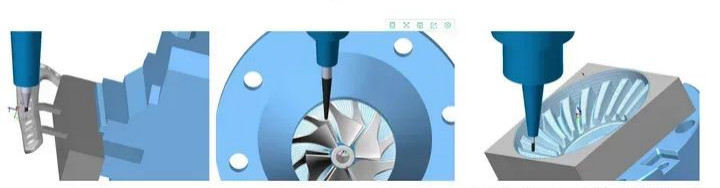
Introduction
Impeller components are widely used in high-level manufacturing sectors such as aerospace, energy, and petrochemicals as a main component of turbine and pump equipment. Due to their complex 3D geometries, thin-walled structures, and spatial twist characteristics, impellers exert extremely rigorous demands on machining toolpath accuracy and stability. Especially in five-axis CNC machining, it is a major problem for CNC technology how to construct rational toolpaths free of interference and improve machining accuracy and efficiency.
Hand traditional programming is not only error-prone and time-wasting but also unable to cope with complex geometries of impeller components. As with the rapid development of CAD/CAM technology, there are new digital manufacturing technologies applied increasingly for high-precision machining of impellers, and CAD/CAM software then becomes a significant tool to enhance efficiency and quality of machining of impellers.
This article deeply elaborates on the application of CAD/CAM software for designing high-precision toolpaths of impellers, including modeling techniques, toolpath strategy selection, interference control and posture optimization, parameter optimization, and other technologies, for the purpose of providing theoretical support and practical reference for impeller machining designers.
Complex Impeller Modeling and Data Preparation
During high-precision machining of the impeller, the accuracy of the 3D geometric model directly decides upon the quality and practicability of subsequent toolpath planning. Therefore, before really generating toolpaths, one must create a highly geometrically reducible impeller model with advanced CAD software (e.g., Siemens NX, SolidWorks, CATIA, etc.). The below-listed crucial links are mandatory for quality modeling:
Surface Continuity Control
Smoothness of impeller blade surface smoothness is the foundation for the generation of high-level toolpaths, which typically require a minimum of C2-level surface continuity (second derivative continuity). When there are breaks in a model’s surfaces, abrupt changes, or changes in the normal direction, it will cause extreme oscillations in acceleration when there are transitions in toolpaths and result in machining vibration, texture flaws, or path interferences. For this reason, high-order fitted surfaces, transition chamfering, or NURBS technology should be used during modeling in such a way that natural transition and smooth surface connection flow are ensured.
Geometric Feature Recognition
Impeller geometry designs are usually composed of a number of complex substructures, e.g., blades, hubs, guide edges, root transition zones, etc. Different zones have different machining characteristics and path strategies, thus geometric feature (zone recognition) should be used during modeling. For example, the hub zone is suitable for high-speed spiral roughing methods, while the paths of flow between blades are most appropriately utilized in five-axis equidistant finishing paths. Proper structural division enables segmented programming and called optimized path strategies in the CAM system.
Model Precision and Resolution Control
For the sake of geometric reducibility of the resulting machined part, the exported model’s facet resolution and geometric accuracy have to meet the CNC machine’s trajectory interpolation accuracy requirements. A suitably low tolerance value must be set during exportation (e.g., STL file triangular face error ≤ 0.01mm) to avoid toolpath jitter or redundant vibration marks from sparse meshes. Apart from that, subtle elements such as thin walls and sharp edges need to be encrypted while modeling to yield sufficient resolution for the tool in actual machining.
CAM Pre-Processing Data Preparation
After the completion of the geometric model, it needs to be exported with a smooth transition into the CAM software environment (such as NX or PowerMILL or HyperMILL, etc.) for preprocessing before generating toolpath, mostly comprising:
- Coordinate system definition: Set a reasonable machining reference system according to the workpiece clamping method;
- Blank modeling: Define the actual raw material shape for blank comparison and residual material identification;
- Allowance setting: Reserve reasonable allowances for roughing and finishing to ensure complete machining of transition areas;
- Equipment selection and simulation setup: Call the post-processing setup of the target five-axis machine for checking accessibility and interference.
With the fine processing of the above steps of modeling and preparation, a good platform is provided for the subsequent generation and simulation of five-axis toolpaths, which is a prerequisite for efficient and accurate machining of complicated impellers.
Toolpath Strategy Selection and Finishing Technologies
Toolpaths in CNC machining of complicated impellers not only determine the forming path of workpieces but also directly affect surface quality, machining efficiency, and tool life. Under difficult impeller shapes, severe surface variations, and shallow machining spaces, the selection of appropriate toolpath techniques and finishing processes is particularly critical. Modern CAM tools (e.g., NX CAM, PowerMILL, HyperMILL, etc.) provide various multi-axis toolpath techniques. Below are typical path schemes and their use benefit analyses:
5-Axis Equidistant Machining
Five-axis equidistant toolpath is an accurate finishing method by which the tool is continuously maintained in an equidistant contact with the workpiece surface. Compared to the traditional three-axis or inclined surface machining, this method can modify the tool posture automatically according to the surface normal, significantly reducing the risk of surface overcutting or undercutting and ensuring continuity and equality. It is particularly well suited to blade surface finishing. Assuming smooth tool path and successful interference control, it can yield a surface finish of Ra ≤ 0.2 μm, meeting the very high level of surface finish needed for aviation compressor impellers and precision turbine blades.
Flowline-Driven Machining
For the curved and narrow flow channel zones between the blades of the impeller, the path of flowline uses the blade centerline or surface orientation as a reference to generate machining paths conforming to the blade shape. This method can eliminate path confusion and overcutting in confined zones as a result of traditional contour machining paths, with smooth trajectories, stable loads, and gentle local transitions. It is extensively used in medium-finishing and roughing operations, especially best suited for big stepover or substantial removal cutting, reducing tool wear but ensuring material removal efficiency.
Barrel Tool Engagement Path
Applying new barrel cutters to free-form surface machining is an effectively recommended path strategy. Unlike conventional round-nose cutters, the barrel cutters accommodate a larger effective cutting radius, enabling larger stepovers at the same tool position density, reducing the number of toolpaths drastically and the machining time. They provide proper surface fit and consistent cutting angles, making them suitable for free-form surface machining of impeller airfoils, with high performance in finishing high-precision impellers applied in aviation and energy sectors.
Toolpath Strategy Combination and Process Integration
In practice, one toolpath strategy is not capable of satisfying all the needs of roughing and finishing. Therefore, toolpath strategy combination has been an effective means to gain higher overall efficiency. For example:
- Roughing stage: Adopt the “Adaptive Clearing” strategy to effectively control cutting load and enhance material removal rate;
- Finishing stage: Select “equidistant five-axis machining” or “barrel tool strategy” to obtain excellent surface quality and geometric precision;
- Transition area treatment: In root transitions and guide edge intersections, supplement with the “Flowline” strategy to optimize transition smoothness and reduce tool vibration.
By moderately (allocating) toolpath approaches, process adaptability, peak machining efficiency, and effective tool life extension can be achieved, meeting manufacturing needs of highly complex impeller components in mission-critical sectors such as aviation, energy, and automotive.
Interference Control and Path Posture Optimization
Another problem in five-axis machining is controlling spatial interference. In five-axis (linkage) machining of impellers, due to dense blade spacing and complicated hub shapes, tools will readily interfere with workpieces. Accordingly, recent CAM software has provided several interference control technologies:
Dynamic Interference Checking
Using path simulation, the CAM software is able to identify potential collision between workpiece, fixture, and tool automatically, compensating in advance to avoid interference during machining.
Automatic Tilt Axis Compensation
With respect to the spatial posture, the CAM system can compensate for the tool angle automatically so that it stays within a safe cutting region to avoid collision between the workpiece and tool.
Minimum Tool Length Calculation
In complex route five-axis machining, CAM software can automatically determine and recommend the optimal tool overhang length for rigidity to avoid tool vibration or bending.
Some advanced CAM software also supports automatic posture smoothing, which can efficiently reduce machine vibration and improve machining stability and tool longevity by reducing sudden posture changes in five-axis machining.
Parameter Optimization and Path Quality Control
When generating toolpaths, parameter setting fineness will directly affect the machining quality. Common optimization parameters are:
Cutting Stepover and Depth
Small stepover and adequate cutting depth help improve surface fineness and reduce unnecessary tool wear.
Tolerance Settings
Establish the maximum allowable tolerance between tool path and theoretical surface, typically recommended to be kept below 0.005mm for the sake of preserving high machining accuracy.
Tool Approach/Retract Strategies and Path Jump Optimization
Proper tool engagement strategies (such as spiral engagement) are able to effectively prevent premature tool entry-induced edge chipping and maximize path jumps to conserve air move time.
With machining simulation and post-processing modules, designers can perform visual toolpath analysis, conduct comprehensive cutting simulation, and generate G codes to further ensure path feasibilities and machining quality.
Conclusion
As digital manufacturing technologies continue to advance, the role of CAD/CAM software in machining precision parts such as impellers has grown even more significant. Precision, efficiency, and automation level of impeller machining can significantly be enhanced on the basis of rational modeling, toolpath strategy selection, interference control, and parameter optimization. In the future, as technologies such as artificial intelligence and machine learning continue to integrate steadily, CAD/CAM systems will develop further in the direction of “intelligent toolpath optimization” and “real-time closed-loop control” to help continually boost China’s high-end manufacturing capacity.


