
With the rapid development of precision technologies such as aerospace, medical devices, and micro-energy devices, micro-impellers are increasingly important in high-speed rotational fields with small size and high tolerance. Due to the extremely small size and complex geometric structure of micro-impellers, very stringent requirements for precision manufacturing are posed, and precision measurement technology is an essential method to ensure shape consistency, surface quality, and dynamic performance.
Introduction
Throughout my experience in micro-precision manufacturing process research and application, the production of the micro-impeller has always been a complex and challenging job. Such kinds of structures commonly have numerous small blades with various configurations, whose contour surfaces are not only three-dimensionally complex but also possess very strict requirements for their dimensional and geometric tolerances. Any minor deviation may lead to serious degradation or even failure of the whole machine performance. As a result, the traditional mechanical contact measurement methods generally fail to cope with the full-scale and high-precision measurement task of such micro-structural components, especially in the measurement of the complex inner cavities or small-scale surface features.
Against this backdrop, precision measurement technology, as the “invisible guarantee” in micro-impeller manufacturing, has progressively put its pivotal role into the limelight. Not only does it go through all the stages such as design verification, manufacturing control, and quality inspection but also plays a crucial role in achieving micro-precision feedback and closed-loop machining control. This paper will start from some key measurement methods, discuss their applications in actual cases of micro-impeller production in an organized manner, especially their great contribution to improving manufacturing consistency, aiding reverse modeling, and optimizing the design.
Core Tasks of Precision Measurement in Micro-Impe ller Manufacturing
Because of widespread use in aerospace, medical equipment, and precision pumps, geometric accuracy and surface finish of micro-impellers have become key factors for product performance and service life. Therefore, during the process of production, precision measurement equipment needs to be used to inspect and test parts completely in order to ensure consistency and traceability in batch production, as well as reduce the percentage of defects and quality fluctuation caused by measurement errors. Generally speaking, the primary roles of precision measurement for micro-impeller production are mainly concentrated on the following aspects:
Geometric Dimension and Form-Position Error Control
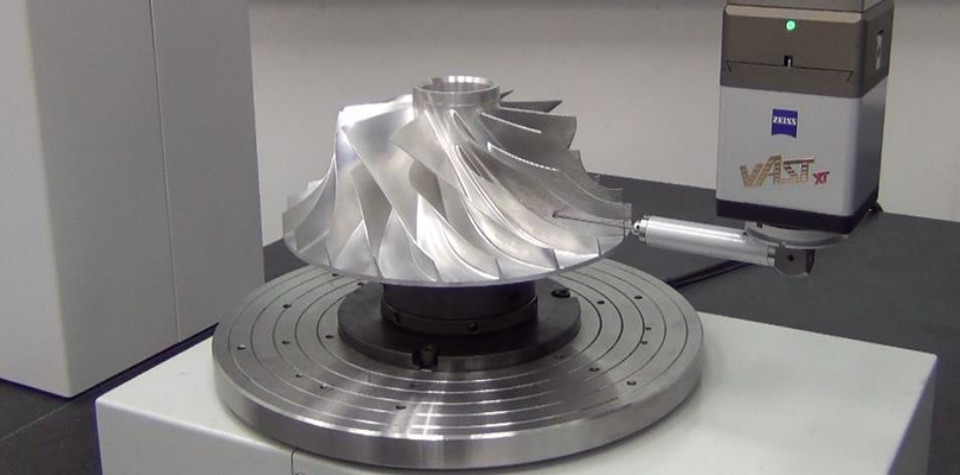
Micro-impeller parts involve various significant geometric parameters such as blade thickness, channel width, rim diameter, and various angles whose dimensional accuracy is closely linked with the assembly accuracy and operational performance of the impeller and supporting components. With the use of a Coordinate Measuring Machine (CMM), point-to-point inspection can be carried out for each of the geometric features of the component (e.g., profile, coaxiality, cylindricity, parallelism, etc.), and accurate coordinate data can be gathered for comparison with the CAD model so that out-of-tolerance conditions can be identified in a timely manner and process parameters can be adjusted accordingly. In the precision pump impeller manufacturing that I was directly involved in, closed-loop control of CMM measurement and error feedback substantially reduced rework and rejection levels, significantly improving production efficiency and consistency.
Surface Contour and Surface Quality Detection
Micro-impeller blades are complex 3D free-form surfaces with radical local curvature variation and extremely delicate blade edges, and therefore traditional contact measurement will cause shape damage and measurement error. Blue light 3D scanner and structured light measurement machine technologies have the potential to acquire full surface point cloud data within a limited time to gain overall analysis and benchmarking of the spatial curvature of blades, shape errors, and surface deviations. Concurrently, with the help of surface profilometers and optical interferometers, micro-crack and roughness conditions after machining can be accurately checked, excellent data evidence for surface finishing and fatigue life improvement. Data measurements also indirectly control design optimization and cutting parameter setting, which really improves impeller service life and performance.
Assembly Fit and Dynamic Balance Measurement
In the assembly connection, micro-impellers must fit precisely into other components such as bearing seats, shaft sleeves, and sealing rings with main indicators such as concentricity, roundness of circle, and end face runout to be maintained under (extremely small tolerances). High-resolution contact measuring instruments are used to measure to achieve smoothness and stability in assembly of parts while reducing vibration and noise problems caused by poor fit.
In addition, dynamic balance measurement is an indispensable part of micro-impeller testing. Dynamic balance correction of the impeller by a special balancer can actually reduce the eccentricity of rotation, reduce bearing load and energy consumption, and extend the service life of the entire machine. In some precision pump projects that I have actually followed up, the application of an integrated control method of measurement and dynamic balance not only improved the operation stability of the entire machine but also reduced maintenance costs and after-sales rates.
Application Analysis of Typical Precision Measurement Technologies
With the increase in the structural complexity of micro-impellers and the continuous upgrading of precision requirements, it becomes challenging for a single measurement method to meet production and design verification demands. Therefore, the right measurement technologies must be selected and the strengths thereof fully utilized in guaranteeing the quality of impeller components and enhancing the design and manufacturing process. The current common precision measurement methods are contact and non-contact measurement, 2D and 3D measurement, and analysis of micro-nano surface topography, which can be supplemented for the completion of full measurement loop and precision guarantee for impeller design and production. The following analyzes and introduces some common precision measurement methods and their emphasis points.
Coordinate Measuring Machine (CMM) Technology
Coordinate Measuring Machine (CMM) has been an indispensable core facility for precision measurement over its history, with higher flexibility and high-precision performance characteristics, particularly widely used in the measurement of complex surfaces and large dimensions. While micro-impeller is being manufactured and inspected, CMM can utilize contact probes to make micron-level measurements on major parts such as blade sections, end face angles, and blade root transition fillets. The measurement data can be directly compared with the 3D design model to evaluate manufacturing errors and deviation distribution precisely.
I personally would prefer to implement CMM as the chief measurement medium for end dimension and form-position tolerance verification to ensure that the parts meet the design specifications and provide reliable quality assurance for mass production.
Blue Light 3D Scanning and Structured Light Systems
Blue light 3D scanners (for example, Zeiss T-SCAN Hawk 2, etc.) have become indispensable measurement equipment for impellers in recent years. Blue light structured light features superior anti-interference capability on high-reflective and high-curvature surfaces, which can quickly obtain the surface point cloud data of the entire impeller, suitable for overall scanning of blade surface and flow channel cross-section morphology, and is widely applied to design adjustments and reverse engineering.
In actual projects, I prefer to use 3D scanning data for reversing the impeller model and establishing an entire digital twin, therefore providing accurate data support for subsequent optimization design and tool path optimization, which has greatly improved the design and manufacturing process efficiency.
Optical Interferometry Measurement
For situations where impellers have ultra-smooth surface quality (such as high-speed turbines and precision pump impellers), interferometers are essential test equipment. Surface profile data at the nanometer level can be obtained through Michelson-type or white light interferometers with a precision to the 0.5-nanometer level and that can clearly differentiate microscopic textures and tool marks. It is of direct reference value to inspect the effect of tool wear and cutting conditions on surface integrity and difference in quality before and after surface coating.
Personally, I believe that routine inspection of the key contact surfaces of impellers with interferometers is beneficial in checking the influence of the manufacturing process on surface quality in the long term and provides strong data backing for process optimization.
Atomic Force Microscope (AFM)
In nanometer-scale requirements testing in scientific research, Atomic Force Microscope (AFM) has the capability to perform three-dimensional micro-nano-scale local area surface topography measurement. Especially in fatigue source analysis, AFM can directly reveal the microscopic characteristics of micro-crack initiation points, nanoparticle deposition, and stress concentration areas, which can assist in understanding the local failure mechanism of the material and providing a theoretical foundation for prolonging the service life of impellers and optimizing their design.
In past micro-impeller failure analysis work that I have performed, AFM has played a significant role in micro-area analysis with practical and reasonable grounds for the development of surface improvement treatment and stress concentration reduction strategies.
Comprehensive Significance of Precision Measurement in the Manufacturing Process
In my own practice, precision measurement is not just an “quality inspection” link after product manufacturing has taken place but should rather be a “controller” while manufacturing. In the first stage of processing, its 3D data can be utilized to verify process manufacturability, simulate tool paths, and order fixtures; at the middle stage of processing, it can be used as online measurement data for dynamic compensation correction of tools and adjustment of cutting parameters; at the later stage, it is the basis data for quality inspection and statistical analysis.
In addition, the improvement of precision measurement technology has also improved the two-way information interaction between manufacturing and design. When the scanning data is compared to the design model, not only can processing errors be found, but also the reasonableness of the design itself can be tested, and a “design-manufacturing-measurement” closed-loop optimization mechanism is built.
Conclusion
Overall, precision measurement technology not only improves the manufacturing quality in micro-impeller manufacturing but also promotes the intelligence and close-loop control of the entire manufacturing system. As measurement technology continues to advance towards higher accuracy, higher speed, and greater adaptability, like the step-by-step enhancement of online scanning, AI-assisted detection, and digital twin platforms, I believe micro-impeller manufacturing will truly undergo the mode shift from “experience-driven” to “data-driven” in the future. Meanwhile, deep integration among measurement equipment and CNC machining centers will also facilitate a great enhancement in the automated machining ability of micro-complex structures.


