
As the continuous improvement of manufacturing industry requirements accuracy and traceability of complex surface parts, reverse modeling technology has been more and more valued as a quality inspection and design improvement tool for impellers. Using physical measurement combined with digital 3D models, enterprises are able to accurately evaluate dimensional differences between physical impeller geometric features and design parameters and provide data support for subsequent production improvement and quality control.
Role of Reverse Modeling in Impeller Inspection
As core components of fluid power devices, the precision of impeller design directly affects the overall performance of equipment. Especially in aerospace, turbomachinery, water pumps, and other sectors, the precise control of impeller geometry and dimensions not only affects the efficiency of equipment, but even stability and safety. Contact measurement is typically based on the traditional method of impeller inspection. Despite the high precision of this method, low efficiency and poor operability for complex surfaces, minor deformations, and high-efficiency checking demands generally plague it.
With the development of reverse model technology in the areas of 3D scanners and high-precision data processing methods, the impeller inspection and quality control methods have been significantly improved. Reverse modeling not only can efficiently acquire 3D geometric data of impellers but also conduct comprehensive error analysis through digital model-making, providing easy and reliable data support for quality management. Through reverse modeling technology, the geometric deviations of impellers can be fully understood by manufacturers, and usable data can be provided for optimizing product design.
Measurement Process Based on Reverse Modeling
Reverse modeling is a technical process starting with physical components and obtaining precise digital models through 3D scanning, data processing, and surface reconstruction. For sophisticated surface components such as aviation impellers, the process can provide detailed and authentic data support for quality inspection and optimization design.
Data Collection and Preparatory Work
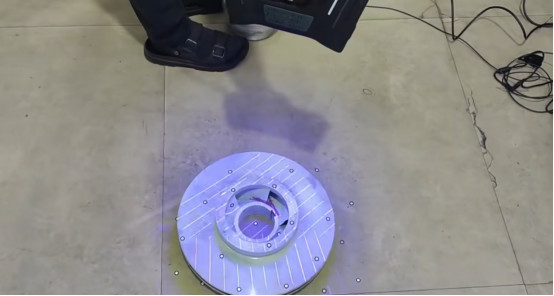
The spirit of reverse modeling is to obtain full and high-accuracy 3D data of impellers, and the procedure of selecting measurement equipment and preparatory work are crucial chains to ensure data quality. Common measurement equipment adopted are blue light scanners, laser scanners, and Coordinate Measuring Machines (CMMs). Among them, laser scanners became the mainstream of reverse measurement of complex surface impellers due to their non-contact mode, high efficiency, and high resolution. The surface of the impeller would be pre-sprayed with developer or pasted with reference points in advance to reduce the impact of surface reflection and texture defects on the accuracy of measurement, in order to obtain full point cloud data with blind spots. In measurement, conditions such as environmental lighting and environmental vibrations should also be controlled in order to enable easy gathering of data and stable and reliable data.
Point Cloud Data Preprocessing
Noise points, duplicate points, and measurement errors may be present in raw point cloud data, and these will degrade the quality of surface reconstruction if used as is. Therefore, before model reconstruction, specialized software should be used to filter, denoise, align, and stitch the point cloud data, removing isolated points and redundant points such that the point cloud data is continuous, complete, and accurate. This process lays a good quality foundation for surface reconstruction and error analysis in the next, lowering surface deviations and geometric defects in the next fitting process.
Surface Reconstruction and Model Generation
After preprocessing of the point cloud data, reverse modeling software can be used for surface reconstruction and 3D model building (e.g., Geomagic Design X, PolyWorks, etc.). With support from automatic and manual surface fitting and feature recognition algorithms, discrete point clouds can be effectively converted into continuous and smooth 3D digital models. This mode can actually rebuild the impeller’s geometric features with high accuracy and applicability, providing precise and accessible reference data for following comparative analysis, numerical simulation, and manufacturing process optimization.
Comparative Analysis and Error Evaluation
After obtaining the 3D digital model, compare and align it with the original design CAD model and use error analysis software to generate color error maps and deviation statistical tables to quantitatively examine the geometric disparities between them. Such comparative analysis could directly reveal the differences in primary dimensions of each blade, i.e., chord length, thickness, curvature radius, and installation angle, to assess the stability and precision grade of the manufacturing process. Through this, manufacturers could identify possible process faults and design revision points and utilize it as a decision foundation for improving manufacturing quality and performance consistency of impellers.
Technical Advantages of Reverse Modeling Inspection Process
The reverse modeling inspection process is a mature, efficient, and highly intelligent measuring technique for modern-day aviation impeller quality control. Compared with traditional contact measurement, the process can greatly increase levels of measurement efficiency, traceability of quality, and optimization of design to a great degree, to provide excellent guarantees for enterprises to make lean production and implement continuous improvement, which is especially expressed in the following aspects:
Comprehensive Coverage and Strong Visualization Effect
Traditional contact measurement tends to be limited to key points and sections, thin point of measurement, and less working time, while reverse modeling can scan a tremendous number of data points on the impeller surface simultaneously, achieving 100% coverage of complex surface geometric details. This comprehensive measurement ability not only is able to capture high and full-density 3D point clouds but also inherently express impeller design and manufacturing variations through visualization means such as color error maps and curvature distribution maps, allowing engineers to discover latent defects in time, reduce measurement omissions, and act as scientific proof for follow-up process adjustment and accuracy improvement.
High Efficiency and Strong Repeatability
Reverse modeling utilizes contactless 3D scanning technology that can significantly reduce the time and manual operation links in measurement, especially suitable for batch measurement and rapid quality inspection of impellers in mass production workshop. A single scan is able to obtain a complete surface data without repeated positioning and measuring, not just accelerating the inspection tempo but also eliminating errors introduced by manual operation. At the same time, the uniform process and automatic data capture used in reverse modeling can ensure the high consistency of measurement results on different batches and operators, significantly improving the repeatability and stability of the measurement data.
Data Traceability and Easy Sharing
The 3D models and the measured data generated in reverse modeling can be stored and called upon for a long time, which can provide enterprises with comprehensive traceable quality files. Not only does it allow the analysis and inspection of the quality status of previous batches of impellers but also provides convenience for smooth docking and information sharing among all supply chain stakeholders. By means of standardized and electronic test results, enterprises are more capable of informing customers, suppliers, and certification agencies on product status and quality information, thereby laying a good basis for supply chain optimization and customer relationship maintenance.
Helping Design Optimization and Quality Improvement
The results of measurement and error analysis from reverse modeling can be easily fed back to the design and process departments, in detail offering data foundation for design optimization and process improvement. For example, if again and again some of the features of certain blade go out of tolerance relative to the design specification, then designers can alter the design model or change the process specifications accordingly, and the manufacturing department can also optimize processing parameters, tools, and fixtures accordingly. This measurement-driven closed-loop management mode helps to continuously improve the design precision and manufacturing quality of impellers, reducing the rework rate and expense, and promoting enterprises to achieve a win-win situation among efficiency and quality.
Practical Application and Prospect
At present, the reverse model-based impeller inspection process has been widely applied in different industries such as aerospace, high-reliability turbomachinery, and automobile superchargers. Throughout the manufacturing process of those precision-accuracy and precision-fidelity products, reverse modeling technology has served as a priceless quality management and design optimization tool because of its advantages of high efficiency, low error, and strong visualization.
With the continued advances in technology and improvements in accuracy of 3D scanning technology, application of reverse modeling technology will become smarter and more automated and is bound to be of greater significance to future impeller production and quality inspection. For example, automatic scanning and data processing systems will continue to improve the efficiency of inspection, reduce the production cycle, and reduce costs.
Conclusion
Through the incorporation of reverse modeling technology, the impeller physical inspection process has come to transform from traditional contact measurement to digital processing through 3D scanning and data processing. This kind of process is not only capable of comprehensively capturing impeller geometric features, reducing the error of measurement, but also improving inspection efficiency, reducing human involvement, and increasing the consistency and accuracy of mass production. At the same time, traceability and data exchange of digital information also have excellent support for the following design optimization and quality improvement. Along with the development of technology, the process of reverse-modeling-based inspection will become more and more pivotal in the quality control and optimization of such intricate components as impellers, leading to the upgrading of the manufacturing industry into intelligence and digitization.


