
With ongoing improvement of quality control requirements for critical parts in the high-technology production industry, geometric precision control of complex free-form surface products like impellers is faced with unprecedented challenges. In mass production conditions, traditional hand-type inspection methods have proven themselves incompetent in terms of efficiency, consistency, and traceability of data. As a new inspection technology integrating mechanical clamping, non-contact measurement, data processing, and system integration, automated measurement tooling gradually becomes a crucial support for enterprises to achieve efficient quality inspection and promote intelligent manufacturing reform.
Demand Upgrading for Batch Impeller Inspection and Limitations of Traditional Methods
Impellers are used widely in high-performance machinery such as aerospace, gas turbines, and automotive turbocharging systems. Geometric profile deviations with small sizes (e.g., bend, twist, cross-sectional profile, etc.) may lead to poor aerodynamic performance, reduced fatigue life, or even machine breakdown. During the mass production process, dozens to hundreds of impellers need to complete high-precision measurement every day, so the speed of response of the inspection system, the measurement accuracy, and the automation level must be very high.
Traditional contact probe and manual clamping coordinate measuring machine (CMM) systems are precise, characterized by low clamping efficiency, high operational dependency, poor repeatability, and data flow interference. During an aviation compressor impeller project, I experienced that manual inspection took over 45 minutes on average for an impeller, and due to different measurement paths and reference selection by multiple operators, outcomes deviated by more than ±0.01mm, greatly affecting the accuracy and real-time (timeliness) of the manufacturing feedback. In such a backdrop, the arrival of automated measuring tooling has proved to be a watershed moment for quality enhancement.
Technical Composition and System Functions of Automated Measurement Tooling
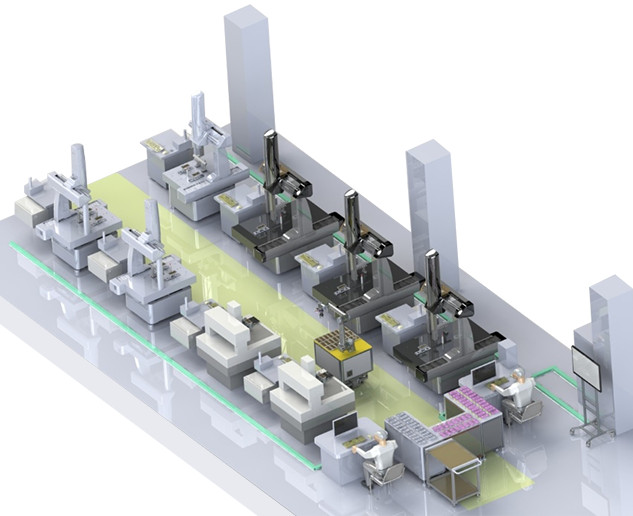
Automated measurement tooling integrates high-precision mechanical engineering, optoelectronic sensing technology, and intelligent control algorithms to form a closed-loop system from clamping, measurement to processing data. Its principal elements are:
Precision Mechanical Positioning System
Tooling ensures consistency of each impeller within the measurement coordinate system by means of modular fixture structures and repeat position systems. Accuracy of clamping repeatability is typically controlled to ±5μm. Rapid change modules, conversely, allow for quick change of impellers with different diameters and channel numbers, which helps to meet batch multi-variety production requirements.
Multi-Modal Sensor Integration
Depending on the degree of difficulty in measurement tasks, various non-contact measurement modules can be integrated, including laser scanners, structured light cameras, video probes, and even micron-level CMM probes. Among them, laser scanning technology is particularly suitable for free-form surface structure, capable of quickly achieving million-level point cloud acquisition without damaging the workpiece and providing an accurate data basis for follow-up error analysis.
Automatic Control and Data Processing Unit
The PLC or industrial PC system controls the tempo and path optimization of the entire measurement process, with built-in error evaluation modules for performing various profile indicators in real-time and NG part (judgment) and alarm automatically. The system also provides access to MES/SPC platforms with automatic upload, traceability, and visualization of the measurement data.
Human-Machine Interaction and Information Visualization
Fitted with touch screens, industrial control panels, or remote terminals, the status of the measurement process is displayed in a clear manner, and 异常 (abnormal) problems are fed back in real-time. On top of that, automated tooling can generate standard inspection reports, trend charts, and control charts that provide robust data support for quality management and process optimization.
Deployment Advantages: A Quality Assurance System Emphasizing Both Precision and Efficiency
In contemporary impeller production, automation measurement tooling not only significantly improves the efficiency of inspection but also constitutes an exact and credible technical foundation for quality control. Through systematic automated deployment, firms are capable of achieving efficient, stable, and traceable quality management and improving productivity and consistency of products in both directions.
Significantly Improving Inspection Efficiency
Computerized tooling cuts clamping and measuring time for impellers considerably. Manual clamping takes about 3 to 5 minutes, while computerized clamping is limited to as little as 30 seconds; the measurement cycle of an entire impeller is reduced from 60 minutes to less than 20 minutes.
For example, for a military turbine impeller production line where I was working, after introducing automatic tooling, the daily production quantity increased from 28 pieces to 75 pieces, and the pass rate of quality sampling increased by 12 percentage points, significantly freeing the capacity bottleneck and basically meeting high-load production requirements.
Ensuring Data Consistency and Measurement Reliability
The tooling realizes measurement in a unified reference system with preset measurement paths and references, thus ruling out the data-fluctuating effects of random manual selection of measuring points and clamping offset.
The system, coupled with temperature compensation algorithms and continuous calibration mechanisms, can remain stable in high-precision measurement, save periodical calibration frequency, guarantee long-term comparability and test reliability of measurement data, and improve the scientificity of quality control.
Reducing Human Dependence and Operational Risks
Uniform tooling processes and computerized inspection eliminate over-reliance on highly trained operators and minimize errors and risks due to human factors.
Automatic clamping and non-contact measurement successfully bypass equipment damage and injury to people through misuse, bringing additional controllability and safety assurance into enterprise quality management.
Building Digital Factory Infrastructure
The automatic measuring system completely captures all the inspection data, associates it with the workpiece ID, and sends it to the MES system for real-time monitoring and trend analysis of batch quality data.
With the Statistical Process Control (SPC) platform, the system also has a warning function that can identify potential process defects in advance and facilitate digital closed-loop quality management and intelligent manufacturing transformation and upgrading.
Adapting to Complex Structures and Diverse Measurement Needs
Automatic tooling not only suits traditional dimension measurement of impeller outer surfaces and end faces of inlet/outlet, but also can complete precise reconstruction of blade aerodynamic surfaces, roots of blade crowns, and complex inner surfaces of multi-channels by multi-angle scanning technology.
This highly flexible measurement function gives it extensive versatility in applications of aero-engines, energy equipment, and precision compressors, for diversified product structures in inspection.
Analysis of Typical Application Cases: From Theory to Practice
On a precision impeller production line changeover project of an airline company I did, a laser scanning measurement tooling system with automatic model changing capability was applied to measure three impeller compressor specifications. Actual operation data shows:
- Single-piece measurement time was shortened from the original 58 minutes to 22 minutes;
- Accuracy in measurement remained at ±0.01mm, and data consistency was 83% higher than manual measurement;
- An optimization model for process was established with the MES platform, reducing the rate of rework due to machining deviations by 15%.
More significantly, after system implementation, it realized automatic identification and visual monitoring of high-end twist errors, establishing a closed-loop of data for subsequent tool path adjustment and hence an intelligent link of quality control “inspection-feedback-correction”.
Key Deployment Points and Strategy Recommendations
In the real-world deployment procedure of automated measurement tooling, the following must be logically designed and implemented:
- Fixture design must adopt a universal and modular approach while balancing between multi-model compatibility and expansion in the future;
- Sensor selection must take into account impeller surface reflectivity, structural complexity, and requirements for measurement accuracy, where possible employing equipment with temperature drift correction and self-calibration features;
- Operators must receive systematic training in order to understand the principle of tooling operation and emergency treatment programs to ensure smooth on-site operation;
- System interfaces must be capable of supporting docking with MES/ERP/PLM and other systems to achieve vertical business integration and horizontal data collaboration and to eliminate “information silos”;
- In high-reliability application scenarios, it is recommended that dual redundant control and breakpoint continuation functions be supplemented to improve system fault tolerance and maintenance convenience.
Conclusion
Automatic measuring equipment is not only a means of saving efficiency in batch quality inspection of impellers but also an important cornerstone for manufacturing processes to move forward with smart and digital transformation. It possesses the best balance between accuracy and efficiency and acts as a core linking bridge for data-driven and visual management. I firmly believe that with the continuous integration and innovation of measurement algorithms, industrial networking, and artificial intelligence, future automatic measuring tooling will be heading towards higher integration, higher flexibility, and deeper mining of data value, ultimately establishing a quality ecosystem throughout the entire process of design, production, and testing. For production enterprises committed to competitiveness improvement, its application is no longer an “optional item” but a “compulsory course” for the future.


