
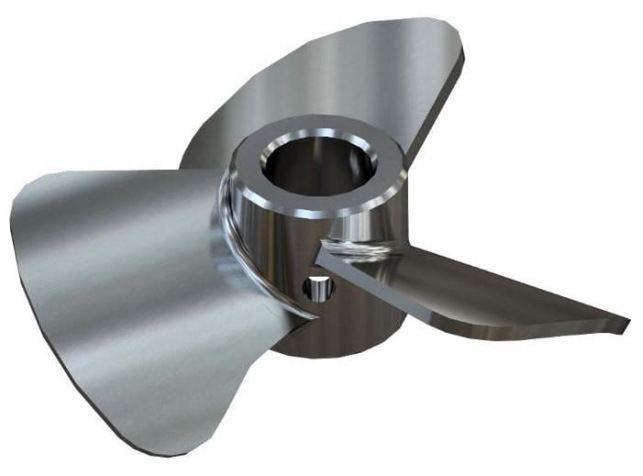
Mixer blades are mixers with two to four propeller-type mixing elements. The propeller mixer has a relatively high revolution speed when mixing, and under this condition, the materials can be driven axially by the relatively high rotation speed, enabling the materials to be fully circulated and mixed.

What are mixer blades?
Blades in a mixer are the most critical components of a mixer. They are attached to the mixing shaft and, when rotated, create shear, convection, or turbulence of the fluid in order to achieve processes such as mixing, suspension, dispersion, emulsification, and dissolution. Their structure, composition, and size directly determine the efficiency of mixing and product quality, and they are also widely used in chemical engineering, pharmaceuticals, food processing, and environmental protection.
Types of Mixer Blades
Being one of the key accessories of the mixer, here is the classification of mixer blades:
Blades of Propeller Mixer
The blades of the propeller mixer include 2 to 3 propeller blades. They operate at a fairly high speed of rotation, and the circumferential speed of the outer edge of the blades is generally 5 to 15 m/s. The propeller mixer mainly generates an axial liquid flow and produces a high circulation volume. It is suitable for mixing low-viscosity (<2 Pa·s) liquids, emulsions, and suspensions with below 10% solid particle content. The mixer’s rotating shaft can also be inserted horizontally or obliquely into the tank. At this point, the asymmetric circulation loop of the liquid flow can intensify turbulence and prevent the liquid surface from caving in.
Blades of Turbine Mixer
It comprises 2 to 4 flat or curved blades supported on a horizontal disk. The ratio of outer diameter, width, and height of the blades is normally 20:5:4. The circumferential speed of the turbine mixer blades is typically 3 to 8 m/s. During rotation of the turbine, a very turbulent radial flow is generated, which is suitable for gas dispersion and immiscible liquids and liquid-liquid phase reaction processes. The liquid viscosity to be mixed typically does not exceed 25 Pa·s.
Blades of Paddle Mixer
There are two categories of paddle mixer blades: flat paddle type and inclined paddle type. The flat paddle mixer has two flat blades. The blade diameter to height ratio is between 4 and 10, and the circumferential speed is between 1.5 and 3 m/s, generating a relatively small radial liquid flow speed. The two paddles of the inclined paddle mixer are turned back at 45° or 60° in opposite directions, thus creating an axial flow of liquid. Paddle mixer has a very simple construction and is normally used for mixing low-viscosity liquids as well as dissolution and suspending solid particles.
Blades of Anchor Mixer
The outer rim of the blades is aligned with the inner wall of the mixing tank, and between them there is only a very small gap. This can remove the viscous reaction products stuck on the tank wall or the solids settled at the bottom of the tank, providing a good heat transfer effect. The peripheral velocity of the outer rim of the blades is 0.5 to 1.5 m/s and can be used to blend Newtonian fluids and pseudoplastic fluids up to a viscosity of 200 Pa·s.
Blades of Ribbon Mixer
Outer ribbon diameter is equal to pitch. It is particularly used in mixing high-viscosity liquids (200 to 500 Pa·s) and pseudoplastic materials and generally operates in the laminar mode of flow.
Blades of Magnetic Heating Mixer
Magnetic mixing substitutes dynamic sealing with static sealing, totally eliminating sealing failure and leakage pollution difficult to be solved by mechanical seals and packing seals. Therefore, it can realize different chemical reactions of flammable, explosive, and toxic media under high temperature, high pressure, high vacuum, and high rotational speed.
Blades of Pitched Blade Mixer
Selecting a right mixer according to the physical properties, volume, and mixing purpose of different media can do an excellent work to accelerate chemical reaction rate and improve productivity. Pitched blade turbine mixer is widely applied for gas-liquid phase mixing reaction, and the rotational speed of mixer should be normally selected above 300 r/min.
Blades of Variable Frequency Double-layer Mixer
The support rod, motor, and base of the variable frequency mixer are attached as a whole unit with patented technology. The patented chuck is not loose, unstable, or likely to fall off, being highly dependable and secure. The lower section of the support rod is thick while the upper section is thin and highly rigid and reasonable in structure, chrome-plated. It is simple to transport and light in weight, and can be accommodated in most small containers.
Manufacturing Materials and Technology of Mixer Blades
Mixer blades work for a long period in high shear, high corrosion, and high load states in applications of chemical engineering, pharmaceuticals, food processing, and new energy. Therefore, their production materials and process technology have direct relationships with the lifetime, efficiency of operation, and safety of the equipment. Following is an introduction to this section:
Common Materials I Use:
| Material | Features & Usage | Notes |
| 304 Stainless Steel | Good for neutral or mildly acidic fluids. Common in food and daily chemical products. | Avoid in chloride-rich environments. |
| 316L Stainless Steel | Contains molybdenum, offering better corrosion resistance to salt or acids. GMP-compliant. | Slightly more expensive. |
| Carbon Steel | Strong and low-cost, good for non-corrosive slurries or wastewater. | Needs anti-corrosion coating. |
| Hastelloy (e.g., C-276) | Resistant to harsh acids and high temperatures. Great for fine chemicals. | High cost and tough to machine. |
| Titanium Alloys | Lightweight and seawater/chlorine-resistant. Perfect for aerospace and marine use. | Very expensive and challenging to weld. |
| Polymers (PP, PVDF) | Great for low-temperature, corrosive, but not high-temperature use. | Weak under mechanical stress and heat. |
Surface Treatment Technology
Electro-polishing
By utilizing the electrochemistry principle to remove the microscopic unevenness on the metal surface, to form a dense, uniform, and mirror-effect passivation film, significantly improving corrosion resistance and sanitation of the stainless steel surface. It has wide application in pharmaceutical and food-grade equipment for CIP/SIP cleaning.
Spraying Treatment
Typical plating materials for common plastics are polytetrafluoroethylene (PTFE), epoxy resin, ceramic coatings, etc., that can greatly increase the blades’ acid and alkali media corrosion resistance. Simultaneously, they have the anti-adhesion and anti-scaling properties and are used for mixing equipment under harsh conditions in such fields as chemical engineering and metallurgy.
Metal Plating
Similar to nickel plating and chrome plating processes, they are used to improve the hardness, smoothness, and wear resistance of the blade surface and also have some anti-corrosion property. They can be used in mixing conditions with high shear and abrasive wear. The thickness and bonding strength of the plating layer need to be strictly controlled so that it does not peel off in the future.
Passivation Treatment
Through chemical or electrochemical reactions, a stable oxidation protective film is formed on the metal surface to further enhance corrosion resistance. It is usually used as a supporting treatment after electro-polishing or mechanical polishing and is an important link to ensure the long-term steady operation of stainless steel materials.
Surface Nitriding/Hardening Treatment
Used on carbon steel or a specific austenitic stainless steel blades. Surface layer of high-hardness alloy is accumulated in the surface layer for improved wear resistance and fatigue strength. Often used under conditions of severe wear and high-speed rotation, and can extend the service life of the blades considerably.
Selection of surface treatment technology should consider entirely the material type, the physical properties of the mixing medium, operating conditions, and industry technical standards with cleanliness and cost consciousness but adequate strength.
Processing and Manufacturing Technology
In addition to requiring good structural strength and geometric precision, high-performance mixer blades should also guarantee stable operation and consistency in processing. The most important manufacturing processes are:
CNC Cutting
Utilizing laser cutting, plasma cutting, or waterjet cutting technology to perform high-precision contour processing on plates such as stainless steel and carbon steel to ensure the shape and size of the blades are accurate and the edges are clean, paving the way for subsequent bending and welding.
Sheet Metal Bending and Forming
With CNC bending machines, the already cut blades are bent into complex spatial curves such as spiral blades, sloping blades, or curved blades depending on the pre-set angles, which can ensure the hydrodynamic performance according to the design requirements.
Welding Assembly
Blades are usually rigidly attached to the mixing shaft using welding processes such as TIG (Tungsten Inert Gas) welding or MIG (Metal Inert Gas) welding. For high load applications, a fully welded seamless design or a multi-pass weld configuration is often used to optimize structural strength and fatigue life.
Dynamic Balance Testing
The processed blades need to be dynamically balanced and trimmed on special fixtures to eliminate the moment of inertia deviation, eliminating vibration, noise, and bearing wear owing to imbalance in running condition, and ensuring the reliable and long-time running of the system.
Grinding and Trimming
Grind and machine the welded components, cutting edges, etc., to remove weld slag and burrs and improve the overall surface finish. For sanitary-grade food mixing equipment and pharmaceutical process mixing equipment, the requirement for surface roughness is usually maintained at Ra≤0.4μm, and manual fine grinding or polishing to a mirror finish is required.
In mass production, tools such as die stamping, welding robots, and automatic bending systems may also be applied in order to increase manufacturing efficiency and consistency, which is fit for the fast delivery of standardized and standardized blade products.
Conclusion
Mixer blades are the primary components of mixing equipment and are widely used in chemical engineering, pharmaceutical industry, and food processing industries. At the same time, all these types of mixer blades have their respective application conditions and advantages. Selecting the proper type of mixer blade can improve the mixing efficiency and optimize the reaction process.


