

Impeller is the link between power input of the pump (driver) and power output (fluid flow). The moment pumping begins, the driver spins the impeller by the shaft. When the impeller rotates, water is pushed outward from the middle along the edges of the blades and develops pressure. Pressurized discharged water at the tips of the blades flows into the pump volute (or diffuser). Along the volute/diffuser path, water is supplied with a pressure and flow rate by the impeller geometry. Water accelerates along the impeller blades, creating low pressure at the impeller inlet. Atmospheric pressure, which exceeds the low pressure, pushes against the pump fluid surface and causes the fluid to move towards the impeller inlet continuously.
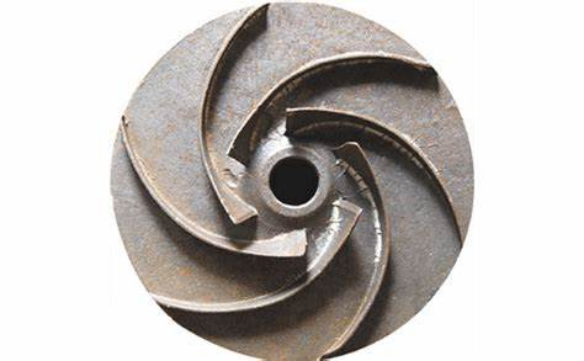
What is a Centrifugal Pump Impeller?
As the main component of the pump, the impeller is the most critical component responsible for governing the working efficiency of the pump. The impeller is turned through the motor, which generates centrifugal force or lifting force on the medium (water) and transfers mechanical energy to it. In some working conditions, if the impeller is not designed well or is in poor balance and stability, hydraulic losses and clearance losses will occur at the pump inlet and blade locations. Therefore, it is necessary to choose a high-quality pump impeller. An automatic pump impeller balancing machine can provide balance testing, improving the stability and quality of the impeller.
The impeller of the pump conveys the prime mover’s mechanical energy to the liquid directly, thereby increasing its static pressure energy and kinetic energy, mainly the static pressure energy. Impellers contain 6 to 12 backward-curved blades.
Driven by the motor, the impeller rotates to create suction in the middle, which water just bursts into the vacuum chamber (essentially, the impeller sucks water at all times), then discharges water out using the high-velocity rotating impeller thus pushing the water forward.
Working Principle of Centrifugal Pump
In operation, the centrifugal pump is founded on the high-speed rotation of the impeller, and the fluid is imparted energy under the action of centrifugal inertia force and hence its pressure increases. Prior to the startup of the centrifugal pump, the pump body and the inlet pipeline must be filled with liquid completely to prevent cavitation.
When the impeller is running at a high speed, the blades cause the medium to spin at a high speed. When the impeller is put under the force of centrifugation, the spinning medium is expelled. Once water within the pump is forced out, there will be a vacuum area located at the center of the impeller. Fluid is constantly being drawn in on one side; energy is transferred to the fluid constantly on the other side, as well as being expelled. This is how the centrifugal pump works constantly.
Centrifugal pumps are widely utilized. Besides industrial applications, they are also used extensively in irrigation for agriculture, municipal water supply, power plant circulating water supply, and city pollution treatment.
Various Types of Centrifugal Pump Impellers
As the main working component of a centrifugal pump, the impeller conveys energy to the fluid through its high-speed rotation, hence enabling effective fluid transport. It has generally three main components: the hub, blades, and front/rear shrouds.

Closed Impeller
Its characteristic is that it has two shrouds on both sides, between which 4 to 6 blades are present, as shown in Figure (a). If blade curvature direction is inverted with respect to impeller rotation direction, then it is a Francis-type blade. Backward-curved blades are normally the standard arrangement, though. It is a very efficient closed impeller and is used broadly, being particularly suitable for handling clean fluid free from solid fibers and particles. Single-suction and double-suction types of closed impellers do exist, with double-suction impellers having a superior fluid-handling capacity.
Semi-Open Impeller
It may be divided into front semi-open and rear semi-open types. Front semi-open impeller consists only of rear shroud and blades. Its efficiency is relatively low, but may be increased using adjustable-clearance sealing rings. Rear semi-open impeller consists of front shroud and blades; its efficiency approaches closed impellers’ efficiency, and blades also have a sealing function. This type of semi-open impeller is especially applicable for transporting fluids with solid particles, fibers, and other suspended solids. Its convenient manufacture, low cost, and high flexibility are making it increasingly popular in chemical centrifugal pumps.
Open Impeller
It has no rear or front shrouds, but blades and ribs only, as shown in Figure (c). It has fewer blades, usually 2 to 5, with relatively low efficiency and limited range of application, but mainly for high-viscosity fluids and slurry-type fluids.
KESU’s Centrifugal Impeller Machining Services
In centrifugal pump equipment, the impeller is the “heart” of the pump. Its shape and quality of craftsmanship directly determine the operating efficiency, stability, and life of the pump. KESU has professional expertise in high-precision machining for centrifugal impellers and dynamic balancing services, committed to providing customers with stable, highly compatible core component solutions.
Conclusion
Along with the continuous development of manufacturing technology and digital technology, centrifugal pump impeller design has entered a new age. From the initial purpose of saving money, to pursuing efficient and stable performance, and now extensively applying simulation optimization, intelligent algorithms, and green manufacturing principles, impeller design is undergoing unprecedented change.
Now, more than 2,700 different types of impeller designs have been developed and implemented. Some of the classic models still function flawlessly, whereas new-generation designs have enormous potential for improving performance and energy saving and environmental protection. However, they also face challenges in material selection and adjustment to complex working conditions.
We always learn from history that innovation is based on reliability. In the future, impeller designs with intelligent manufacturing and green concepts will create more opportunities to the industry.


