
Impellers are essential core elements of fluid machinery, and their functions are basic in equipment such as turbines and pumps. The edge curvature of impellers considerably affects their hydrodynamic performance and the efficiency of the machine, and complex impeller geometries make edge curvature measurement particularly challenging. The traditional contact measurement methods suffer from issues such as probe wear and location errors during edge curvature variation measurement. To avoid the mentioned above challenges, profilers as non-contact precision measurement tools have gained widespread applications in the detection of complicated impeller edge curvatures due to their high resolution and continuous data acquisition.
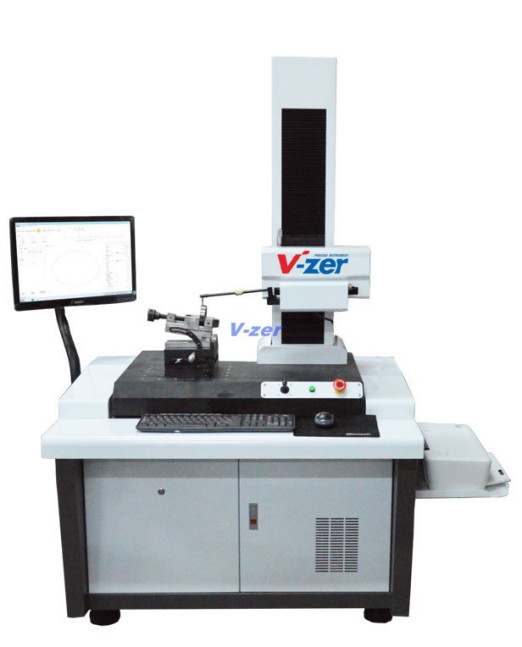
Importance and Challenges of Edge Curvature Detection
Being essential components of fluid machines, impellers have edge curvatures which critically influence aerodynamic and hydrodynamic blade performance. Especially for blades with complicated free-form surfaces, they don’t just require high geometry accuracy but also higher measurement accuracy. Common applications are turbochargers, centrifugal pumps, and high-speed turbofans.
Traditional edge curvature measurement typically uses contact tools like Coordinate Measuring Machines (CMMs) or special gauges. However, these methods have limitations: first, contact measurement easily causes local deformation or scratches on the impeller surface; second, the positioning accuracy of probe contact points is low, unable to effectively capture continuous changes in complex curves. Additionally, impeller edge measurement often requires multiple clampings, affecting measurement repeatability and reducing efficiency.
On the other hand, profilers, being non-contact precision measuring instruments, by-pass such issues directly and are characterized by accuracy, repeat-ability, and data integrity. Profilers have therefore emerged as the chosen tool in increasingly detecting sophisticated impeller edge curvature.
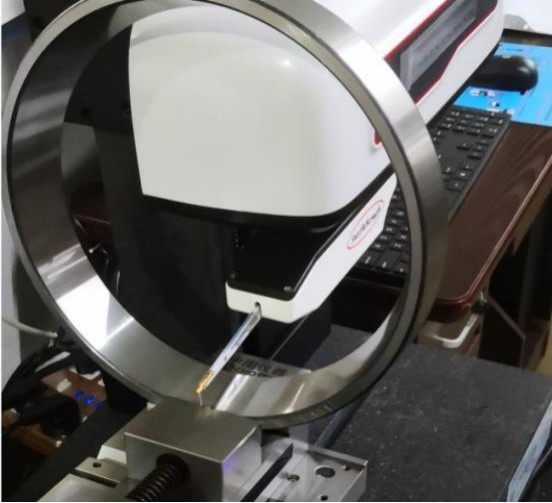
Measurement Principle and Key Performance of Profiler
As the design complexity of aviation turbine impeller rises, proper measurement of edge curvature becomes crucial to enhance aerodynamic performance and structural strength. Among the widely used high-precision measuring tools, profilers provide traceable and comprehensive measurement information for significant impeller feature measurements through the use of advanced mechanical and sensing technologies.
Measurement Principle of Profiler
The profiler measurement principle is based on coordinated operation among precision guides and highly sensitive sensors. While taking the measurement, the internal drive mechanism of the instrument propels the probe in a predetermined trajectory under smooth motion and keeps the probe against the impeller edge to register continuous vertical displacement signals. These signals are converted into digital curve data by the onboard high-precision data acquisition module, and significant geometric data such as edge radius, curvature mutation points, and curvature deviations of individual sections are automatically calculated by comparing with the reference design model (such as CAD data). The entire measurement process is highly automated, effectively eliminating the effect of human operation on measurement results and ensuring data consistency and integrity.
Performance Characteristics
- High resolution and sensitivity: Profilers’ resolution of measurement is 0.1–0.2 µm with the capability to precisely capture minimal variations in edge curvature and meeting measurement specifications of high-precision products like aviation impellers in a bid to deliver timely and accurate quality feedback to the manufacturing process.
- Wide measurement range and flexibility: Profilers can match impeller edge measurement work of varying sizes, curvatures ranges, and degrees of spatial change of curve complexity. Either on the inlet side, outlet side, or fillet transition region, they can record full and unbroken measurement data to avoid missing any measurement points.
- Data integrity and traceability: Profilers generate uninterrupted, high-density data acquisition through removing manual interpolation, not only reducing subjective errors in the measurement process but also completely exporting original curve data to standard data files for easy docking and analysis with 3D design models with a complete database support for subsequent production optimization and quality control.
- Automation and intelligent analysis capabilities: The new profilers’ software solutions typically consist of automatic comparison, statistical processing, and chart output capabilities, generating visual curvature deviation maps after measurement to allow engineers to instantly identify potential defects and provide data support for on-site trouble-shooting and process tuning.
Practical Case: Edge Curvature Measurement of an Aviation Turbine Impeller
In order to explain more intuitively the application performance of precision gauges and measuring instruments in actual production inspection, the following provides an example of aviation turbine impeller to introduce the entire process and evaluation of edge curvature measurement. The example not only explains measurement work and implementation steps but also provides a complete analysis and comprehensive evaluation of measurement results, with citable measurement standards and operation specifications for factory locations.
Measurement Object and Objectives
The object to be measured in this case is an aviation turbine impeller of nickel-based superalloy with given edge curvature radii between 0.50 mm and 2.00 mm and a design tolerance of ±0.03 mm. Curvature parameters exert significant influences on aerodynamic performance and structural integrity, so the requirements for measurement accuracy and data consistency are particularly demanding. The measurement objective is to acquire the actual curvature distribution curves of all the edge sections of the impeller using accurate instruments and rational methods, compare with the basic design curves, determine the range of deviation, and offer data evidence for subsequent optimization and calibration.
Measurement Process
- Preparatory work: The impeller is securely clamped in a three-jaw fixture before measurement, so that it will not shift or vibrate when measuring. The right probe model is then selected according to the geometric feature of blades and the scale of curvature, and the measuring instrument is zero-calibrated to offer a reference base for getting high-precision data.
- Measurement path planning: Consolidating typical sections such as the impeller inlet edge, outlet edge, and mid-sections, an automated measurement program is used to pre-load the measurement path and point density to ensure coverage of all significant sections. The measurement is carried out by a CNC program while the instrument continuously records data in automatic scan mode, reducing operator influence and automating the measurement process to deliver efficient and reproducible results.
- Data collection and analysis: When a measurement is taken, the profiler forwards the collected real-time curve data to the analysis software, where it automatically compares and matches the measurement point data with the design curve and automatically calculates main indicators such as curvature deviation values, maximum, minimum, and standard deviation for all sections. At the same time, distribution curves of curvature and statistical diagrams of every section are drawn, with the visual references evident being used by the technicians to evaluate the quality and uniformity of edge machining.
Measurement Results and Evaluation
Measurements show that impeller edge curvature values measured fall within 0.49 mm and 2.02 mm, the curvature deviation range controlled within ±0.02 mm, considerably better than the requirements in design. This indicates that the edge machining process of this impeller batch is stable, and conditions such as tool wear and clamping errors have been controlled well. The curvature curve is smooth and continuous and does not possess mutation points or local distortions, providing natural edge fillet transitions and no surface flaw such as machining burrs or flanging, providing aerodynamic design conditions for smoothness of the flow field and providing strong guarantees for dynamic balance of the whole and machine service life.
Application Effectiveness and Promotion Value
The advantages of the use of profilers in the detection of intricate impeller edge curvature are mainly described as follows:
- Improving measurement accuracy: The high resolution and reproducibility of profilers significantly reduce human operation error, guaranteeing reliability and accuracy of curvature data.
- Enhancing production efficiency: The fully automated measurement process reduces human interference, improving inspection efficiency, with the inspection cycle reduced more than 30% compared to traditional methods.
- Promoting quality traceability and improvement: The entire curve data may be contrasted against the design model to allow for machining procedures and tool selection optimization, thereby enhancing the quality level of the production process.
- Adapting to measurement tasks of multiple impeller models: By altering the probe and measurement programs, profilers may be widely used in measuring applications of different impeller types, still expanding their application area.
Conclusion
As a high-efficiency and high-precision measuring instrument, the profiler has shown remarkable application value in detecting complex impeller edge curvature. Not only does it significantly enhance measurement accuracy in manufacturing impellers, but it also allows manufacturers to boost production efficiency, save measurement errors, and provide quality control with reliable data support. With continued developments in measurement instrument technology and automation, profilers will make an increasing contribution to impeller and other sophisticated surface component measurement, making ongoing high-precision manufacturing and intelligent quality management possible.
With the constantly evolving technology, the performance of profilers is also becoming better with each passing day. As an example, the Yike new intelligent 3D laser profiler series 24 with its ultra-high resolution, high-scanning speed capability, and auto-measuring function is providing better measurement solutions to industry after industry. In the days to come, the application of profilers will be further expanded, and it will become a must-have key detection tool in the Industry 4.0 period.


