
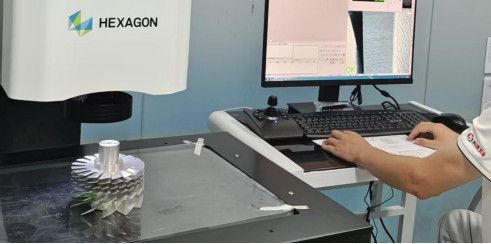
With the widespread application of micro-impellers in precision fields such as drones and micro-turbochargers, their small dimensions, complex curved profiles, and extreme design precision standards pose more resolution and measurement capability demands on inspection technologies. Based on its non-contact, high-precision, and efficient nature, digital image measurement systems are becoming increasingly the mainstream choice for micro-impeller quality inspection. Nevertheless, pushing the resolution and accuracy of such systems at the micro level remains extremely demanding.
Challenges and Demands in Micro-Impe ller Inspection
As central elements in the majority of precision mechanical products, micro-impellers are generally small with blade heights ranging from a few millimeters or even smaller, and surfaces commonly being very sophisticated curved surfaces. Traditional contact measurement instruments struggle to get high-precision measurement data efficiently because of probe radius limitation and the effect of contact force on delicate parts. Digital image measurement systems have gradually become the standard method of micro-impeller inspection, capitalizing on their non-contact, high-speed imaging, and high precision. In practice applications, however, due to the complicated and curved surface of impellers, traditional digital image systems are still faced with problems such as misty imaging, mistaken boundary location, and heap-up of measurement errors. Accordingly, increasing the resolution and precision of these systems has been a major challenge for the industry.
Optimization Paths for Imaging Hardware
In micro-impeller inspection, image hardware, as the most critical front-end interface of the entire measurement and analysis process, plays a direct role in determining the quality of image data and measurement accuracy. Therefore, entire optimization of image hardware needs to be adopted on three aspects: optics, sensing, and illumination, which lays a solid foundation for subsequent feature identification and error analysis.
High-Magnification Low-Distortion Optical Lenses
To achieve fine and realistic geometric features of micro-impellers, high-precision measurement industrial-grade telecentric lenses and high numerical aperture optical components specifically designed for measurement should be selected first. These lenses can effectively eliminate edge blur and imaging distortion, with constant scaling and boundary sharpness of all measurement points in the image. Furthermore, low-chromatic aberration and low-distortion structures can avoid geometric distortion of images caused by optical errors, providing a certain warranty for the extraction of small features and image boundary recognition. Not only can this make boundary sharpening and contrast of images improved, but it also provides more precise optical input for subsequent measurement and analysis.
High-Pixel, High-Dynamic Range Cameras
Cameras are fundamental elements in imaging devices for grabbing detail and luminance ranges. Choosing industrial CMOS cameras with high resolutions and a pixel number of 50 million or more can greatly enhance the clarity of imaging in micro-impeller boundaries, channels, and curvature transitions to enhance the integrity of feature extraction and the accuracy of measurements. In addition, HDR capable cameras can effectively enhance the brightness range without loss of information due to local over- or under-exposure, keep different reflection intensities and detail textures in every frame of the image completely intact, and provide sufficient and high-quality input for data analysis.
High-Brightness, Uniform Lighting Systems
To avoid measurement errors caused by complex curved surface and reflection characteristics, lighting design must be homogeneous in brightness, angle variable, and stable and controllable. By the use of a mixture of adjustable ring light sources, coaxial illumination, and big-area diffused surface light sources, reflections and shadows on the surface of the impeller can be reduced, and (recognizability) of boundary contours and details can be improved. Flexible adjustment of illumination angle and intensity ensures light can freely enter narrow grooves and curved grooves to take images with clear edges and full textures, laying a good foundation for micron-level measurement and flaw detection.
Enhancement of Image Processing and Measurement Algorithms
To achieve the imaging performance of equipment, advanced image processing and measurement algorithms must be utilized to ensure more precise and efficient retrieval of the significant dimensions and geometric parameters of micro-impellers. This association not only includes boundary recognition accuracy improvement but also involves noise removal and 3D data integration, offering a solid technical foundation for subsequent measurement and analysis.
Subpixel Boundary Recognition Algorithms
Boundary extraction is the most critical operation in digital image measurement and directly influences impeller measurement accuracy and reproducibility. Traditional pixel-level boundary detection methods suffer from boundary position inaccuracies resulting from limited spatial resolution. Use of subpixel-level interpolation algorithms and edge enhancement technology (Sobel enhancement and Canny edge detection) can accurately represent discrete pixel boundaries in smooth curves, resulting in high boundary recognition accuracy. This is particularly critical for measurement of micro-impeller blade leading edges, trailing edges, and fillet transitions, and can reduce the impact of boundary sawtoothing and false boundaries and provide reliable data to facilitate accurate dimension analysis.
Noise Filtering and Feature Enhancement
Micro-impeller surfaces are oftentimes plagued by (trace) scratches, reflections, and imaging noise that reduce the efficiency and credibility of measurement data. Therefore, before boundary extraction, high-order filtering techniques (such as bilateral filtering and wavelet filtering) are needed to denoise the original image, inhibiting the disturbance of irrelevant textures during boundary detection. Sharpening processes are mixed in the process of denoising to improve boundary attributes and texture information, increasing image contrast and feature recognizability. Through this progression of preprocessing steps, maximum imaging conditions can be set to provide boundary and feature extraction, allowing more accurate and complete measurement inputs.
Automatic Stitching and 3D Reconstruction
Full information for 3D complex curved surfaces such as various spatial angles and boundary details of micro-impellers is difficult to obtain using single-view imaging. Automatic 3D point cloud reconstruction algorithms and automatic stitching are therefore used to stitch together and combine image data from different viewpoints to get whole and high-accuracy 3D models. This process can completely demonstrate impeller surface data, facilitating complete visualization and measurement data support for critical features such as cross-sectional dimensions, curvature radii, and boundary changes, not only expanding the measuring range but also significantly reducing viewpoint-limited measurement blind spots, establishing a solid digital model foundation for subsequent accurate measurement and error calculation.
Optimization of Measurement Environment and Process
To ensure the precision, repeatability, and stability of measurement data, for high-precision measurement of micro-impellers, specification of measurement process and environment is critical control to ensure the precision, repeatability, and stability of measurement data. Through the improvement of environmental conditions, automation measurement, and calibration process, not only can external disturbance affect on measurement results be reduced, but also productivity and inspection efficiency can be improved, and mass production instruments with long-term stable quality control can be offered.
Vibration and Temperature Control
When measuring micro-impellers, the slightest vibration or change in temperature may affect measuring data. There is a need to establish a stable measurement environment. The external interference may be controlled through the application of high-precision vibration isolation platforms and constant temperature and humidity conditions to ensure that measurement instruments and samples are run under stable conditions.
Automated Measurement and Calibration
Standardization and standardization of the measuring process may be achieved by calibrating the measurement system with automatic tooling fixtures and periodic calibration standards. Human mistakes can also be reduced. Besides that, the automation control system can speed up the inspection process, increase efficiency, and ensure the high-precision requirements in mass production.
Application Effects and Prospects
Through image processing algorithm optimization and imaging equipment, the digital image measurement system has improved significantly in resolution and accuracy for micro-impeller inspection. This provides reliable technical aid for micro-impeller quality control and precision in manufacturing and offers feasible solutions to mass production online inspection. In the future, as artificial intelligence and machine vision technologies continue to evolve, measurement systems will also develop towards greater intelligence and automation, improving not only measurement accuracy but also achieving more efficient and smarter quality control. With continuous advancements in technology, we can be sure that micro-impeller and other micro-structured parts inspection will achieve more accurate and efficient quality assurance.
Conclusion
Digital image measurement technology systems are increasingly an accessible method to improve the resolution and accuracy of micro-impeller inspection through systematic hardware optimization, algorithm refinement, and environmental control. It not only provides effective assurance of micro-impeller quality control and manufacturing accuracy improvement but also offers valuable references for measuring technologies of more advanced micro-structured parts in the future. In light of the continuous evolution and advancement of technology, we are confident that digital image measurement systems will be used more broadly within the industry of micro-fluid machinery production and the business of technological innovation promotion and precision manufacturing improvement.


