
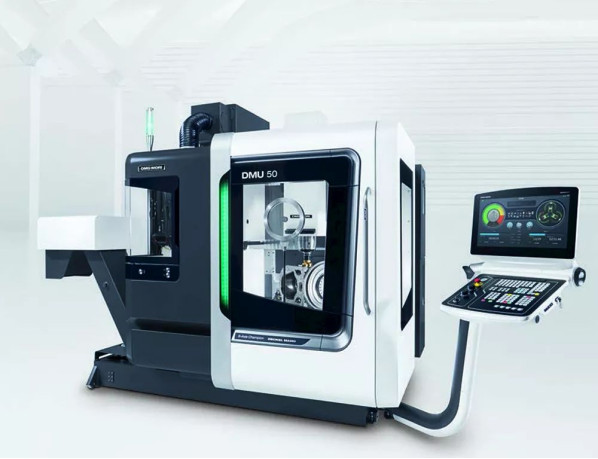
With the increasing need for high-performance fluid machinery components in aerospace, energy power equipment, and chemical equipment industries, the precision machining of impeller parts has been among the strongest aspects of the manufacturing industry. The complexity in structure of impellers makes traditional machining methods unable to catch up with their high-precision requirement, especially in machining 3D free-form surfaces and complex contours. The five-axis machining centers of the DMU series manufactured by DMG MORI, Germany, have been the first option in high-precision impeller machining due to their excellent structural design and control system dominance.
Introduction
Impellers are primary components in major equipment, spread widely in aero-engines, power generation in energy, chemical pumps, etc. Due to the 3D free-form surfaces, complicated geometries, and large changes of curvature of impellers, machining processes for them have very high demands on machine tools. Traditional three-axis or four-axis machining centers are not able to meet the machining needs of these high-precision and complicated shapes. German DMU series five-axis machining centers have now become the principal equipment to solve the technical issues in machining complex impellers, owing to their advanced hardware structure and precise control system. The application of DMU five-axis machining centers in machining impellers is deeply elaborated in this paper and how their excellent technical benefits take a significant role in high-precision manufacture.
Structural and Performance Advantages of DMU Five-Axis Machining Centers
The high-performance five-axis machining centers DMU series made in Germany by DMG MORI are superior in machining sophisticated surface components of great precision due to their integrated and modular structural design. Specifically, in the high-difficulty machining process of impeller components, standard models such as DMU 65 monoBLOCK, DMU 75 FD duoBLOCK, and DMU 210 P are extensively used in aerospace, energy equipment manufacture, and high-level mechanical production. Their key strengths are as follows:
High Dynamic Rigidity and Stable Structure
The DMU series fully employs roller guides and large-diameter pre-tensioned ball screws, together with a combined cast bed structure, significantly enhancing overall rigidity of the machine. It still possesses low vibration and stable cutting in high-speed and high-feed machining conditions, significantly strengthening the control performance of form and position accuracy in complex surface and hard material machining.
High-Precision Direct-Drive Rotation Axis System
The swing head drive and the chief rotation axis are both utilizing torque motor direct drive to achieve sub-arcsecond-level resolution and repeat positioning accuracy, which allows continuous and smooth adjustment of tool axis posture. It is particularly suitable for five-axis linkage machining of continuous multi-curvature surfaces of impeller blades, which can effectively avoid tool joint marks and trajectory jumps caused by sudden angle change and improve surface quality.
Thermal Symmetry Structure and Active Thermal Compensation Function
Structural design is especially concerned with thermal symmetry in DMU models: spindle box, Z-axis support, and rotary shaft components are positioned symmetrically to reduce thermal stress deformation during the process of machining. The machine tool, in turn, is equipped with thermal sensors and software thermal compensation algorithms that can independently correct position and angle deviation, greatly improving the stability of machining dimensions under thermal conditions.
High-Performance Intelligent Control System
The DMU series are typically equipped with Heidenhain iTNC 640 or Siemens Sinumerik 840D sl control systems, with capabilities such as five-axis linkage optimization, multi-axis synchronous interpolation, dynamic error compensation, and look-ahead path control. Especially in high-speed small-segment interpolation, it can guarantee path smoothness and dynamic stability, thereby greatly enhancing the efficiency and quality of complex surface milling.
Technical Requirements for High-Precision Impeller Machining
Being the typical complicated free-form surface structural components, impeller configuration has direct impact on the aerodynamic or hydrodynamic performance of the entire machine, and the precision in machining will determine the equipment’s running efficiency and life. Due to their extremely intricate structure properties, traditional three-axis or four-axis machining tools are difficult (compete) in path accessibility, posture continuity of machining, and contour accuracy, therefore five-axis linkage machining technology is the sole approach that is feasible to achieve high-quality machining. High-precision machining of impellers is mainly faced with the following technical requirements:
High Contour Precision Control
To ensure the geometrical coherence between the theoretical design and the impeller blades, the machining contour accuracy should be controlled to ±0.01 mm. Especially for the middle and near-root areas of the blades, due to large changes in curvature, the CAM system has to provide high-resolution tool position interpolation and tool posture control capabilities.
Extremely Low Surface Roughness
The impeller surface is directly engaged in the fluid medium energy transfer, and the surface roughness needs to be controlled within Ra 0.8 μm or even less in order to keep flow resistance and friction loss as low as possible. In this direction, the machining process needs to ensure a correct balance between cutting parameters, tool path strategies, and machine tool dynamic performance.
Assurance of Posture Angle Continuity
The impeller blade surface is a complex 3D curved surface, and the tool should be able to withstand sequential changes in posture angle during the course of motion without abruptly turning or mutation zones to avoid formation of tool marks, erosion of surface integrity, or even machining instability.
Adaptability to Complex Flow Channels and Curved Root Shapes
The space between blades of an impeller at the root is extremely minute, having reverse curvature modifications, and the challenge shifts to tool geometry and path availability. Five-axis machining centers rectify spatial angles with rotary axes, which enable the tool to be in the most favorable possible contacting conditions in any direction and to assume extreme geometric constructions efficiently.
Balancing Material Adaptability and Machining Efficiency
High-performance impellers are usually processed with hard-to-machine materials such as titanium alloys and nickel-based superalloys, thus equipment must have strong spindle power, high-rigidity structure, and adequate thermal stability. Simultaneously, by implementing best toolpaths under multi-axis linkage, roughing and finishing paths are combined to maximize overall machining efficiency.
Application Cases of DMU Five-Axis Machining Centers in Impeller Machining
During an impeller precision machining operation of an aircraft firm, the DMU 75 monoBLOCK five-axis machining center demonstrated its world-class machining capability. The operation utilized a Siemens 840D sl control and in combination with HyperMill toolpath programming completed the entire machining of a nickel alloy-based aero-engine impeller.
Key Process Steps:
- Roughing Stage: Three-axis roughing with a large spiral angle end mill to remove large allowances and lay the foundation for subsequent finishing.
- Transition Zone Pretreatment: Adopting a five-axis contour milling strategy to precisely clean residual materials in curved areas and maintain uniform wall thickness.
- Free-Form Surface Finishing: Using a ball-end mill combined with RTCP (Real-Time Tool Center Point) control for 3D surface finishing, with errors controlled within ±5μm.
- Root Area Optimization: Through the collaborative rotation of the swing head and turntable, the tool axis is always perpendicular to the root contour, further improving surface quality.
Finally, the test results showed that with the application of the DMU five-axis machining center in this project, the surface quality, cutting cycle, and precision of the impeller products were all in line with technical standards. Compared with traditional equipment, the efficiency was increased by approximately 35%, and the rate of scrap was reduced by 80%.
Integration Advantages of DMU Platform and Intelligent Manufacturing
DMU series five-axis machining centers are equipped not only with hardware advantages but with high integration of digitization and smart manufacturing as well. They can directly connect with various CAD/CAM software (e.g., NX, HyperMill, etc.), provide online simulation and path verification, and detect toolpath jumps and interference risks in advance.
In addition, DMU series machine tools have good integration capability and can be combined with automatic tool changing system, part recognition system, and MES system to achieve highly automated and intelligent production. Remote diagnosis functions of CELOS platform and MATRIS industrial IoT interface enable users to track machining status in real-time and perform predictive maintenance, further improving equipment utilization rate and productivity.
Conclusion
German DMU five-axis machining centers are becoming primary equipment in the high-precision impeller machining sector due to their excellent structural design, sophisticated control technology, and high degree of system integration ability. Equipped with high-precision and high-efficiency machining performance, the DMU platform can meet complex surface, multi-axis coupling, and high surface quality needs of impeller machining and provide excellent support for precision manufacturing in aerospace, energy power, and other fields. As digital factories and intelligent manufacturing keep advancing, the DMU series will play an even more important role in future impeller manufacturing, pushing China’s precision manufacturing to a new height.


