
Impeller parts impose extremely demanding requirements on tool types, geometry parameters, and machining performance since they have complex free-form surfaces, limited machining space, high material performance, and stringent precision needs. Scientifically selecting proper types of tools for each machining stage is the solution to ensuring the machining quality and efficiency.
Introduction
Impellers in integral form, as they are critical rotating components in aero-engines, steam turbines, turbo compressors, etc., find extensive application in aerospace, energy, automotive, wind power, and other industries. The parts are typically machined from difficult-to-machine materials like titanium alloys, precipitation-hardened stainless steels, and superalloys with complex structural features of thin-walled structures, large overhangs, and narrow flow passages. Not only is the machining process technically complex, but tool performance, life, and machining stability are also put under stringent demands. As five-axis CNC technology and CAD/CAM programming methods are enhanced, tool structural innovation and process compatibility have also emerged as most essential factors in improving impeller machining quality. Therefore, systematic research on the types and natures of normal tools used in each stage of impeller machining processes holds great engineering value with regard to enhancing manufacturing efficiency and quality of machining.
Process Characteristics of Impeller Machining and Tool Selection Requirements
The geometric structure and material properties of impellers directly decide their machining process paths and tool structure conditions. Their shared process features are:
- Complex free-form surfaces: Radical changes of curvature on blade surfaces place severe requirements on tool surface following capability and cutting path management;
- Limited machining space: Overcrowded multiple blades and narrow flow channels require tools to be interference-free and follow small spatial curve radii in machining;
- High machinability difficulty of materials: Widely applied materials such as Inconel and titanium alloys with high strength contain high hardness and low heat conductivity, which place highly rigorous requirements on the tool’s thermal stability and wear resistance;
- Multi-axis machining needs: The common use of five-axis or multi-axis machines, which require good angle flexibility and cutting stability for the tools.
Therefore, tool hardness, chip removal capability, thermal wear resistance, and machining flexibility should be optimized in tool design. Reasonably selecting tool types and parameter values according to the different jobs of roughing, semi-finishing, and finishing operations is the foundation for improvement of machining efficiency and quality of the workpiece.
Analysis of Typical Tool Types and Applications
Ball End Mill
Ball end mills have excellent surface following ability due to their hemispherical tool tips and are therefore ideally suited in machining of complex surfaces in 3D contour machining. They are used in impeller semi-finishing and finishing in root cleaning at blade surfaces and junctions of curved surfaces.
Advantages are consistent cutting trajectories and minimum surface roughness, favorable to five-axis machining with multi-curvature transition. But because of the low cutting linear speed at the cutting tool tip, evacuation of the chip is difficult and efficiency in machining is poor for machining large areas, and methods such as high-speed spindles or spiral tracks must be used to increase efficiency.
Barrel Cutter
Drum cutters or barrel cutters have non-cylindrical cutting faces in the shape of drum faces or cone-drum composite faces having longer contact arc lengths, which are best suited to finish broad surfaces effectively.
Compared to ball end mills with traditional milling operations, barrel cutters can provide greater step pitches at the same degree of contour accuracy, thus reducing machining time significantly. Barrel cutters are widely utilized in integral impeller finishing process, especially functioning outstandingly in high-speed blade back and free surface milling.
However, the tool path planning of this type of tool is complex and relies significantly on CAM software programming methods and five-axis machine tool linkage stability.
Taper Ball End Mill
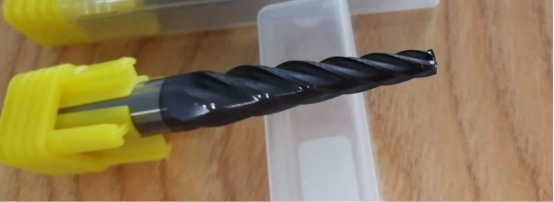
Taper ball end mills combine the high rigidity of the tapered tool shank and the profiling ability of ball ends, suitable for deep cavity cutting in long overhang and narrow space. With high rigidity and good anti-vibration properties, they are widely used for finishing impeller blade roots, hub junctions, and bottom of deep grooves.
High-performance taper ball mills such as Xiamen Golden 鹭 STB200 series and SILMAX high-precision product suppress tool vibration effectively and improve machining surface quality and tool life through special edge design and unequal pitch distribution technology.
Disc & Chamfer Mills
Mainly used for chamfer and trimming cutting of intersection edges between blade roots and impeller hubs, the tools are characterized by high structural rigidity and the majority of multi-edges, which are very suitable for batch cutting with high consistency.
In actual machining, linkage methods are mainly used for ensuring precise forming with stringent requirements on tool forming precision and cutting stability. Suitable for aviation and energy impeller products with high assembly precision requirements and balance requirements for rotors.
Tool Material and Coating Selection for Different Material Impellers
Impeller machining not only calls for complicated tool structures but also selecting proper base materials and coating processes for different materials. For example:
- Titanium alloys: Low thermal conductivity and poor tool adhesion require high-toughness + high-hardness tools. Micro-grain cemented carbide substrates with TiAlN and AlCrN coatings are recommended to be applied because they can avoid built-up edge formation and improve heat resistance and tool life;
- Superalloys (e.g., Inconel): Heavy cutting force and prone to wear, employing tapered tools with chip-breaking geometries, special bottom edge grooves, and arc structures is advisable to enhance the chip accommodation;
- Precipitation-hardened stainless steels: Hardened surface and susceptible to burning, tool materials with high thermal shock resistance should be utilized, along with high-pressure cooling or minimum quantity lubrication (MQL) technology.
Secondly, the use of fairly good internal cooling channel tools, spray cooling, or mist lubrication helps with thermal deformation control and tool life increase.
Tool Selection and Path Strategy Optimization Recommendations
| Machining Stage | Recommended Tools | Machining Objectives | Programming Strategies |
| Roughing | Wave-edge end mills, flat mills | Efficient material removal | Zoning slot cutting, three-stage cutting, avoiding interference |
| Semi-finishing | Ball end mills, taper mills | Pre-forming of curved surfaces | Improved path spacing, equal cutting depth path control |
| Finishing | Barrel cutters, taper ball mills | Achieving surface finish and contour accuracy | Dynamic milling + equal residual machining, optimized tool entry/exit |
Particularly in severe impeller flow channel rough machining with large allowances,(drastic) depth variation, and complex tool forces, using high-helix wave-edge tools in combination with a three-stage machining process; while at the finishing process, barrel cutters and high-precision taper ball mills are used to achieve the surface quality target in single-pass cutting, precluding the time consumed in subsequent grinding and trimming.
Conclusion
With continuous innovation of integral impeller machining technology, tools as fundamental components in direct contact with part surfaces are constantly promoting the dual improvement of machining efficiency and quality by structural innovation, material innovation, and coating improvement. In combination with the intelligence of CAM programming and high stability of five-axis machine tool control, modern tools are developing toward multi-functional compounding, application modularization, and intelligent use. In the future, with the building of tool databases concerning some materials and geometric properties and online life prediction and monitoring, digital and intelligent processing levels will play a bigger role.
In the whole processing process, tool selection is not only a means of material removal but also a guarantee for the achievement of high-performance impeller product precision manufacturing.


