
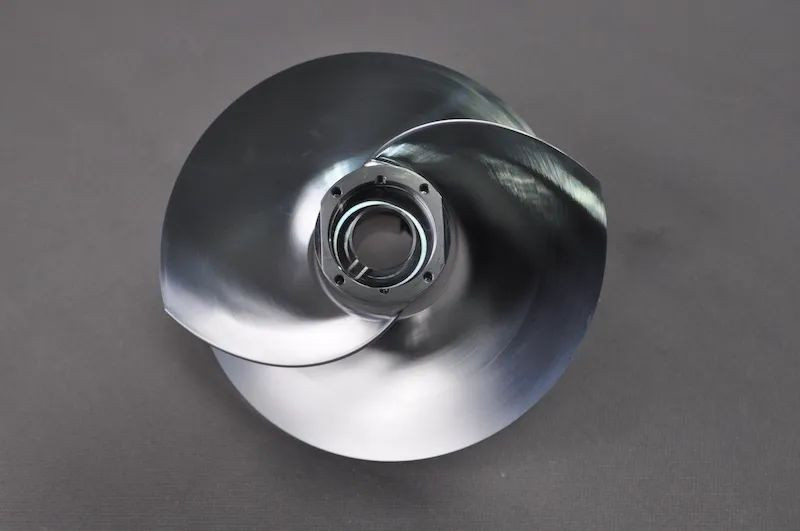
Being a core rotating component of aero-engines, the aviation impeller has a complex structure and operates in harsh environments, which determines the demand and technical difficulty for its performance detection. With the requirement for quality and reliability of aviation manufacturing continually improving, the traditional detection methods relying on experience and vision cannot meet the high-end impeller production quality assurance requirements.
Introduction
The superior guarantee of high performance and reliability of aero-engines cannot be distinguished from that of the central component—the superior guarantee of performance of the aviation impeller. The impeller not only has crucial functions in compressing air and promoting gas flow but also needs to withstand long-term harsh working conditions such as high temperature, high pressure, and high speed. Therefore, it erects extremely high technical requirements on its geometric shape, material structure, dynamic stability, and surface state.
In one assembly project of an aero-engine that I even performed myself, we felt deeply that a mistake in the quality control of an impeller might cause aerodynamic instability or abnormal vibration of the whole machine test, and thereby affect the whole machine’s service life and safety performance. This enhances my awareness of the importance that quantitative performance detection technology is not only within the field of quality control but also the “nerve center” for constructing a reliable power system. With intelligent, digital, and multi-physical-field integral detection equipment now, the detection capacity of aviation impellers is evolving from “qualified judgment” to “performance prediction”, establishing a full-cycle quality guarantee system from production to service.
Main Dimensions of Quantitative Performance Detection for Aviation Impellers
Aviation impeller performance detection technology is not confined to qualification verification of geometric shape but includes multi-dimensional system evaluation from structure to performance and from material to function, particularly including the following:
- Geometric accuracy detection: Parameters such as contour error, chord length, blade profile angle, leading and trailing edge position, maximum thickness, etc., are the basis for evaluating impeller forming accuracy and aerodynamic performance;
- Material performance evaluation: Including grain size, structural uniformity, inclusions, precipitated phases, and hardness and strength performance after heat treatment;
- Surface integrity detection: Roughness, residual stress, shot peening layer thickness, micro-cracks, etc., directly affect fatigue life;
- Dynamic performance testing: Involving dynamic balance error, critical speed, vibration response, etc., which are the core to ensure high-speed operation safety;
- Aerodynamic performance verification: Through wind tunnel tests or CFD simulation, it is ensured that the design of the impeller can achieve the desired aerodynamic efficiency under actual working conditions.
These indices are not independent, but they interact with each other in the process of evolution in the impeller performance. For example, dynamic balance drift can result from abnormal surface residual stress, and coarse grains influence high-temperature creep life. Therefore, quantitative detection technology must be very accurate, multi-dimensional, and data-oriented.
Analysis of Key Detection Technical Methods
As the primary component of aero-engines with high-heat, high-pressure, and high-speed rotating loads, the manufactured quality of impellers has a direct impact on the safety and life of the overall machine operation. Given the real conditions of manufacture, only depending on traditional coordinate measuring machines and manual methods cannot catch up with the demands for intricate surface structures, micron-level precision, and multi-field-performance control. Therefore, it is necessary to establish a multidimensional detection system from geometric precision to material structure, from surface condition to dynamic behavior. The following will discuss from five crucial dimensions, reasonably classifying the main detection technology directions relied on in the new aviation impeller production and verification process.
Four-axis (Linkage) Adaptive Scanning and 3D Digital Modeling
Compared with traditional contact coordinate measuring machines, the four-axis linkage intelligent scanning system possesses larger spatial degrees of freedom and data acquisition efficiency, especially being compatible with impeller structures with complex shapes and (drastic) changes on the surface. With the multi-axis cooperative scanning and rotatable turntable. It can. It can achieve (blind angle)-free gathering at the blade tip, leading edge, blade root transition region. And hub (runout) parts. The technology has adaptive path planning function, able to real-time optimize the scanning path to meet the changing target surface, thus greatly improving the modeling integrity and spatial precision.
In a high-pressure compressor impeller design project that I managed, PowerBlade analysis software was used to perform surface reconstruction and error calculation on the point cloud data we had acquired. The system offers more than 30 structural parameters like chord length, torsion angle, thickness distribution, and blade profile coordinates. With comparison against design CAD model, the error is kept within ±0.02 mm, which hugely improves geometric consistency and traceability and enables batch consistent production of impellers.
Material Structure and Non-destructive Testing
Intrinsic material quality is the basis for ensuring the evaluation of fatigue strength and long-term serviceability reliability of impellers. Especially against the backdrop of the extended and ongoing application of core materials such as nickel-based superalloys and titanium alloys, there is a need to comprehensively evaluate their grain structure, phase structure, and internal defects by various methods.
- Metallographic microscopic inspection is typically used to verify the heat treatment effect, assess the recrystallization behavior and precipitated phase distribution;
- Industrial X-ray and CT non-destructive testing technology can achieve the detection of internal flaws in the whole volume of integrally cast impellers and find hidden flaws such as air holes, inclusions, and looseness;
- Multi-frequency eddy current technology can not only detect defects at different depths but also suppress the edge effect through the superposition of excitation frequencies, which is especially suitable for thin-walled blades and blade root structures;
- In addition, embedded sensor signal detection technology has achieved wider applications in in-service monitoring systems as well. By detecting sensing signals from embedded MEMS or fiber optic sensors, it provides real-time monitoring on the service condition of the impeller, which is one of the prominent trends in intelligent aviation component innovation.
Surface Integrity and Fatigue Performance Evaluation
Aviation impellers need to withstand long term high-frequency and high-amplitude alternate loads, and surface integrity has been the most significant factor in controlling fatigue life. In particular, control of roughness, residual stress, and micro-crack status will have a direct effect on aerodynamic efficiency and the probability of crack initiation.
- Using a roughness tester to measure Ra/Rz parameters so that the machining surface roughness is below 0.4 μm can greatly reduce airflow disturbance and thermal stress concentration;
- X-ray diffraction (XRD) measurement of residual compressive stress distribution can verify the effect of shot peening or sand blasting strengthening treatment;
- Electromagnetic eddy current testing is an important means to quickly detect micro-cracks, surface peeling, or coating (peeling), which can realize automated rapid screening in batch factory inspection;
- In thermally concentrated load areas such as the sealing area of the tip blade and rim of the transition section, the aforementioned methods should be combined for cross-verification to improve surface strength reliability.
Dynamic Response and High-speed Operation Testing
In the actual service, the impeller must rotate at tens of thousands of revolutions, and its dynamic balance state, resonance frequency, and temperature rise vibration response must be exactly verified in advance. Some popular test technologies are as follows:
- Dynamic balance testers (single-sided/double-sided) can be set to modify the unbalance amount to enhance operating stability;
- The combination of laser speed measurement and three-way acceleration sensors can real-time capture modal frequency, response amplitude, and resonance points;
- Simulation of the loading of the impeller structure at the (predetermined) temperature and speed using a high-speed rotation simulation platform is an essential step in testing the dynamic adaptability of the final product before conducting the whole machine test
- On turbofan engine transition section impeller test, I accurately calculated the potential resonance modal frequency range through excitation test and temperature rise collection, and promoted the subsequent structure strengthening and vibration prevention design, and effectively avoided the danger of actual machine vibration cracking.
Aerodynamic Performance Verification and Flow Field Feedback Analysis
As the core flow component, the aerodynamic performance of the impeller must be examined through simulation and real-measurement channels. Geometry precision itself cannot ensure the overall performance requirement, and it must be found through geometric-performance mapping relationship through multi-dimensional methods such as CFD simulation, wind tunnel test, and air film pressure measurement.
- Using a CFD simulation program (e.g., Ansys Fluent), one may simulate the flow field from the experimentally measured 3D model and predict the velocity gradient, pressure field, and vortex pattern;
- The placement of pressure holes or PIV velocity sensors in low-speed or high-speed wind tunnels to conduct quantitative analysis of flow properties is a critical procedure for model design and aerodynamic optimization;
- Design of cooling structures, based on experiments for measuring the air film pressure, can accurately evaluate the coverage rate of air film and flow uniformity, define the spray hole design and their distribution, and improve the overall thermal protective capability.
Engineering Example: Turbine Impeller Detection Closed-loop Process
In the process of quality control of a specific turbine impeller on which I worked, the following closed-loop scheme was pursued:
- First stage of inspection: CT detection for cast defect removal;
- Middle stage of inspection: Coordinate measurement of blade shape size and wheel disc position;
- Fine inspection stage: Laser scanning + CAD comparison error map generation;
- Dynamic balance adjustment: Double-sided dynamic balance tester adjusted to <0.5 g·mm;
- Surface detection: Ra controlled within 0.4μm, residual compressive stress value remains stable;
- Rotation experiment: Operate at the target speed for 1 hour, record vibration and temperature rise curves;
- Aerodynamic test: Test efficiency deviation <2% in the wind tunnel, and release after passing the standard.
The entire process forms a closed loop of “design-detection-feedback-optimization”, significantly improving product consistency and operation stability.
Conclusion
As the “heart blade” of aero-engines, aviation impeller quality inspection and performance warranty should urgently depend on the support of an accurate, rational, and wise quantitative detection system. On the basis of systematic exploration of mainstream and frontline detection technology nowadays, this paper demonstrates the trend of aviation impeller detection development from geometric inspection to overall performance prediction, from static measurement to dynamic perception, and from manual decision to intelligent judgment.


