
With the continued improvement in geometric accuracy and performance stability needs of impellers in principal parts such as aero-engines, high-efficient compressors, and power equipment, inspection of complex surface parts has become the gist of manufacturing quality control. Being a global leader in metrology solutions, Hexagon established a rigorous measurement system for all flow channel parameters, leading edges, blades, etc., based on its accuracy Leitz coordinate measuring machines, multi-sensor integrated probe technology, and QUINDOS smart measurement software.
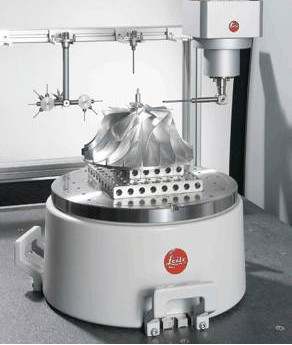
Precision: The Bridge Between Manufacturing and Performance
Advanced impellers, as a fundamental component of central machinery such as aero-engines, gas turbines, and hydraulic pumps, possess three-dimensional surfaces with high freedom, asymmetric torsional deflection, and extremely small geometric tolerances. Dimensions such as blade thickness, contour tolerance, leading edge curvature, and flow channel area are of vital importance in aerodynamic efficiency and operational stability. These deviations not only impair the overall efficiency of the machine but can also lead to assembly interference, dynamic imbalance, or even structural fatigue. Conventional methods of contact measurement have found it difficult to satisfy the twin demands of accuracy and efficiency when dealing with highly twisted and thin complex geometries.
In these situations, I have applied Hexagon metrology systems in a number of practical impeller mass production projects, achieving the transformation from single measurement to intelligent high-dimensional data fusion through means of multi-sensor coordination, high-speed path calculation, six-dimensional error fitting, and multi-threaded data processing. Especially in the situations of multi-model mixed-line production and rapid delivery, Hexagon systems have demonstrated excellent flexibility and reliability and emerged as the “precision hub” in the precision manufacturing chain.
The Essence of Challenges in Complex Impeller Measurement
In fields such as aero-engines, impeller measurement is far more than simple 3D coordinate acquisition, involving overall challenges in precision, efficiency, and automation, etc. Therefore, we must investigate deeply into the nature of these challenges from three perspectives: geometric features, precision standards, and manufacturing processes.
Complex Geometric Structure with Significant Nonlinear Changes
Impeller blades are typical spatial free-form surfaces with continuous and sudden changes in the radial, spanwise, and chordwise directions of cross-section with complex 3D streamline shapes. In measurement, planning of probe path needs to fully consider the transition of curvature and potential interference between the blade pressure surface and suction surface so as not to damage probes or miss measurement points due to improper probe entry/exit directions. This spatial geometric complexity also adds to the complexity of measurement coordinate system calibration and compensation algorithm design.
Measurement Precision Reaching the Micron Level
Impeller measurement accuracy is extremely critical, especially for aerodynamic curves of blades and dovetail root positioning dimensions, with tolerance levels traditionally kept at ±5 μm. This mandates that the measurement process be immune to the influence of machine tool thermal drift, probe ball diameter error, coordinate error, etc. To ensure controllable measurement repeatability and linearity error, high-accuracy coordinate measuring equipment and specialized probes must be utilized, together with temperature compensation and calibration procedures to ensure stable and consistent data.
High Requirements for Process Integration and Automation
Today’s aviation manufacturing is heading towards intelligence and automation, meaning deep integration of the measuring process into the production process. It not only needs to attain automatic measurement program generation and execution but must also exchange measurement information with processing equipment to create a closed-loop back of precision manufacturing. This suggests that the measurement system must have the capabilities of smooth docking with CAM/CAD, rapid speed automatic positioning and invocation of programs, and real-time transmission between measurement data and machine tool parameters in order to reduce man in the loop and maximize production rhythm.
Environmental Impact and Measurement Stability
In actual production environments, temperature fluctuation, cutting fluid spray, and vibration are all feasible factors of influence on measurement accuracy and stability. Therefore, measurement equipment must have excellent environmental adaptability, such as adopting active vibration suppression design, enhancing probe airtightness, optimizing instrument thermal stabilization design, etc., to reduce the external environment interference to measurement data and ensure the consistency between measurement data and actual conditions.
Data Consistency and Traceability in Mass Measurement Tasks
With rising production batches, maintaining the comparability and consistency of mass impeller measuring data has also become a significant challenge. This requires not only the standardization of measuring programs and normalizing the arranging of measuring points but also the establishment of a complete measurement database and traceability system in order to provide effective support for follow-up analysis and quality statistics.
Multi-Dimensional Measurement Technology Solutions of Hexagon Systems
Meeting the entire need for precision, efficiency, and intelligence in complex impeller measurement, Hexagon has introduced the entire series of measurement solutions starting from hardware to software, providing users with the end-to-end process support beginning from measurement planning to data acquisition and result analysis.
Hardware Foundation: High-Precision CMM Platform and Intelligent Sensors
Hexagon’s Leitz PMM-C 12.10.7 series CMMs utilize granite bases with high stability and laser interferometer grating scales, with a resolution of up to 0.02 μm along the axis, fully ensuring structural rigidity and geometry of large-size impellers. Thanks to the collaborative operation of the HP-O laser interferometer probe and Precitec LR white-light confocal probe, not only does it allow for non-contact high-accuracy scanning of complex blade edges but also avoids elastic deformation and force displacement of traditional contact probes during high-speed scanning, thereby significantly improving data acquisition stability.
Software Core: QUINDOS Intelligent Measurement Platform
QUINDOS 7 software supports easy configuration of multi-degree-of-freedom spatial coordinate systems and, with the built-in Impeller module, automatically generates measurement paths, tunes workpiece posture, and optimizes turntable angle for complex curve structures such as blades, flow channels, and leading edges. The variable-speed scanning algorithm VHSS is able to dynamically control the probe scanning speed in accordance with curvature, and “return scanning technology” ensures that the probe can automatically correct the trace in case of abnormal offset, truly achieving “non-stop measurement”.
It should be pointed out that by using a six-degree-of-freedom spatial optimal fitting algorithm, QUINDOS can fit the minimum deviation surface between the theoretical airfoil and measurement points to precision, greatly improving the accuracy of contour tolerance and thickness check. In a practical impeller measurement project, I used its one-click CAD programming feature to shorten the original path planning with more than 2 hours to 20 minutes, greatly improving efficiency and operation stability.
Full-Dimension Data Processing and Evaluation Capability
After measurement, the system will automatically output more than 30 crucial parameters (e.g., leading edge thickness, bend angle, pitch deviation, etc.) and mark error locations by applying graphical color distribution maps to achieve rapid detection of abnormal data and process adjustment. Conversely, QUINDOS offers multi-thread parallel processing, and the master thread handles data while the assistant thread simultaneously completes error calculation and report output, offering high-performance closed loop measurement-analysis-feedback.
Key Measures and Experience Summary for Precision Control
To ensure the accuracy and replicability of the measurement process of complex impellers, measures must be implemented in an all-round manner in the measurement environment, probe calibration, data-driven optimization, etc., representing a complete control chain involving hardware, software, and management, along with high-precision measurement equipment and software algorithms.
Environmental Control and Clamping Stability Assurance
High-precision measurement needs to be done in conditions of constant temperature (20±0.5℃) and the measurement platform should have good vibration resistance and temperature compensation performance. During actual use, it is recommended that a combination of special impeller fixtures and rotation platforms be used to enhance the relative position between the probe and workpiece and lower measurement deviation caused by thermal expansion/contraction and clamping error.
Probe Compensation and Periodic Calibration Mechanism
QUINDOS allows for periodical automatic calibration of the probe system and on-line compensation as a function of the state of stress of the scanning path, correcting the small errors due to elastic deformation of the probe rod to improve the repeatability of repetitive measurements.
Establishing a Process Database to Support Production Closed-Loop Optimization
On the basis of modeling, analysis, and trend extraction from historical measurements, an error compensation model of CNC machining is developed. With the added facility of virtual programming capability of the I++ simulator, offline path verification of the entire process and data processing strategy optimization can be ensured.
Conclusion
Based on Hexagon’s measurement equipment and QUINDOS smart platform, I believe we are transforming from a “measurement tool” to a “process smart control node”. Impeller measurement is no longer just an inspection tool but a critical impeller to promote manufacturing chain optimization and process improvement. In real life, I really believe only by integrating equipment, software, environment, and personnel with rational thinking can the sustainable development of high-precision manufacturing truly be achieved.


