
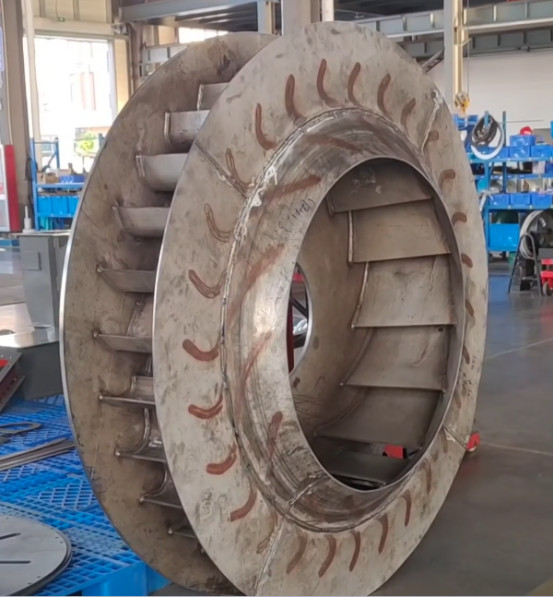
Impellers in chemical industry pumps function in the long term in complex and highly corrosive fluid environments. Operating environments such as strong acids, alkalis, chlorides, and high-temperature sulfur environments (highly prone) to induce failure of material. The current paper critically discusses the applicability of typical high-corrosion-resistant materials such as austenitic stainless steel, duplex stainless steel, nickel alloys, titanium alloys, and composites in various chemical environments.
In addition to actual corrosion mechanisms, it discusses selection rules and economic tradeoffs. By classifying corrosion types and protection technologies of materials, it indicates future material selection will aim at overall consideration of performance-cost-corrosion flexibility with an outlook on providing the theoretical support and practical guidance for the rationalization of impeller design and operation by chemical companies.
Introduction
Through my practice experience as an engineer, chemical pump failure is mostly most closely related with corrosion damage. Especially being the primary element for energy conversion, impellers are more prone to pitting corrosion, crevice corrosion, stress corrosion cracking, or even catastrophic failure in harsh corrosive operating environments. Chemical industry includes generally acids, alkalis, salts, organic solvents, chlorides, sulfur-containing, and hydrogen-containing media. These process chemicals in process conditions such as high temperature, high pressure, or redox will enhance the corrosion of impeller materials.
Therefore, selecting highly corrosion-resistant materials to suit various complex media is the primary requirement in the stable and safe operation of chemical equipment. This paper attempts to start from the application of common corrosion-resistant materials, augmented by examples from various corrosion environments, deeply analyze the strategy for selecting the impeller material in the chemical process industry with respect to their adaptability in working conditions, mechanical strength, and economic acceptability, and form a multi-dimensional guidance framework for the application of impeller materials.
Types and Performance Comparison of High-Corrosion-Resistant Impeller Materials
In petrochemical, shipping, environmental protection, and other fields, fluid media typically entail harsh working conditions such as highly corrosive ions, high temperature, and high pressure, which require greater stresses on the selection of the impeller material. Therefore, for the purpose of ensuring long-term safe and reliable operation of equipment, the corrosion resistance, mechanical properties, and economic cost of materials should be comprehensively evaluated according to the corrosive medium, temperature, pressure, and possible solid particle content in the fluid. In the next section, we will introduce the performance and usage conditions of some typical high-corrosion-resistant impeller materials to be a reference for design and material selection.
Austenitic Stainless Steel (such as 304, 316L)
Typically in equipment such as chemical pumps, austenitic stainless steel is typically used because it has a better overall performance as well as wonderful forming and welding characteristics. In particular, 316L stainless steel contains a higher molybdenum content, greatly improving its corrosion resistance to chloride ions and enabling it to stay stable in long-term running in conveying low-concentration acid-base, seawater, or salt solution media. But under the hot and dense chlorine environments, 316L still has some tendency to pitting and crevice corrosion and thus is not ideal for long-term use in severe corrosion environments.
My opinion is that 316L suffices for working conditions of medium corrosion severity and comparatively stable corrosion conditions. In instances of serious corrosion or extreme corrosion variation, highest-quality alloys have to be employed so as to obtain greater safety margins and guarantee of life.
Duplex Stainless Steel (such as 2205, 2507)
Duplex steel has both austenitic and ferritic structures, not only with a yield strength almost twice that of 316L, but also with outstanding pitting and crevice corrosion resistance. By using 2507 duplex steel as an example, it is still able to exhibit outstanding performance under extreme conditions like high chloride ions and high temperature, thus being extensively employed in seawater desalination pumps, chlor-alkali industry, and acidic medium pumps.
From the engineering application, I recommend the use of duplex stainless steel as an upper-class substitute for 316L in medium-to-high corrosion and high-load conditions. It is capable of(higher service life and reduced maintenance cost) at a reasonable price, hence a mid-term substitute with excellent overall performance and economy.
Nickel-Based Alloys (such as Hastelloy C-276, Monel Alloy)
Nickel-base alloys are capable of resisting harsh chemical media such as saturated hydrochloric acid, moist chlorine gas, phosphoric acid, and superheated strong corrosive solutions due to their superior corrosion and high-temperature characteristics, with Hastelloy C-276 being a typical example. Monel alloy is, nonetheless, capable of existing for an extended period in hydrofluoric acid and strong alkalies.
Personally, when selecting materials, I personally prefer to use nickel-based alloys in core components of equipment that are unreplacable, especially in special service where shutdown is expensive and maintenance is difficult. While the initial cost is expensive, the (in the long run) dependability and serviceability it allows are well worth the cost.
Titanium Alloys (such as Ti-0.3Mo-0.8Ni)
Titanium alloys became the ideal impeller material for seawater pumps, chlor-alkali pumps, and aggressive chemical processes due to their extremely light weight, satisfactory mechanical properties, and superior corrosion resistance against chloride ions. Especially in heavily oxidizing media such as wet chlorine and hypochlorite, titanium easily forms a dense oxide film on its surface to resist further corrosion and pitting. In the meantime, titanium alloys scarcely suffer stress corrosion cracking, which is particularly required for equipment requiring long-cycle continuous operation. However, due to its high processing and welding requirements, the cost of manufacturing is very expensive.
I think that titanium alloys are well adapted to major equipment that needs long life and high reliability, including seawater pumps with big flows and phosphoric acid pumps with high concentration, which are able to efficiently shorten maintenance time and reduce life cycle costs.
Composites and Polymer Materials
In the recent years, with the evolution of new materials and shaping processes, carbon fiber reinforced composites (CFRP), ceramic matrix composites, polytetrafluoroethylene (PTFE), polyvinylidene fluoride (PVDF), etc., have also joined the list of engineering application. CFRP and ceramic materials are highly resistant to corrosion and are light and high-strength and have been advocated in pump casings and blades and are well-suited for working conditions with high quality demands and particle-laden fluids. These materials also have shortcomings such as high brittleness and complex processing and shaping and are limited in their extensive application. Polymers such as PTFE and PVDF, though highly chemically corrosion-resistant and capable of adapting to almost all common corrosive media, have poor mechanical strength and are mostly used as coatings or linings along with metal substrates to optimize overall performance.
Analysis of Typical Corrosion Environments and Material Adaptation
In petrochemical, chemical engineering, power generation, and other fields, different equipment and parts often reside in various complex corrosion conditions, which impose more stringent demands on the selection of material and protection design. It is only by the rational selection of corrosion-resistant alloys and proper anti-corrosion measures according to specific corrosive media, working temperature, and pressure conditions that the service life of equipment can be really extended and unplanned shutdowns and maintenance fees reduced. Therefore, in the case of general corrosion types, process parameters and environmental characteristics need to be completely considered and material and coating systems with a high degree of adaptability and satisfactory cost-performance ratio need to be selected to ensure long-term safe and stable operation of equipment.
High-Temperature Sulfur Corrosion
In oil refining equipment, especially in equipment such as hydrocracking, vacuum distillation, and atmospheric-vacuum furnaces, where the content of hydrogen sulfide and free sulfur in the medium is significant, equipment is kept (long-term in) serious operating conditions over 450°C, (highly susceptible) to sulfur corrosion at high temperatures. To improve the corrosion resistance of the equipment, stainless steel or alloy steel with excellent sulfur resistance such as 0Cr13, 0Cr13Al, or 316L is suggested. Aluminized steel or stainless steel-carbon composite plates may also be employed for particularly severe parts to function as the protective role of the bimetallic interface. For heat exchanger tubing, bearing in mind that there are thermal cycles and scouring at high speeds, such alloy steels as Cr5Mo or 316L should be selected so that they can withstand the combined action of sulfur corrosion and scouring corrosion for a long time.
Wet Sulfide and Cyanide Corrosion
Processes such as catalytic cracking and gas desulfurization typically use corrosive media such as hydrogen sulfide, ammonia, and hydrogen cyanide. Superimposition of acidic water solutions developed in the wet condition and stress will result in local stress corrosion cracking (SCC) and hydrogen-induced cracking (HIC). To avoid such damage, steel grades having good stress corrosion cracking resistance such as 0Cr13 or duplex stainless steel should be selected to achieve sufficient strength and improve corrosion resistance. In the meantime, post-weld stress relief heat treatment (PWHT) can effectively remove welding residual stress and reduce the stress corrosion tendency. In addition, adding imidazoline-based corrosion inhibitors or deoxidizing and deammoniating water quality can significantly reduce the corrosion rate and prolong equipment life.
High-Temperature Hydrogen Corrosion
For such equipment as hydrogenation reactors and hydrocracking units that are sustained for a long time in high-temperature and high-pressure hydrogen environments, the materials undergo decarburization and hydrogen embrittlement, leading to steel structure deterioration and loss of mechanical properties and even producing instant rupture. It must refer to the Nelson curve in API RP941 and select appropriate steel grades on the basis of hydrogen partial pressure and operating temperature, for example, Cr-Mo low-alloy steel (e.g., 2.25Cr-1Mo), or austenitic steel such as 321 for improved hydrogen-induced damage resistance. Additionally, holding of operation temperature and hydrogen partial pressure and extension of equipment nondestructive checking (e.g., TOFD ultrasonic checking) can early detect potential defects and reduce the risk of accidents.
Storage Tank and Circulating Water Corrosion
Storage tanks, especially bottom and top plates, are prone to local corrosion and electrochemical corrosion due to water effect and corrosive air. To extend the tank life, coating the inner wall of the tank with epoxy resin or polyurethane coating, and sacrificial anode cathodic protection methods to prevent local galvanic corrosion, is recommended. For water-cooling systems involving circulating waters, erosion- and corrosion-resistant steel such as 316L or duplex stainless steel must be utilized, in conjunction with side-stream filtration and chemical treatment to reduce scale build-up and microbial corrosion to provide good conditions for the long-term safe operation of plant equipment.
Economy of Material Selection and Future Development Directions
When selecting material for an impeller, apart from technical conformity, economy is also a concern of companies. I believe that there must be a dynamic balance between cost control and reliability. For example, under non-extreme corrosion operation conditions, duplex stainless steel can replace costly nickel-based alloys, and for local high-corrosion areas, surface spraying (for example, tungsten carbide spraying), laser cladding, or composite linings can effectively improve the overall life and cost-performance ratio of materials.
Looking forward to the future, with the emerging technologies of high-entropy alloys, superhydrophobic anti-corrosion coatings, and new self-healing coatings, impeller materials will evolve toward “structural lightweight + corrosion-resistant intelligence”. I believe that the development of a system for material selection with backing from intelligent working condition recognition, corrosion prediction, and correlation with material databases will be the gate to the chemical industry’s achievement of long-cycle, efficient, and low-maintenance equipment operation.
Conclusion
As a key component of chemical pumps, impeller material performance is directly related to the safety, stability, and economy of the entire system. Practical material choice depends not only on physical and chemical properties of the material but also on full understanding of the corrosion environment and extensive experience accumulation. Only through establishing a system correlation mechanism among performance, price, and corrosion environment can equipment operation in the chemical industry be provided with permanent protection.


