
With the continuous improvement of the manufacturing precision requirements of the core components of aero-engines, especially for aviation impellers with free-form surface complex structures, the precision and efficiency of the measuring of geometric parameters have been important indicators to assess quality control capability. Facing the complex high-curvature structures of the aviation impeller, the traditional three-coordinate measurement system is confronted with poor efficiency, large posture errors, and inadequate data. Since the past few years, five-axis hybrid inspection systems with RTCP technology have become the common technology used for precise measurement, which benefits from flexible probe control, automatic posture correction, and path optimization.
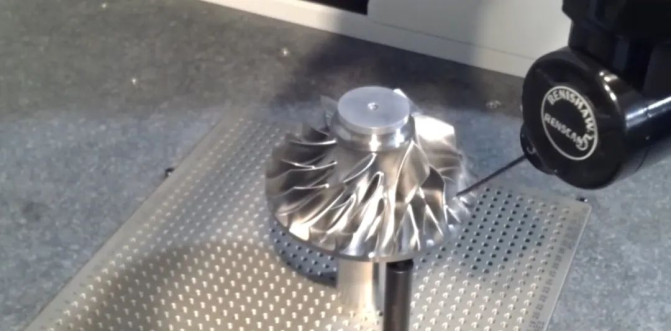
Technical Challenges in Geometric Measurement of Aviation Impellers
As the central power components of aero-engine compressor and turbine systems, aviation engine impellers are extremely challenging for measurement methods in both geometric complexity and need for high accuracy. Especially in newly developed aero-engines that are currently being produced, there are large bending-torsion, multi (multi-blade clusters), and high sweep angles types of blades with small curvature radii, high steep curves, and numerous special structures (such as cavities, coatings, and film holes).
Under such complex configurations, traditional Coordinate Measuring Machines (CMMs) require repeated probe direction changes, leading to handy breaking of measurement trajectories, and also blind spots and posture error accumulation issues, significantly restricting measurement accuracy and efficiency. In my relevant measurement practices, I have fully realized that the exclusive application of three-axis linear motion systems can no longer meet the requirements of quick, precise, and stable measurement of new aviation impellers.
Five-axis integrated inspection technology, by adding two rotation axes (A/B axes) and RTCP functions, achieves real-time adaptive probe posture and optimal tracking of measurement point paths, providing technical assistance for high-efficiency measurement of complex free-form surfaces.
Comparative Analysis of Three-Axis and Five-Axis Measurement Modes
While the complexity of the aviation impeller surface increases, the selection of appropriate measurement mode is necessary to ensure the accuracy and efficiency of measurement. Both three-axis and five-axis measurements possess their own characteristics and application scopes. The following comparative analysis on their limitations and technical merits is of reference to practical production measurement.
Limitations of Three-Axis Measurement Mode
Three-axis measuring systems occupy the workpiece space through X, Y, and Z axis linear motions with high equipment maturity and precision but expose the following weaknesses for complex surfaces such as impellers:
- Frequent probe direction changes: While measuring complex areas such as blade bending sections and leading/trailing edges, the probe has to be repeatedly changed manually or programmatically, resulting in tedious and lengthy measurement operations.
- Measurement blind spots and path interruptions: Three-axis systems struggle to achieve continuous scanning in areas of high curvature, resulting in data loss at very small radii of curvature and compromising point cloud integrity.
- Accumulation of posture errors: Any deviation in probe direction and recalibration introduces minute posture errors, which accumulate with the number of measurements and compromise measurement consistency and accuracy.
I had previously seen a multi-section blade measurement task in actual production, in which direction change errors resulted in variation in leading/trailing edge thickness measurement, pointing towards the inherent disadvantages of three-axis modes of measurement on complex surfaces.
Advantages of Five-Axis Measurement Mode
Compared to three-axis measurement, five-axis measurement adds two axes of rotation based on three linear axes, and the probe can acquire six-degree-of-freedom spatial movement capability. Especially with the support of RTCP (Tool Center Point Control) functions, it exhibits the following better advantages:
- Real-time posture following: The probe can automatically reverse direction of measurement and eliminate manual angle setting, which greatly simplifies pre-measurement preparation and reduces operation time.
- Continuous path without blind spots: Five-axis systems are able to scan uninterrupted across complex blade surfaces, reducing point misses as a result of sudden curvature transitions and capturing full, high-density 3D point cloud information.
- Strong on-site adaptability: Increased capability for clamping errors, reducing reprogramming and calibration effort as a result of offsets, and increasing measurement flexibility and on-site flexibility.
Overall, five-axis measurement transforms probe direction control from manual adjustment to automatic optimization, not only increasing measurement efficiency and reproducibility to a great degree but also providing a more precise, efficient, and stable means of measuring complex surface parts such as aviation impellers, and it is a key direction for improving future production measurement processes.
Comparative Analysis of Accuracy and Efficiency of Five-Axis Combined Inspection
With the growing needs for precision and efficiency in aviation impeller measurement processes, traditional three-axis measurement technology exhibits bottlenecks of frequent direction changes, complex path planning, and poor data integrity rates. Under such circumstances, five-axis measurement technology with RTCP functions can significantly improve measurement precision, data coverage, and work efficiency and become the first choice for measuring aviation impellers. The overall advantage of five-axis measurement is researched in three areas: path optimization and data integrity, posture error control, and comparative analysis of measurement results.
Path Optimization and Data Integrity
RTCP-based five-axis measurement can be employed to optimize the spatial posture of the probe automatically while maintaining constant measurement point trajectory to achieve overall coverage of complex blades. This not only significantly increases density of measurement points and spatial uniformity but also avoids measurement blind spots and missing phenomena due to direction change interference. In real-world tests, intelligent path planning software is able to automatically avoid interference areas based on CAD models, saving time on programming manaully and debugging in the field, and providing robust support for mass measurement.
Posture Error Control Capability
Unlike three-axis measurement, five-axis systems real-time correct probe posture errors in the RTCP model during probe motion, obviating the need for repeated probe direction reprogramming. This feature significantly reduces cumulative errors caused by direction changes and clamping, making the measurement process more stable and controllable. Compared to three-axis repeated measurement results, five-axis measurement shows apparent improvement in measurement accuracy and consistency, with the accuracy of measurements being enhanced by approximately twice and posture error diffusion being significantly suppressed.
Comparative Results of Actual Measurement Accuracy and Efficiency
For quantitative comparison of multiple kinds of effect on different measurement modes, repeated measurement was done in several rounds on one and the same sample of aviation impeller and statistical results are as follows:
| Measurement Mode | Repeatability Accuracy (mm) | Single-Piece Measurement Time (min) | Data Integrity Rate |
| Three-Axis System | ±0.008 | 18 | 88% |
| Five-Axis System | ±0.004 | 11 | 97% |
As can be seen from the table, five-axis measurement possesses nearly double the repeatability accuracy compared to three-axis, improves measurement efficiency by around 35%, and significantly increases data integrity rate. That is, five-axis measurement is able to effectively reduce measurement time and improve measurement data quality while keeping accuracy intact and is especially suitable for batch, high-precision, and high-complexity impeller part measurement tasks, allowing enterprises to realize more stable, efficient, and traceable quality assurance functions.
Value of Five-Axis Combined Inspection in Impeller Geometric Metrology Assurance
Together with the constructing requirements of geometric parameter testing and metrology systems for aero-engine blades, five-axis measurement not only expands inherent measuring functions but also provides important aid in constructing an overall geometric parameter value traceability system:
- Supports unified evaluation of multiple geometric parameters: Such as two-dimensional airfoils, three-dimensional surfaces, surface roughness, coating thickness, and other multi-dimension parameters.
- Improves on-site adaptability and standardization capabilities: May be used for a series of measurements with different clamping conditions, preventing fluctuations in measurements caused by clamping errors.
- Supports digital manufacturing integration platforms: Five-axis system data interface is more smoothly integrated into CAD/CAM systems to establish an “design-manufacturing-inspection” close loop for blade manufacturing.
As a front-line technical personnel member, I firmly believe that five-axis systems are not just a revolution of metrology machines but also a key driving force in promoting the development of precision manufacturing into intelligent manufacturing.
Conclusion
Five-axis integrated inspection technology is the dominant developing trend for complex structure measurement technology, especially for high-requirement products such as aviation impellers, whose high precision, high efficiency, and high adaptability have been validated in practice. Based on this research, we can confidently draw the conclusion that five-axis inspection technology possesses unique value to promote the measurement efficiency, ensure data integrity, and construct geometric parameter value transmission systems.


