
Along with the continued advancement of precision and performance demands for impellers in aviation, automotive, and power equipment industries, quality inspection of impellers through 3D quality control has been a critical bridge. Conventional contact measurements suffer from disadvantages such as low efficiency and low precision in measurement and are unable to meet the demands of modern high-precision and high-efficiency manufacturing. Blue light scanning technology, on the other hand, possesses characteristics such as high speed, high precision, and no-contact measurement and is gradually becoming a primary tool for 3D quality control of impellers.
Significance of 3D Quality Control for Impeller Manufacturing
As core components of power transfer and fluid conveyance, the size consistency, surface quality, and geometric precision of impellers directly affect the operational performance, efficiency, and service life of the whole machine. Along with the increase in design sophistication and accuracy, impeller manufacturing is more difficult. It is difficult to implement the traditional contact measurement methods to high-precision and real-time quality control demands due to complex operation, poor efficiency, and sensitivity to scratching and deformation on the impeller surface.
Therefore, as a contactless and high-accuracy 3D measurement technology, blue light scanning technology is becoming a more important tool in the industry of impeller quality control. Through the effective capture of 3D data of impellers, blue light scanning technology can empower manufacturing companies to quickly inspect dimensional deviations and surface defects, and hence provide powerful support for optimalizing production processes, enhancing product uniformity, and reducing production costs.
Principles and Characteristics of Blue Light Scanning Technology
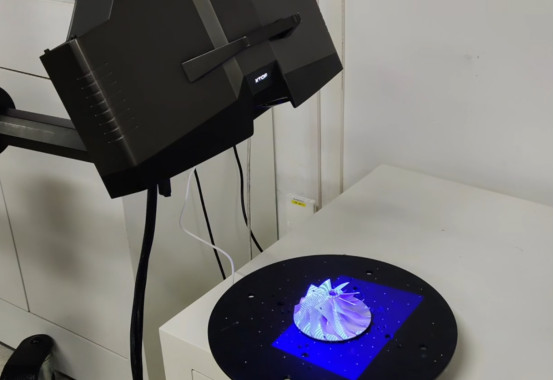
Blue light scanning technology mainly adopts a blue LED light source, projects structured light, and incorporates a binocular camera system to scan the object surface and provide high-precision 3D point cloud data based on the triangulation principle. Its main benefits are:
- Fast measurement speed: Blue light scanning technology is able to complete the thorough scan of complex impellers within a short span of time, greatly increasing production efficiency. This advantage is extremely important for mass production, particularly in high-demand production environments with tight schedules.
- High precision and resolution: Blue light’s short wavelength has a strong ability to reduce ambient light interference and improve the accuracy and resolution of measurements. Especially in micron-level dimensions, blue light scanning can capture slight changes of curvature, defects, and surface details of impellers, providing high-quality data support for inspection.
- Non-contact measurement: Blue light scanning has less surface scratches or deformation due to physical contact compared to the conventional contact measurement, hence it is better for precision parts. Particularly for impellers with complicated geometries, it has a better ability to ensure measurement stability and accuracy.
Role of Blue Light Scanning in 3D Quality Control of Impellers
As a high-efficiency, high-precision, and non-contact 3D measurement technology, blue light scanning is becoming more and more crucial in the quality control of impellers. Blue light scanning can fully acquire spatial information of complex impeller surfaces, which provides robust support for precision quality analysis and process improvement.
Real-Time Geometric Data Acquisition and Comparison
Blue light scanning can capture the complete 3D data of the impeller surface in a very short time and automatically compare and register it with the design CAD model. This system is capable of monitoring in real time and with high precision geometric deviations of key elements of the impeller, such as blade thickness, tip fillet, and inlet/outlet edge curvature, enabling the engineer to trace in a short time the source of errors in the manufacture and providing an objective basis for processing technology and parameter adjustment. This closed-loop back-correcting mechanism can effectively reduce trial cut numbers, accelerate tempo and pass rate of production.
Visualization of Global Surface Error Distribution
Blue light scanning 3D point cloud data can create chromatographic error maps showing clearly and intuitively the deviation distribution of each area of the whole machine. For instance, small surface errors at decisive positions like blade leading edges, trailing edges, and blade roots can be observed clearly. This visualized method bypasses information loss through discrete measuring points in traditional measuring, allows quality engineers to quickly identify the causes of defects, design particular (trimming) measures and optimization strategies, and significantly improve manufacturing and trimming accuracy.
Quality Consistency Monitoring of Multi-Variety Impellers
During mass production, consistency and interchangeability between impellers of different batches must be strictly guaranteed. Through.use of instant and high-precision 3D measurement, blue light scanning is able to conduct full-quality inspection and comparative contrast of impellers.of every batch, effectively eradicating quality.variation due to factors such as tool wear and equipment drift. When measurement values are beyond the normal range, quality engineers are able to respond in time and adjust process parameters to ensure the stability and traceability of impeller quality for mass production and provide customers with long-term stable and high-performance impeller products.
Integration Prospect of Blue Light Scanning Technology and Automated Production
As the popularity of smart manufacturing and automatic production technology is continuously growing, deep integration with robots and automatic production lines is increasingly becoming a major future development direction of the manufacturing industry. The integration not only has the potential to greatly improve production efficiency and measuring accuracy but also lays a solid foundation for realizing digital and intelligent quality management.
Automatic Loading/Unloading and Precise Positioning Clamping:
The smooth convergence of blue light scanning technology and automatic machines (robots, automatic fixtures, etc.) renders the measurement process more intelligent. Through robotic auto loading/unloading and accurate positioning clamping, manual handling can be reduced to a minimum, and position (deviation) and repeated position errors caused by manual handling can be reduced to a minimum. This process, by automation, ensures that measurement of each batch of impellers can be conducted in the same conditions, providing a guarantee for ensuring large-scale and high-precision production.
Integration of Measurement and Analysis:
The blue light scanner’s 3D data can automatically be transmitted to analysis and statistical software through the industrial network and automatically generate measurement reports and deviation analysis charts. This integrated measurement and analysis mode breaks intermediate links and transmission errors of data, not only improving detection speed and rate of information utilization but also supporting more visual and traceable quality management and stronger big data-based process optimization and production decision-making.
Digital Twin and Closed-Loop Optimization:
Both blue light scanning and digital twin technology have the potential to create closed-loop optimization of impeller manufacturing and design. By correlating the measurements with the digital model in real time, not only are manufacturing deviations identifiable on a timely basis, but the information can be inputted back into the design and production cycles to guide tool compensation, program modification, and process optimization. This closed loop in the digital era can optimize trial-and-error costs and product development times efficiently, help companies continuously optimize impeller performance and production stability, and realize intelligent closed-loop management from design-manufacturing-measurement-optimization.
Application of Blue Light Scanning Technology in Inspection of Power Assembly Components
Blue light scanning technology, in the field of power assembly, especially in the manufacturing of key components such as steam turbine impellers and engine blades, is capable of fast and accurate capture of 3D information and provide wide-range quality analysis. For example, when inspecting steam turbine impellers, blue light scanning can measure major parts such as flatness, edges, and R angles’ dimensional discrepancies, enabling engineers to quickly identify and correct quality problems during production.
In addition, blue light scanning technology can be combined with motion simulation software to conduct dynamic tolerance analysis, predict dimensional deviation and interference problems of impellers in running in advance, and offer a scientific basis for optimizing this type of product in this manner.
Conclusion
Blue light scanning technology is increasingly crucial for 3D quality inspection of impellers. Through high-speed, high-precision, and contactless measurements, blue light scanning technology not only can effectively capture the 3D information of impellers, but also can process impeller manufacturing procedures through deviation analysis and dynamic tolerance analysis to improve product quality and consistency.


