
With the continuous increase in demand for customized impellers, precise measurement of impellers of different models and batches becomes increasingly important as well. Being an indispensable tool for impeller measurement, the reasonableness and stability of fixture structure design have immediate effects on the precision and replicability of measurement values.
Challenges in Customized Impeller Measurement
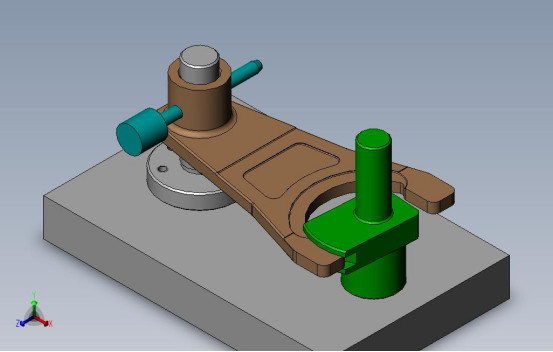
With the increasing customized demands for impellers in aircraft, automobile, and equipment power uses, customized impeller varieties and specifications have been diversified. Special fixtures corresponding to each impeller are also necessary to support and locate it for measurement due to its exclusive geometric features and dimension requirements. Blade spatial curvature change complexity in customized impellers makes measurement a more difficult process. In this process, fixture structure design is especially significant. Irresponsible fixture design not only leads to unstable references and gigantic positioning errors in measuring impellers, but also may cause gigantic dispersion of measured data, which will affect the reliability of final measurement results. Thus, how to design high-rigidity, high-precision, highly repeatable fixtures has become the key issue in improving the stability and accuracy of impeller measurement.
Influence Factors of Fixture Structure Design on Measurement Stability
As a critical supporting and locating tool during measurement, the fixture design capability will have direct impact on measurement data accuracy and repeatability. In measuring intricate parts such as impellers, fixtures need to be capable of realizing overall optimization in structural stiffness, positioning precision, and clamping designs to facilitate long-term stability of the measurement environment and offer a reliable foundation for high-precision inspection.
Rigidity and Support Structure Design
Rigidity of a fixture is one of the primary factors in measurement stability. When a fixture undergoes slight deformation due to external loads, gravity, or usage during measurement, it causes offset of measuring points, and therefore measurement accuracy is affected. Therefore, while designing fixtures, high-rigidity materials such as cast iron and steel should be given preference, and proper welding and heat treatment processes should be employed to keep internal stress low to ensure that the fixture is dimensionally and geometrically accurate during long-term usage. On the other hand, the support structure must be sensibly designed to support the workpiece so that it cannot vibrate or deflect during measurement, thereby creating a stable and trustworthy support condition for measurement.
Positioning Accuracy and Repeatability Control
Precise and repeatable positioning is the overall goal of fixture design. In measurement of an impeller, positioning references similar to the geometric features of the workpiece, such as the hub, reference surface, and blade root, should be selected to reduce measurement errors due to positioning. More sophisticated schemes such as three-point positioning and taper hole and pin positioning can well ensure repeat accuracy and positioning consistency, enable each measurement to be performed in the same reference system, cancel out unstable measurement data caused by positioning errors, and enable measurement results to be comparable and traceable.
Clamping and Fastening Design
The fixture clamping scheme must reduce workpiece deformation caused by the clamping stress on the basis of guaranteeing solidity, particularly for thin-walled and complex curved surface impellers. Clamping schemes such as elastic pressure plates, multi-point flexible support, and vacuum adsorption can be used to avoid local concentration of stress and enable the impeller to maintain its original shape and positioning posture during measurement. These engineered structures are able to efficiently reduce the impact of clamping on measurement accuracy, thereby providing an assurance of obtaining real and genuine measurement information.
Design Measures to Improve Fixture Stability
To ensure the accuracy and consistency of the impeller measurement process, mass production, and long-term use, the modularity versatility, adjustment and compensation capabilities, and structure optimization must be fully considered in fixture design. These design methods will also promote the stability and strength of the fixturing, guaranteeing measurement accuracy compliance.
Modular Design and Universal Interfaces
For impellers of different models and lots, modular design and standardized universal interfaces are an efficient means. By splitting the fixture into multiple combinable and exchangeable modules, the disassembling and resetting of the entire fixture in model change can be minimized, and measurement errors due to re-calibration can be avoided. This modular design not only increases the fixture’s flexibility, but also reduces production switching time and cost, ensures consistency and reproducibility of the measuring process, and offers good conditions for mass production efficiency improvement.
Positioning Error Compensation and Fine-Tuning Structure
In application, manufacturing error and assembly tolerance may lead to minor discrepancies between fixture positioning accuracy and theoretical value. Thus, by including precision fine-tuning units such as fine-tuning screws, micrometer seats, or scales within the design, operators can make minor adjustments to positioning or support points on the basis of real measurement results, actually reducing cumulative deviations due to production and assembly inaccuracies. Designing this way enables the fixture to maintain precision under extended use, providing traceable and manageable quality assurance for measurement results.
Finite Element Analysis (FEA) for Optimization Design
In a bid to ensure the fixture remains stable under all loads and usage conditions for a long period of time, using finite element analysis (FEA) to model and optimize the structure of the fixture is a core connection. By simulating stress and deformation during the designing stage, structural weak points can be identified, and rib plate, support, and connection point design can be optimized to avoid deformation and precision loss resulting from stress concentration and long-term fatigue. FEA not only prevents potential design defects in advance but also provides a quantitative foundation for structural optimization, such that the fixture can be ensured to have sufficient rigidity and stability in actual production, extending service life and improving measurement reliability.
Practical Impact of Fixture Stability on Measurement Quality and Case Analysis
In measuring a certain aviation impeller, we contrasted the performance of an optimally designed fixture with that of a standard old fixture using a comparative test. The comparison test showed that the optimized fixture improved the repeatability of the measurements by approximately 35%, minimized the range of fluctuations of measurement deviations significantly, and improved the consistency of the measurement results with the coordinate measuring machine (CMM) reference data significantly. This case fully verifies the importance of rational fixture structure design to improve measurement stability and accuracy. By optimizing the structure of the fixture and improving rigidity, positioning accuracy, etc., we can greatly improve the repeatability and reliability of impeller measurement, and the final measurement result will be more stable and accurate.
Conclusion
Structural design of fixtures significantly influences the measurement stability and accuracy of the customized impeller. By enhancing fixture rigidity and locating accuracy, in accordance with modular and fine-adjustable structures, and through finite element analysis optimization, it is actually possible to eliminate measurement error during the measurement process and improve the reliability and consistency of measurement results. These provisions not only enhance the accuracy of impeller measurement but also provide good assurance to quality control during customized impeller manufacture.


