
With the accelerating enhancement of the quality and performance requirements of impellers in the aviation, automotive, and energy industries, internal impeller defects (such as pores, inclusions, cracks, etc.) have become more and more prevalent factors affecting the service life and safety of impellers. Yet, these kinds of defects are typically concealed and in complicated form, and hence conventional contact measurement and surface non-destructive testing techniques are hard to use effectively to detect. Due to its exclusive features of non-contact, high resolution, and 3D imaging, industrial X-ray CT (Computed Tomography) has been a key technology for high-precision internal defect inspection of impellers.
Introduction
Being the most significant factors in modern power machinery, impellers are increasingly utilized for wider applications in high-performance machinery such as aero-engines and gas turbines. Their internal perfection directly affects their hydrodynamic performance and mechanical life. Especially minute defects such as pores, inclusions, and cracks—these internal defects not only weaken and shorten the lifespan of impellers but can also cause fatigue fracture or stress concentration under long-term operation, affecting the safety of the entire machine. However, due to internal defects in impellers with invisible distribution and complex morphology, it is difficult for traditional contact detection technologies to capture these minute defects well. Accordingly, non-destructive testing with industrial X-ray CT has become a strong means for detecting internal impeller defects and raising their quality control level.
Principles and Measurement Characteristics of Industrial X-ray CT
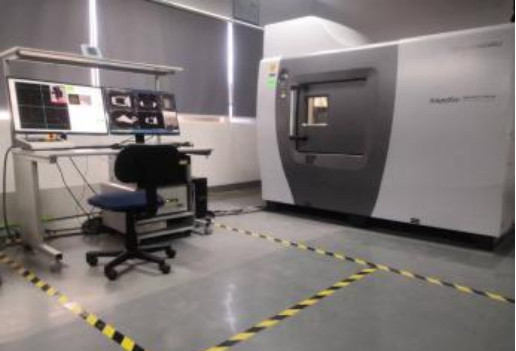
Industrial X-ray CT uses X-ray beams to scan measured objects such as impellers from multiple directions, collects 2D projection data from multiple directions, and then reconstructs the data in three dimensions through computer algorithms to get a complete and high-precision 3D volume model. This inspection technology can accurately display the real geometric structure of each part in the impeller, and provides extremely valuable basis for internal flaw detection, dimension measurement, and quality inspection. Compared with traditional non-destructive testing methods, industrial X-ray CT has apparent superiority in measuring accuracy, data integrity, and operation flexibility, of which the main technical advantages include the following aspects:
High Spatial Resolution and Detection Sensitivity
X-ray CT uses high-penetration and high-energy X-ray beams, which have sufficient ability to identify internal defects at the micron scale, such as pores, micro-cracks, and inclusions. This is because there are big density differences in the object, and different distributions of densities lead to different levels of X-ray attenuation, which can conveniently pick up these finer features in image. For certain concealed and intricate structural regions in impellers, like blade roots with significant curvature and corners of the flow channels, X-ray CT can also accurately find potential faults, assisting engineers in systematically assessing the inner quality of components.
Strong 3D Visualization and Quantitative Analysis Capability
Through 3D reconstruction, industrial CT not only has the ability to acquire a clear and uninterrupted space distribution of inner structures, but also makes accurate analysis of the properties of defects, including defect volume, shape, quantity, and space distribution. These information are employed as a quantitative reference for design verification, process optimization of manufacturing, and service life prediction, so that production’s quality hidden dangers may be discovered and product precision and stability ensured. In practical engineering practice, this quantitative analysis and 3D visualization also become significant references to formulate repair plans and design improvements.
Non-Contact and Non-Destructive Testing
Industrial X-ray CT is a completely non-contact measurement method with no contact or surface damage of the impellers included in the measurement process and thus is extremely well-suited for inspection of high-precision and high-value parts. This is particularly important in aviation, aerospace, and high-tech manufacturing companies. Not only does it avoid potential damage caused by the process of measurement but also obtains accurate and thorough measurement information based on the preservation of original status of impellers integrity, improving the standardization and scientificity of the quality management system.
Analysis of CT’s Capability for Internal Defect Detection in Impellers
With continuous improvement in quality standards of impellers in the fields of aviation, energy, etc., internal defect inspection is particularly critical. Industrial X-ray CT (Computed Tomography) with its advantages of non-destructiveness, high precision, and 3D visualization is now becoming the mainstream technical means for internal quality inspection of impellers. Following CT scanning, internal information of detailed structures can be obtained without damaging the integrity of impellers, providing solid basis for quality evaluation and process optimization.
Identification Capability for Pores and Inclusions
Pores and inclusions are major factors determining the mechanical properties and working life of impellers. Traditional detection means are generally limited by detecting accuracy and observation angles, and there is no way to identify deeply hidden internal defects. CT can clearly delineate the location, dimension, volume, and distribution state of pores and inclusions through high-resolution imaging technique based on the variation in material densities. By 3D visualization analysis, the engineers are able to more comprehensively analyze how the aforementioned defects influence flow field balance, stress concentration, and fatigue life, supporting data for the optimization of casting processing and heat treatment processes.
Detection Capability for Cracks and Delaminations
Delaminations, cracks, and fine structural defects are latent sources of failure for impellers under long-term operating conditions. particularly under the state of high temperature, high speed, and high stress during service, these defects would develop rapidly and cause damage. Through CT 3D slicing and cross-section reconstruction, cracks’ direction, length, and depth can be expressed clearly, and even micro-cracks and internal tissue separation difficult to be sensed by other methods can be found. This provides essential data for impeller life prediction, remanufacturing decisions, and safety evaluation, reducing potential risks.
Analysis of Internal Integrity of Complex Flow Channels
The internal flow channel configuration of impellers is usually complex in nature, and channel curvature, cross-sectional change, and local wall thickness variations affect the flow efficiency and aerodynamic performance considerably. X-ray CT is capable of reconstructing the entire 3D geometric model of the flow channel, which not only can examine the patency of passage and dimensional precision but also identify potential internal defects such as necking, deviation, or casting residue. With the comparison and analysis with the original design model, engineers can be able to find out the problems on hydrodynamic performance in a timely manner, data basis for subsequent trimming, polishing, or redesign can be offered, and the impeller can be ensured to satisfy the design requirements and provide the best flow performance.
Application Cases and Effects
Industrial X-ray CT was used in an aero-engine factory to perform non-destructive tests on a batch of turbine impellers. In the test process, about 3.5% of the impellers had pores and inclusions measuring 50-200 microns. Through these data, engineers improved the smelting and casting processes, significantly reducing the rate of defects. The test results show that using industrial CT in impeller testing not only increases the product qualification rate but also extends the service life of impellers.
Future Development and Challenges
With the increasing power of X-ray sources and growing detector resolution, detection capability for micro-nano range defects will continue to expand. In addition to that, extensive use of automatic defect recognition algorithms and artificial intelligence technology will greatly improve the efficiency of CT detection, reduce human operation errors, and promote its development towards intelligence and high throughput. However, the high cost of CT equipment and long scanning and data reconstruction time remain the main reasons limiting its use and popularization in mass production. Therefore, improving the speed of CT detection and reducing equipment costs will be the key to the future development.
Conclusion
Industrial X-ray CT possesses great prospects for internal defect inspection of impellers because of the technical advantages of non-contact, non-destructive and high resolution. CT technology can provide more accurate information on defects than traditional detection methods through 3D visualization and quantitative analysis, and the quality control level and usage safety of impellers are also improved correspondingly. As technology continues to evolve, industrial X-ray CT will be more and more deeply incorporated with technologies such as automated detection and big data analysis, powering the intelligent and accurate upgrading of the impeller manufacturing sector and having a growing greater role to play.


