
With the constant evolution of high-level manufacturing fields such as energy power and aviation, higher machining efficiency and quality standards have been put forward for multi-stage impeller parts. Due to their complex spatial arrangements, multi-layer geometric surfaces, and difficult-to-machine material characteristics, multi-stage impellers have long been confronted with a sequence of machining challenges such as repetitive tool changes, significant positioning errors, and poor machining consistency. Composite modular tooling system application integrates tools of different processes such as roughing and finishing into a single system, which offers multi-task cutting in one clamping, maximally optimizing the production rate and machining process.
Process Challenges in Multi-Stage Impeller Machining
As the core structure of key components such as aero-engines, high-speed centrifugal pumps, and gas turbines, the production quality of multi-stage impellers directly affects the performance, life, and safety of the entire machine. Impellers are generally made of a number of stages, and each stage includes numerous blades, mostly free-form surface structures, with hard-to-machine paths. The machined workpieces are mostly titanium alloys, Inconel and other superalloys, which are typical difficult-to-machine pieces.
With the traditional process scheme, multiple types of tools are required for roughing, semi-finishing, and finishing, which are performed through several clamping operations, resulting in many tool changes and frequent process switching. Taking as an example a multi-stage impeller manufacturing line that I have worked on, with the single-tool process scheme utilizing the conventional classical process scheme, each part had 4 tool changes and the cumulative machining time was well over 45 minutes. In the meantime, repeated positioning errors also caused apparent precision fluctuations, especially in batch consistency machining of workpieces, which became the main obstacle hindering automated and mass production.
Therefore, using a modular composite tooling system capable of performing multiple processes within a single clamping, reducing tool changes, and improving machining stability has become the most critical measure to improve the machining efficiency and quality of multi-stage impellers.
Principles and Technical Characteristics of Modular Composite Tooling System
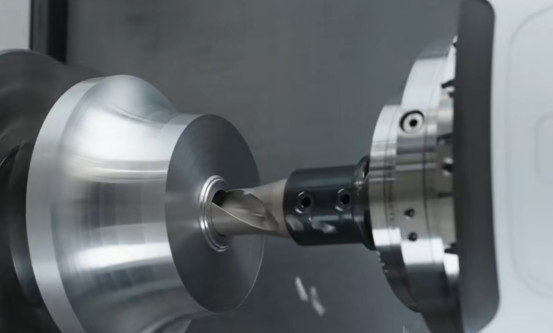
Modular Composite Tooling System unites processes such as rough milling, semi-finishing, finishing, and even chamfering into a single tool through modular design and functional integration, and cooperates with five-axis CNC machine tools and automatic tool changers in achieving the intelligent machining form of “one tool completes several processes”. The system realizes the following key features and technical characters in design and manufacturing.
Modular Structure Design
Detachable tool holder-tool head structure is applied in modular composite tooling, and standardized interfaces (e.g., HSK, CAPTO, etc.) are utilized to achieve rapid replacement and precise positioning of tool elements. In addition to enhancing convenience for maintenance and adjustment, the structure also possesses the ability to select the best tool head module flexibly based on the geometric characteristics of different impeller components, with high convenience in small-lot and multi-variety production.
Differentiated Arrangement of Cutting Edge Functions:
Thus to make fullest use of the efficiency of composite tooling modularity, each cutting edge on the tool is designed and configured uniquely based on process functions: the roughing part uses a large rake angle and high-strength edge for chip breaking in order to achieve large cutting depth and large removal rate; the finishing part uses precision ground ball nose edge and nano-coating in order to achieve outstanding surface quality and precise dimension control. This zonal configuration method slows down sudden change of cutting load, suppresses vibration and thermal shock, and provides high-speed and high-precision machining assurance.
Dynamic Balance Optimization Design:
Due to the relatively complex structure of modular composite tooling typically requiring long overhang and multi-tool position arrangement, high-order dynamic balance calibration must be performed for the entire tool assembly. By precise measurement and compensation, the tool is ensured to be in dynamic balance in high-speed operation, reducing spindle load fluctuation caused by centrifugal force and impact force, extending machine tool life and tool life, and improving controllability and predictability of the cutting process.
Automation System Adaptability:
Modular composite tooling is readily incorporated into standard tool magazines and automatic tool changers without major alteration to installed equipment hardware, further simplifying automated production line introduction and maintenance. Such benefit helps companies minimize upfront transformation costs, maximize equipment utilization, and establish a stable hardware base for future flexible manufacturing.
Application Effects of High-Efficiency Rough-Finish Composite Machining
With the increase in impeller structural complexity and continuously upgraded precision machining specifications, employment of modular composite tooling to achieve integrated rough-finish composite machining has been a major industry trend. By optimizing tool layout and integrating functions, modular composite tooling not only can reduce tool change time and tool setting calibration time but also ensure the continuous, high-precision, and efficient realization of various processes, showcasing excellent process integration and overall competitiveness.
Significantly Improving Machining Efficiency
Modular composite tooling is able to merge the first separate roughing and finishing operations into one clamp and a single tool path, eradicating tool change time along with machine tool idle strokes, and significantly improving production pace. For example, after my unit implemented a certain form of modular composite tooling, the tool changes reduced from 4 to 1, the machining rhythm improved from 45 minutes to 32 minutes, the overall line capacity increased by more than 20%, and the equipment utilization rate and production rhythm were greatly improved.
Improving Machining Quality and Precision Consistency
Tool reduction and repositioning ensure tool trajectory stability and spatial references greatly improved, removing completely the risk of cumulative errors in the secondary clamping and tool setting operation. The measured data confirm that the roughness of the impeller surface after using modular composite tooling can be controlled reliably to below Ra 0.9 μm, considerably better than the initial Ra 1.5 μm, with no tool joint marks or steps on the surface, and accuracy and consistency are significantly improved.
Extending Tool Life and Optimizing Usage Costs
Modular composite tooling has a functional zoning form and different cutting edges carry out different cutting functions of roughing and finishing, which can balance the cutting load and avoid early wear of one cutting edge. At the same time, combined with coating and substrate gradient optimization (i.e., PVD coating and ultrafine-grain cemented carbide substrate), the whole tool life can be extended by as much as 35%, truly reducing tool change costs and inventory pressure and saving significant operating costs for enterprises.
Enhancing Process Stability and Batch Production Consistency
Modular composite tooling reduces thermal cycle interruptions and tool changes, which is advantageous to maintaining the cutting area temperature and the thermal balance of machine tool stable and error fluctuations in the machining process at a minimum. In batch manufacturing, this role can efficiently reduce product size drift and batch variability, improve the yield rate, reduce the waste and rework ratio, and provide technical support for unmanned production and automated production lines.
Typical Cases and Comparative Analysis
The following are the effects of a certain enterprise in the multi-stage impeller machining procedure of a turbocharger, comparing to the traditional single-tool step-by-step method and the integrated modular composite tooling integrated approach:
| Comparison Item | Traditional Step-by-Step Machining | Modular Composite Tooling System |
| Machining Time | 45 min/piece | 32 min/piece |
| Number of Tool Changes | 4 times | 1 time |
| Surface Roughness (Ra) | 1.5 μm | 0.9 μm |
| Tool Life | 90 pieces/tool | 120 pieces/tool |
| Machining Consistency | Poor consistency | High consistency |
The cases clearly show that the modular composite tooling system has effectively optimized the total production cost, product quality, and equipment utilization rate, and is a key technical means to achieve high-efficient batch machining of impellers.
Conclusion
The modular composite tooling system not only is a product of the age of innovation in tool structure but also is an important breakthrough for new-type manufacturing toward high efficiency, high consistency, and high intelligence. In machining of high-complexity parts such as multi-stage impellers with extremely stringent demands for efficiency and quality, modular composite tooling has strong practical application with its own unique advantages of reducing tool changes, improving accuracy, and reducing thermal disturbances. With the ongoing development of intelligent manufacturing systems and unceasing technological improvement of tools, modular composite tooling systems will be promoted and applied on a wider scale to provide enterprises with a win-win outcome both in terms of efficiency and quality in high-end production.


