
With the wide application of small impellers in high-precision fields such as aero-engines, automotive supercharging systems, and medical micro-devices, geometric precision control and non-destructive measurement of parts have become key connections of quality assurance. Small impellers are characterized by compact structures, complex free-form surfaces, and delicate surfaces. Traditional contact measurement methods have obvious deficiencies in adaptability, efficiency, and repetition. Hexagon optical projectors, utilizing non-contact measurement principle, high-resolution imaging technology, and advanced image processing algorithms, provide accurate, fast, and automated measurement solutions for small complex components.
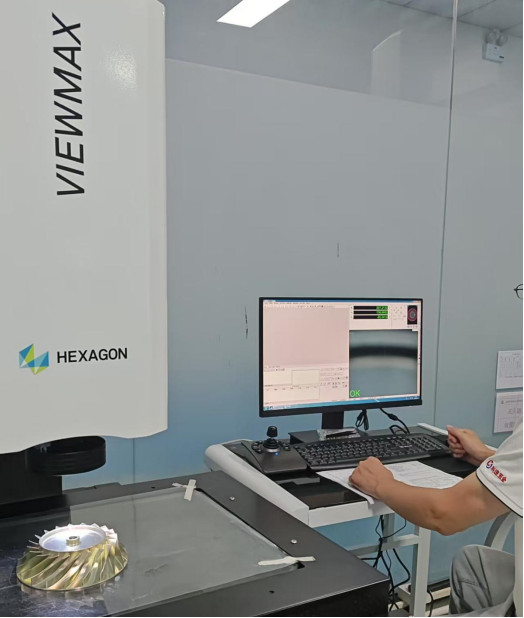
Practical Challenges in Small Impeller Measurement
With years of experience in the precision manufacturing industry, I deeply enjoy that small impeller measurement is almost the last challenge in non-contact precision inspection. These elements are often used in drones, turbochargers, pen-type compressible pumps, dental micro-drive devices, etc., with usually small sizes (diameter 10–60mm), free-form or twisted spiral blade structures, thin-walled soft materials, and accurate form and position tolerances (usually below ±0.01 mm). In practical applications, while CMMs have excellent accuracy, their very large probe diameters, large scanning blind spots, complex programming, long measuring cycles, and high reliance on humans make them unsuitable for mass-produced and highly sensitive parts.
Particularly due to this, the business has an urgent demand for non-contact automatic recognition and high-resolution optical inspection systems. Hexagon’s optical projectors, made under these conditions for micro complicated workpieces, have particularly outstanding performance in small precision impeller measurement.
Core Measurement Technologies of Hexagon Optical Projectors
Hexagon has ample technical reserves in precision optical measurement technology. Its QS series, Optiv Vision, and others optical projectors integrate high technologies such as image recognition, edge extraction, and smart comparison, which enable them to be excellently suited to the geometric inspection of complex structures like small impellers. The main advantages of the system are explained as follows:
High-Precision Optical Imaging System
The projector uses a high-resolution CCD/CMOS camera and telecentric optical lens that provides sub-micron-level image definition without the interference of parallax. Its autozoom can easily accommodate impellers of different sizes, clearly identifying finer features within 0.002 mm for true and accurate geometric reduction.
Non-Contact Measurement Ensures Structural Safety
Since impellers are likely to utilize titanium alloys or ceramic coating materials, contact measurement might be potential damage hazards. Hexagon optical projectors use cold light source non-contact imaging technology, conducting high-precision dimension extraction without contact, excluding probe indentation errors or static electricity adhesion errors, particularly for thin walls and complex surfaces.
Intelligent Image Recognition and Automatic Tolerance Comparison
The system also includes multi-level edge detection and feature extraction algorithms intrinsic to the system, which can automatically detect significant structures such as contour lines, hole positions, bevels, and notches, and compare in real time with imported CAD models. The tolerance zones of size can be defined by users, and the system can automatically decide qualification and give measurement reports, reducing manual operation intensity considerably.
Efficient Measurement Tempo at Fast Pace
Compared with traditional CMM or manual projection methods, optical projectors have obvious advantages in detection speed. For instance, the system is able to complete full-size scanning and analysis of a small five-axis impeller within 3 minutes, which is highly suitable for flexible production lines of large quantities of small batches with high variety, thus being able to meet the requirement of rapid detection of high-frequency warehousing and ex-warehousing.
Analysis of Small Impeller Measurement Application Cases
In order to verify its industrial use, we selected a particular titanium alloy micro impeller for optical measurement experiments. The key data and process reconstruction are outlined as below:
Workpiece Information
- Material: Ti-6Al-4V titanium alloy
- Structure: 5 free-form surface blades + central hole + lower positioning step
- Dimensions: Outer diameter 28 mm, height 12 mm
- Characteristics: Thin wall, ceramic coating, high installation positioning requirements
Inspection Items and Tolerances
| Inspection Item | Tolerance Requirement |
| Blade root thickness | ±0.01 mm |
| Outer diameter concentricity | ≤0.008 mm |
| Outlet angle deviation | ≤±0.5° |
| Flatness/profile accuracy | ≤0.01 mm |
Operation Process
- Fixture installation: Mount the impeller with a high-precision vacuum adsorption platform to avoid micro-deformation caused by manual clamping;
- Automatic focusing and edge recognition: Focus is adjusted automatically and all pre-set feature positions are identified;
- Program calling and comparison analysis: Load standard model, conduct image fitting and error color difference map generation;
- Result output and archiving: Output inspection reports automatically and load them into the SPC database in order to achieve traceability closed-loop.
Efficiency and Precision Comparison
| Project | CMM Measurement | Optical Projector Measurement |
| Single-piece measurement time | 12 minutes | 2.5 minutes |
| Minimum measurable feature | 0.01 mm | 0.002 mm |
| Measurement repeatability | ±3 μm | ±1.2 μm |
| Adaptability | Requires manual adjustment | Automatic recognition, intuitive image |
Industrial Promotion Value of Optical Measurement
From the perspective of operating experience and system integration capabilities, Hexagon optical projectors not only have the laboratory precision inspection capability but also practicability and expansibility for large-scale deployment in factories, especially in new-generation intelligent manufacturing systems, their application value is particularly emphasized.
Achieving Rapid Detection and Quality Closed-Loop Control
Against the burgeoning challenge of production speed requirement, optical projectors significantly improve the efficiency of quality inspection with their second-level identification and high-frequency sampling capabilities. Not only can they replace manual sampling inspection to achieve integrated applications of incoming material inspection, process patrol inspection, and final inspection, but also feed measurement results back to the CNC system through real-time data return functions to automatically compensate for machining tool compensation and achieve machining-inspection closed-loop control in order to ensure product quality stability.
Intuitive Operation, Reducing Skill Threshold
Optical projectors focus on image visualized interfaces and automatic recognition functions. Even front-line personnel with no CMM programming expertise can work independently with short-term training. Their one-key measurement and automatic judgment of tolerance features practically reduce the complexity and error rate of manual operation, substantially reducing enterprises’ dependence on high-skill measurement engineers.
Supporting Automated Integration and Digital Factory Construction
It is supported by some industrial software platforms and is capable of docking with platforms such as MES, ERP, and SPC. Measurement data can be automatically tracked and sent to the central database. With QR code traceability systems and batch coding of the workpieces, it provides quality traceability and SPC throughout the life cycle of the product, so that reliable data support for the building of intelligent and transparent digital factories can be provided.
Conclusion
As advanced manufacturing develops towards miniaturization, complexity, and precision, the inspection requirements for typical components such as tiny impellers have far exceeded the processing capacity of traditional measuring technology a long time ago. Hexagon optical projectors provide a reliable, efficient, and secure quality control solution to such “precise and sensitive” components with their non-contact, high resolution, and highly intelligent characteristics. In future-era production facilities, it is not only an inspection tool but rather an essential capability bearer to propel manufacturing companies to seek digital transformation.
From the practitioner’s perspective, the use of optical measurement technology not only optimized the efficiency of the measurement link but has promoted upgrading of the overall quality management system, a major transformation from “backend quality inspection to front-end design.” Hexagon has proven by technological innovation and industry experience that measurement is increasingly becoming the key driving force behind the development of manufacturing.


