
The ceramic matrix composites (CMCs), with their excellent high-temperature properties, high specific strength, thermal shock resistance, and chemical stability, are now the most ideal materials for aero-engine high-temperature structure parts, gas turbine parts, and so on. Especially for manufacturing advanced geometric components like turbine impellers, CMCs are replacing traditional metal materials to meet engineering demands for elevated temperatures and minimal weight. However, the intrinsic characteristics of these materials—high brittleness and hardness, low thermal conductivity, and high abrasiveness—pose insurmountable obstacles to mechanical machining, making traditional tools unsuitable for precision machining processes.
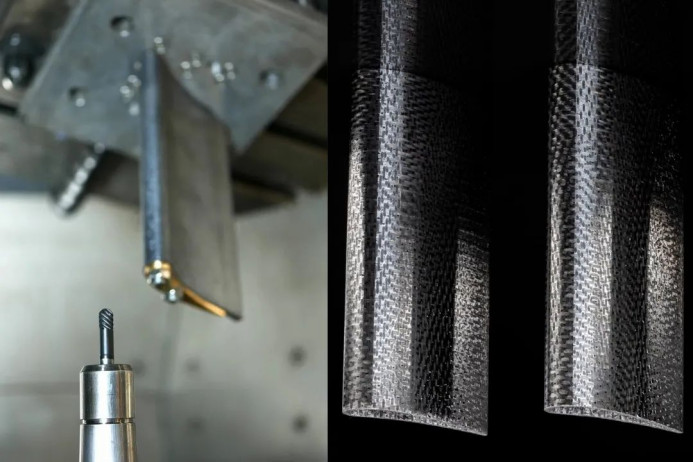
Machining Challenges of Ceramic Matrix Impellers and Demand for Tool Innovation
As advanced aero-engines evolve towards increasing thrust-to-weight ratio and reduced fuel burn, the operating temperature of the hot-end engine components continues to rise, while the thermal efficiency of traditional metallic materials has progressively become the rate-limiting factor. Ceramic matrix composites, especially SiC/SiC and C/C-SiC material systems, have emerged for use in turbine impeller applications owing to their ability to offer structural integrity at temperatures far exceeding 1250°C. However, CMCs have a hardness almost equal to Mohs grade 9, are extremely brittle, and have zero plastic machining capability. In real machining, I discovered that they are highly prone to microscopic defect crack propagation and conduction and dissipation of cutting heat, leading to immediate thermal chipping or enhanced tool wear.
Take my experience with SiC/SiC impeller machining as an example. Prior to employing optimized tools, the traditional cemented carbide milling cutters totally deteriorated following machining less than three workpieces, characterized by extreme edge chipping, evident edge damage, and thermal spot discoloration on workpiece edges. Moreover, chips are pushed out in a fine powder form, highly susceptible to adsorption on the tool flank and causing improper chip removal or even “tool jamming.” This means that correct machining of these materials not only requires tools that are “hard enough” in the material sense but also orderly technological advancements in thermal control, shape control, and life of service. The application of composite tools, especially polycrystalline diamond (PCD) and ceramic-based tools, has been a principal point of access towards achieving such innovation.
Analysis of Composite Tool Types and Adaptability
Under severe conditions such as ceramic matrix composites, conventional tools are likely to fail within a short period by thermal shock, abrasive particle erosion, or brittle spalling, while composite tools have proved to be important tools for successful machining because of their enhanced hardness, wear resistance, and thermal stability. Based on our real-world experience in aviation ceramic impeller machining, different composite cutting tools have their specific performance and application properties and must be matched with machining targets accordingly.
PCD Tools: Perfect Combination of High Hardness and Thermal Conductivity
PCD tools are sintered from micron-level diamond powders at high pressure and temperature, with extremely high Vickers hardness (up to HV8000+) and excellent thermal conductivity and wear resistance. These tools are most ideally suited for roughing and finishing processes of ceramic matrix impellers that are sensitive to cutting temperature to a high level and experience large machining loads. In a silicon carbide-based impeller machining project I participated in, with a Φ6 mm double-edged PCD ball-end mill machining the flow channel region on a five-axis machining center, not only was extremely high machining stability achieved but also surface contour accuracy could be kept within ±0.015 mm, while enhancing cutting efficiency by approximately 30%. Especially in dry cutting or low cooling conditions, PCD tools exhibit much higher thermal annealing resistance than cemented carbides, becoming the leading tools in the process of impeller forming.
Ceramic-Based Tools: Achieving High-Precision Trimming of Complex Surfaces
Silicon nitride (Si₃N₄) or aluminum oxide (Al₂O₃) ceramic-based composite cutting tools have excellent thermal inertia, the ability to regulate brittleness, and high-temperature strength, and they perform exceptionally well under the condition of high-frequency interval cutting and high-speed light cutting. They have a sharp cutting edge and wear evenly, and therefore they are particularly suitable for secondary finishing operations with high surface consistency requirements. In the free-form surface shaping of C/C-SiC based ceramic composite blades, we used alumina ceramic tools for local finishing, which effectively removed fine textures and edge defects generated during initial machining, and finally stabilized the Ra value below 0.6 μm, ensuring the dynamic balance performance and assembly matching of the parts.
Diamond-Coated Tools: A Compromise between Economy and Adaptability
Although diamond-coated tools possess poorer wear resistance than integral PCD tools, they are the most favorable option in medium-strength working conditions due to their high geometric elasticity, lower cost of manufacture, and controllable coating thickness design. Especially in multi-variety and small batch customized impeller projects, they possess excellent cost performance. Microcrystalline diamond-coated ball-end tools were adopted to perform fine sweeping machining on ceramic matrix materials at low feed/high speed conditions. By controlling the edge angle and step approach, we actually reduced the risk of tool (explosive) failure and promoted uniform layer-by-layer wear control. Even for complex rim cutting, precise dimensional stability is still guaranteed.
Multiphase Composite Tools: Exploratory Application across Material Systems
With the continuous development of composite tool structures, some new tools that incorporate cubic boron nitride (CBN) and PCD materials also began showing their benefit in impeller machining under severe conditions. These tools generally achieve a desirable compromise between thermal stability and toughness by structuring the composite layer structure, adapting to complex conditions of simultaneous thermal shock, high hardness, and alternating loads. Despite the fact that they are currently in the small-scale trial stage, their cross-material ductility and flexibility deserve further attention.
In general, composite tool choice should entirely consider material removal rate, tool life, cost management, and equipment versatility, as opposed to relying strictly on one. In ceramic matrix impeller machining practice, it is found that PCD tool roughing, ceramic tool finishing, and diamond-coated tool contour control not only completely make use of the performance characteristics of various tools but also constitute a balanced, efficient, and controllable global tool strategies.
Case Study of PCD Tools Machining SiC/SiC Ceramic Matrix Impellers
In a core-stage SiC/SiC impeller manufacturing project of a turbine engine, I carried out the whole-process milling test of SiC/SiC impeller blanks and conducted the verification of PCD cutting tool performance on machining quality, efficiency, and stability. The impeller diameter is 120 mm, with large flow channel curvature, ±0.03 mm precision requirement, and surface roughness at Ra≤1.0 μm control.
The machining equipment and parameters are set as follows:
- High-speed five-axis machining center, maximum spindle speed 24,000 rpm;
- Tool: Φ6 mm PCD ball-end mill, double-helical edge, R-end passivation design;
- Cutting speed: Vc = 600 m/min; feed speed F = 400 mm/min;
- Cutting depth settings: aₚ = 0.15 mm, aₑ = 0.5 mm;
- Cooling strategy: Full dry cutting supported by low-pressure airflow for chip evacuation.
The machining results are compared and summarized as follows:
| Indicator | Cemented Carbide Tool | PCD Tool |
| Surface Roughness (Ra) | 1.8 μm | 0.9 μm |
| Tool Life (Number of Parts) | 4 pieces | 12 pieces |
| Average Cutting Temperature | >600°C | <450°C |
| Edge Chipping/Cracking | Severe chipping | Uniform wear, intact edge |
| Single-Piece Machining Time | 37 minutes | 29 minutes |
Observations made during machining show that thermal diffusion efficiency of PCD tools is greatly superior to that of regular tools, powdery chips are ejected quickly, and there is no adhesion. The retention of the tool edge is good, and there is no phenomenon of pulling of the fiber or cutting surface tearing, and the consistency of the finished product is greatly enhanced. It can be seen that the use of PCD tools not only greatly enhances performance but also reduces the instability of the machining system and the maintenance cost.
Key Points of Process Parameter Optimization and Tool Geometry Design
In addition to high-performance equipment, scientific parameter matching between machining and path plans is also essential. Based on a combination of different experiments and experience in failure, I conclude briefly the following optimization suggestions:
- Cutting parameters: Medium-high feed rate and high spindle speed (18,000–24,000 rpm) are beneficial to efficient heat dissipation, while multi-pass light cutting (aₚ ≤ 0.2 mm) can avoid stress concentration;
- Edge geometry optimization: Apply a mix of big rake angle and small relief angle to increase cutting lightness; tool tip passivation design (R=0.02–0.05 mm) effectively inhibits micro-crack extension;
- Path control: Helical interpolation and smooth transition surface path paths are proposed to reduce instantaneous impact loads on the tool and extend tool life;
- Auxiliary heat dissipation and chip evacuation: Minimum quantity lubrication (MQL) technology or low-pressure air cooling coupled with dry cutting is the best solution for achieving environmental protection and efficient machining.
Combined optimization of these measures not only helps optimize machining efficiency but also significantly extends the economic tool service life, which is particularly required by mass production.
Conclusion
The experience of composite tool utilization in ceramic matrix impeller machining shows that they are far superior to traditional tools in wear resistance, cutting effectiveness, and machining surface quality, and can even address the machining challenge brought by hard and brittle materials. On the basis of systematic process optimization, tool design, and parameter matching, we have initially established a systematic set of machining paradigms adaptable to SiC/SiC and C/C-SiC materials. In the future, as the power systems of aviation become higher temperature and lighter, composite tools will have more applications in CMC impeller machining to play an important role in providing solid support for China’s high-end manufacturing technology.


