
Being the key rotating components in aero-engines, gas turbines, water pumps, compressors, etc., impellers impose extremely high requirements on the manufacturing quality due to their high rotating speed, heavy load, and awful service environments, especially in the free-form surface control, boundary integrality, and surface property in the further machining processes. Precision grinding wheel technology has become a key technical means in the impeller post-processing process under this circumstance due to its high machining precision, flexible applicability, and repeatability.
Introduction
The complicated configurations and high-performance demands of impellers make their post-processing not only the final step of the manufacturing process but also one of the most critical technological links that determine the service performance of parts. Precision grinding wheel grinding, owing to its highly controllable material removal ability, good surface conformability, and fewer machining residual stress influences, is widely used in high-end manufacturing fields such as aviation and energy in comparison with traditional cutting and polishing techniques.
In a post-processing optimization project of a kind of aviation compressor impeller I participated in, I deeply felt that precision grinding wheels are not a “grinding tool” but a systemic project integrating material science, numerical control technology, and grinding mechanics. Especially in conquering the impeller superalloy and other key machining challenges, multi-degree-of-freedom surface generation, and micro-burr control, it is only with the delicate coordination of wheel material, structure design, grinding parameters, and their CNC path that the leap from “manufacturing” to “refinement” is possible.
Material Composition and Structural Performance Design of Precision Grinding Wheels
Precision grinding wheel design is the foundation of impeller post-processing technology stability and grinding quality. From the material point of view, different impeller materials have differentiated requirements for abrasive types:
- Diamond grinding wheels: Suitable for ceramic-based or carbide-reinforced composite impellers, with extremely high hardness and wear resistance;
- CBN grinding wheels: Widely used in grinding nickel-based, cobalt-based and other superalloy impellers, with excellent thermal conductivity and thermal stability;
- Alumina grinding wheels: Suitable for medium and low hardness metals such as stainless steel and aluminum alloys, balancing cost and machining stability;
- Silicon carbide grinding wheels: Suitable for brittle or composite materials, with good toughness and fracture control capabilities.
In terms of the wheel structure, the range of particle size, binder type (ceramic, resin, metal), porosity, and geometric shape all have a determining effect on grinding performance. The fine particle size (#600~#1000) is generally selected with ceramic binders for finish grinding requirements of free-form surface impellers, and the high-porosity open structure is designed to increase cooling efficiency and cutting ability and reduce local heat accumulation.
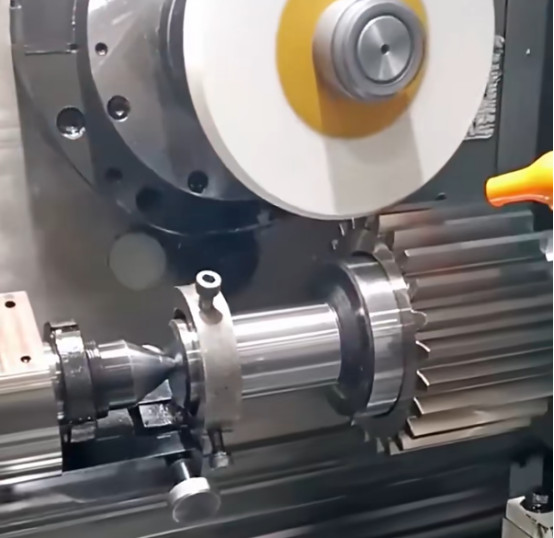
The “clamping point” and “tool setting point” of the grinding wheel form the basis of its coordinate reference system. The clamping point gives the grinding wheel physical location stiffness in the grinder spindle, and the tool setting point, being the logical origin of the CNC trajectory, accurately defines the actual cutting point (tool position point) in the complicated three-dimensional space by precise compensation. Due to the “irregular multi-point cutting” characteristic of the grinding wheel, the coordinate system is particularly complex, with higher requirements being put on the system compensation mechanism, tool setting instrument measuring accuracy, and CNC path generation algorithm.
Process Application of Precision Grinding Wheels in Impeller Post-Processing
In high-end impeller production, though five-axis CNC machining provides rough and finish machining of most geometric shapes, precision grinding operations are still relied upon for post-machining enhancement to meet demands for enhanced surface quality, contour accuracy, and fatigue strength. Especially in aerospace, energy, and precision pump uses, impellers typically need extensive grinding operations such as deburring, edge trimming, surface finishing, and surface strengthening. High-performance grinding wheels—such as precision abrasives of Diamond or Cubic Boron Nitride (CBN)—play an essential core role at this stage of the process because they possess high hardness, acceptable thermal conductivity, and grinding stability. The specific application value and technical mechanism of impeller post-processing are discussed based on three key aspects as follows.
Efficient Deburring and Boundary Cleaning: Balancing Integrity and Topography Control
After milling, impeller blades typically have residual tiny burrs, built-up edges, and cutting stress concentration points in the areas of the blade tip, blade root, and back bend. These micro-defects, if not removed in time, will not only affect the next assembly process downstream but also potentially become the “initiation source” of fatigue cracks, threatening service safety. Traditional manual deburring is time-consuming and lacks consistency, while the application of micro-diameter high-strength grinding wheels to implement boundary flexible grinding treatment on a multi-axis linkage grinder with a programmed track can not only precisely control the grinding force to avoid over-removal but also effectively keep the sharpness of the edge to achieve functional boundary (remolding). Especially for aero turbine impellers of complicated free boundaries, the method significantly improves process stability and part consistency, and greatly extends structural life.
Complex Contour and Free-Form Surface Finishing: Achieving “Geometric Reproduction” and “Error Correction”
Impeller blades nowadays usually have large-range curvature variation, space warping, and non-uniform variable thickness structures, which place extremely high requirements on three-dimensional surface accuracy (within ±5 μm). Traditional finish milling is prone to minute contour deviations in local regions or areas limited by tool geometry that have to be eliminated through “reprocessing compensation” techniques in grinding. By making use of a CNC grinding system to lead the forming grinding wheel to travel along the free-form surface trajectory, the grinding wheel in this case not only functions as a geometric shaping tool but also as an error compensation module, carrying out re-shaping treatment of minute deviation areas through online detection and reverse path compensation mechanisms. This operation can significantly improve overall dynamic balance and aerodynamic performance, with particular application to sensitive dynamic performance precision energy equipment key impeller components.
Surface Roughness and Residual Stress Control: Improving Service Performance and Fatigue Life
In addition to shape accuracy, the second basic goal of impeller after-treatment is to optimize surface topography and stress status. The roughness control directly affects the impeller flow boundary layer and fatigue strength. By employing fine-grain grinding wheels (grain size #1000 or finer) in combination with low feed rate and low cutting depth parameters, the surface roughness can be enhanced from Ra 1.6 μm after milling to below Ra 0.2 μm, even “mirror finishing” can be achieved. Taking an aviation turbine blade project I participated in as an example, the combined use of CBN grinding wheels and a high-pressure cooling system not only realized combined grinding + mirror polishing treatment but also effectively improved the corrosion resistance and service fatigue limit of the parts.
In the meantime, grinding heat control is also one of the key factors determining final performance. CBN grinding wheels have excellent thermal conductivity. When paired with a high-pressure internal cooling + directional nozzle system, they can effectively take away cutting heat and inhibit the occurrence of surface thermal cracks, white layers, or thermal fatigue failure. By streamlining the grinding path strategy and intermittent grinding rhythm, residual stress field distribution can be further optimized to achieve the “strengthening during processing” objective. The components can gain more excellent performance reserves in service throughout processing.
Beyond Definition: The Deep Influence of Wheel Specificity
The grinding wheel’s nature as a “multi-point random cutting” tool makes its tool setting point and clamping point utilization far more complex than that of ordinary tools. Such complexity is reflected in the following three aspects:
- Fuzziness and definition dependence of tool position points: The cutting edge of a lathe tool is a certain geometric point, while the “cutting point” of a grinding wheel is countless abrasive grains that change instantaneously. The so-called tool position point is essentially a theoretical calculation reference artificially defined according to the processing strategy (e.g., forming grinding, trajectory grinding). This requires process personnel to fully comprehend the principle of processing in order to define and compensate appropriately.
- Interference of dynamic characteristics: The centrifugal growth of the grinding wheel during high-speed rotation, the elastic deflection by the grinding force, and even the thermal growth of the spindle will slightly change the actual vector from the clamping point to the tool point. In ultra-precision grinding (e.g., optical glass, silicon wafers), these micron-level changes need to be suppressed by online monitoring and adaptive compensation technology.
- Challenges of measurement technology: The precise calibration of the tool setting point and tool position point offset of non-standard grinding wheels depends on high-end tool setting equipment. The laser tool setting equipment can non-contactly measure the wheel profile, and the three-dimensional probe can scan the wheel topography in the machine and automatically calculate the compensation value, becoming the standard configuration of high-end grinders.
Conclusion
In summary, precision grinding wheels not only play the traditional roles of geometric error rectification and surface performance optimization in the impeller post-processing grinding process but also lay the technical groundwork of contemporary high-precision grinding through their material compositeness, structural design freedom, and control system integration potential. In the future, with the continuous development of intelligent manufacturing technology, research and development of superhard abrasives, and grinding modeling and simulation technology, precision grinding wheels will achieve the evolution of “cutting tools” to “process platforms” in impeller manufacturing and become an important support for the realization of the independent and controllable manufacturing capacity of high-end equipment.
In my opinion, the true “precision manufacturing” is not merely a question of fulfilling (dimensions) but a systematic realization of the whole process process cognition and control. Precision grinding wheels represent the most intelligent and engineering-integrated link in this system.


