
Following extensive popularization of the national “dual-carbon” strategy and green manufacturing concepts, the traditional impeller machining processes relying heavily on abundant cutting fluid more and more show bottlenecks such as huge environmental protection costs, complex treatment of waste liquids, and severe working conditions. As a novel green cutting technology, Minimum Quantity Lubrication (MQL) has increasingly shown to have characteristic advantages in machining high-value complex components due to its extremely low lubricant consumption rate, excellent lubrication and cooling effect, low environmental impact, and higher operator-friendly work environment.
Introduction: Innovation Demands for Impeller Machining under Green Manufacturing
Due to their inherent role in aero-engines, gas turbines, and high-speed compressors, among other uses, impeller parts place very demanding requirements on geometric integrity, surface finish, and consistency of cutting. Traditional impeller machining employs largely wet cutting, i.e., achieving lubrication and heat removal through widespread application of emulsions or oil coolants. Despite this practice maintaining fine machining results in the short run, its long-run environmental pollution, impact on the health of the operator, and rising cost of treatment have proven to be major barriers to suppress the in-depth research of green manufacturing.
I myself faced issues such as seepage of cutting fluid into the ground and frequent blocking of the waste liquid collection system during impeller pilot production, which made me most urgently aware. Micro-lubrication technology has attracted industry attention at a speed that is extremely fast with its concept of “minimum lubrication, accurate spraying” and has been largely conceived as a major breakthrough to replace the conventional wet cutting and towards near-dry green manufacturing.
Principle and System Composition of Micro-Lubrication Technology
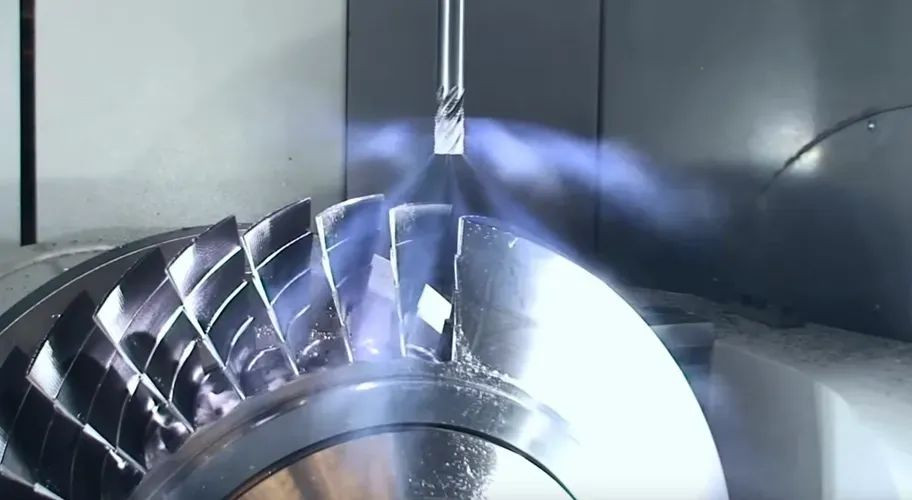
Micro-lubrication technology is a machining lubrication method that achieves efficient lubrication and assist cooling through a low oil consumption, typically keeping the regulation of oil supply in the range of 5–50 mL/h, much lower than the several liters per minute of traditional cutting fluid systems. Its working principle is to (deliver) special lubricating oil into the atomization chamber through a precision oil pump, atomize the oil mist completely through high-pressure air, and lead it to the tool-workpiece contact area through a nozzle.
The typical composition of an MQL system includes:
- Compressed air source: Provides kinetictnergy and spraying force for oil mist;
- Quantitative oil supply pump: Regulates oil supply accurately to avoid excessive spraying;
- Mixed atomization unit: Ensures uniform mixing of oil and gas to form fine droplets;
- Directional nozzle system: Regulates the direction of atomization precisely to move to the cutting interface directly;
- Controllable switch module: Coordinates with machine tool signals to offer automated cooperation with machining tempo.
MQL does not rely on waste liquid recovery equipment or coolant circulation units, significantly simplifying auxiliary equipment. It is a low-technology, green, and high-efficiency manufacturing lubrication technology.
Advantages of Micro-Lubrication Technology in Impeller Machining
In the high-performance impeller manufacturing, with the double requirements of green manufacturing and efficient machining constantly improving steadily, traditional cooling technology step by step shows many shortcomings such as massive liquid consumption, difficult treatment, and serious pollution. As an integrative cooling lubrication solution in the field of environmental protection and machining efficiency, Minimum Quantity Lubrication (MQL) has proven to have a very high practicability and utilization value in the field of high-speed cutting of impellers over the past few years. The advantages are fully summarized from different angles as follows:
Significantly Reducing Environmental Pollution and Operating Costs
In practical operation, MQL hardly generates waste liquid. The atomized lubricating oil is cleaned away along with chips, eliminating collection and treatment, thus actually achieving “source emission reduction”. Following the introduction of MQL in our workshop, waste liquid collection was abolished and supporting sewage equipment no longer needed to be updated or maintained, with over 30% reduction in environmental protection investment. In the meantime, the consumption of lubricating oil per year is kept below one-thousandth of the original, with a great reduction in lubrication costs.
Extending Tool Life and Improving Machining Efficiency
In high-speed milling of impellers, cutting zone temperature normally exceeds 500°C, especially in machining superalloys, the tools are extremely prone to wear and chipping. MQL has the effect of alleviating the adhesion heat accumulation and interface friction by proper lubrication, while the drops also have some thermal diffusion effect for local surfaces, significantly retarding the process of tool wear. Experimental evidence suggests that when MQL is utilized, tool life will generally increase by 20–50%, and even to 80% in some instances. I used to track the tool change cycle of a particular titanium alloy impeller machining line. When it switched to the MQL system, from the previous average of 18 minutes, it increased to 28 minutes, significantly reducing the effect of tool change shutdown on production capacity.
Enhancing Impeller Surface Quality and Dimensional Consistency
Because MQL can uniformly spray the lubricating droplets onto the tool contact point, it might still be able to achieve stable lubrication effects under dynamic machining conditions of five-axis linkage and complicated surfaces. Regular coolants, due to their large range of flushing but non-uniform film deposition, have a tendency to form dry cutting conditions in localized areas, while MQL eliminates this issue and thus significantly reduces surface scratches, edge-building effects, and micro-burning effects. In actual machining, after MQL lubrication, roughness of some blades of titanium alloys constantly decreased from Ra1.4μm to below Ra0.9μm, and assembly tightness and work efficiency were also enhanced at the same moment.
Wide Machining Adaptability, Suitable for Various Materials
Whether for high-speed cutting of aluminum alloys or machining heavy loads of superalloys, MQL can be adapted to different processing requirements through adjustments in oil mist spraying parameters (such as nozzle direction, flow rate, pressure). As an example, in difficult-to-cut materials such as Inconel 718, MQL is able to efficiently minimize the adhesion problem at elevated temperature between the tool and the work material, with uninterrupted machining continuity in a stable manner without introducing significant quantities of coolant.
Analysis of Typical Cases and Comparison Results
The following are the experimental comparison data of a specific aviation factory with regard to titanium alloy materials for impellers:
| Comparison Item | Traditional Wet Machining | Micro-Lubrication (MQL) |
| Tool Life | 18 min | 28 min |
| Surface Roughness (Ra) | 1.4 μm | 0.9 μm |
| Waste Liquid Treatment Cost | High | Extremely low |
| Machining Consistency | Medium | High |
| Workshop Environment | Wet and pungent | Clean and comfortable |
The impact fully exhibits the overall advantages of MQL in environmental conservation, machining stability, and economy. Such a practice of achieving a win-win condition of manufacturing quality and environmental protection through “process innovation + system optimization” is well worth propagating in more manufacturing scenarios.
Promotion Value and Application Suggestions
As the next generation of green cutting and cooling technology, Micro-Lubrication Technology (MQL) combines environmental protection, economy, and intelligent potential, and is the main technical direction for high-performance impeller machining to develop towards “green, efficient, and intelligent”. Combining industry development tendency and operation experience, the following promotion values and suggestions are proposed:
Complying with Policy Guidance and Constructing a Green Manufacturing System
MQL technology is highly compatible with the demands of the “14th Five-Year Plan for Green Manufacturing Development” to “reduce the usage of cutting fluids and popularize dry and near-dry machining methods” and is a strong means to implement energy conservation and emission reduction in the context of the “dual-carbon” strategy. This is the age of the nation as it demands green transformation, and MQL is not only a manufacturing process but also a reflection of increased practice of corporate social responsibility and sustainable development strategy.
Cost Reduction and Efficiency Improvement to Enhance Economic Competitiveness
Through the compression of cutting fluid procurement, transport, recycling, and treatment chains, MQL significantly extends the service life of tools, reduces the frequency of tool change, and minimizes downtime, thereby generally enhancing the availability of production lines and the ability to control unit costs. In the long run from a business perspective, the production benefits and environmental added value brought by MQL will actually drive market competition and brand influence for enterprises involved in the high-end equipment manufacturing industry.
Promoting Intelligent Manufacturing System Integration
New MQL systems are highly compatible with CNC machining centers, and the smart adjustment of lubrication strategy, precision spray control, and tool wear status monitoring can be achieved, therefore, they are a necessary element in the building of an intelligent machining closed-loop control system. Coupled with CAM programming, process simulation, and tool life model analysis, MQL helps to upgrade the manufacturing model from “experience-dependent” to “data-driven decision-making”, and make digital and intelligent upgrading easy.
Promotion Suggestion Paths
For the sake of guaranteeing effective promotion and smooth operation of micro-lubrication technology, the following promotion channels are suggested to advance:
- Priority deployment of application scenarios: Prioritized pilot practice in high-speed and high thermal load impeller machining processes such as titanium alloys and aluminum alloys to achieve rapid accumulation of process maturity experience;
- Joint development of special tools: Collaborate with tool manufacturers to develop special tools suitable for MQL, and achieve integrated design of “structure-coating-lubrication”;
- Optimize cutting parameters and chip-breaking strategies: Match the cooling characteristics of MQL, adjust feed speed, cutting depth, and chip-breaking morphology, and achieve a machining mechanism of “short chips + rapid heat dissipation”;
- Strengthen personnel training and system construction: Establish MQL operating requirements, equipment maintenance systems, and process training systems to improve on-site staff’s technical application ability and abnormal processing level and ensure long-term stable operation of the system.
Conclusion
Micro-lubrication technology not only is an eco-friendly and green lubrication technology but also captures the common pursuit of advanced high-end manufacturing for process control precision, effectiveness of resource utilization, and ability for sustainable development. During the ultrahigh precision and performance requirements of parts processing such as impellers, using MQL represents a three-breakthrough in cost saving, quality improvement, and environmental improvement. In the future, with the increasingly strengthening development of intelligent manufacturing and green factory construction, in my view, micro-lubrication will achieve the process innovation effect of “less is more” in an increasing number of machining scenarios and serve as a main driving factor to push manufacturing transformation towards high quality and low energy consumption.


