
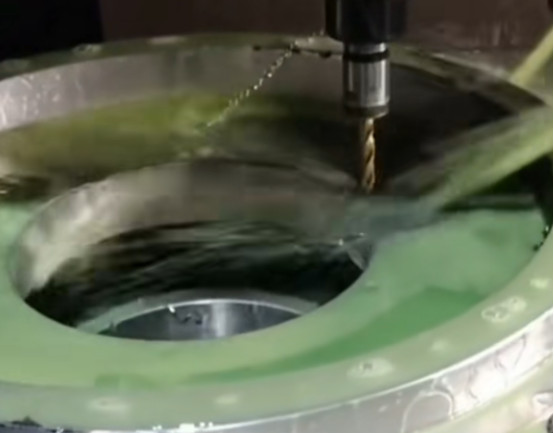
In high-precision impeller part machining, surface roughness is one of the most important part quality and service life criteria. In impeller machining, due to complex surfaces, high heat generation, and the specificity of tool contact areas, surface roughness is susceptible to many influences. As a mandatory auxiliary of machining, the cutting fluid cooling system directly affects machining quality and surface finish.
Introduction
In nowadays’ CNC machining, as the typical complex surface parts, impellers’ performance and service life are largely determined by their surface roughness. Due to abrupt curvature change and thin wall thickness, there are the involved contact states of tools in machining with more serious heat accumulation and chip evacuation issue. These greatly affect surface quality, especially roughness. Cutting fluid cooling system plays a particularly significant role in this process: aside from reducing cutting zone temperature, it also reduces tool wear and improves cutting stability through lubrication, thereby effectively improving impeller surface roughness. In this paper, various cooling methods are summarized to analyze their respective effects on impeller surface quality and provide related optimization suggestions.
Special Requirements for Cooling Systems in Impeller Machining
In high-precision manufacturing, impellers as typical complex surface parts have a great reliance on five-axis or multi-axis linkage technology in machining. The characteristics of their geometric structure make problems such as local heat concentration, enormous tool load fluctuation, and chip adhesion easy to happen. Therefore, the traditional cooling system can barely meet the precision and stability requirements of impeller machining. To ensure machined surface quality, tool life, and machining efficiency as a whole, increasingly more and higher technical demands must be imposed on cooling systems. Certain impeller machining requirements for cooling systems are presented from some critical perspectives as follows.
Severe Local Heat Concentration Requiring Strong Cooling Support
Impeller configurations are generally composed of a number of thin-walled blades and narrow flow passages. High-speed spindle cutting produces much heat per unit time. Due to structural limitations, heat is difficult to dissipate, (highly likely) to generate local high temperatures in the machining area, resulting in thermal deformation and affecting machining accuracy and dimensional stability. This is more obvious when machining low thermal conductivity materials such as titanium alloys or nickel-based alloys. Therefore, the cooling system must have intensive cooling capacity to remove heat quickly, maintain thermal equilibrium in the machining area, and avoid error accumulation through thermal deformation.
Complex Cutting Trajectories Requiring Precise Cooling Coverage
Five-axis machining trajectories often have non-linear complex shapes such as spiral surfaces and S-shaped transitions. Tools continuously shift their attitudes during machining, so it is difficult for traditional fixed nozzles or general cooling methods to provide sustained coverage of the cutting point. Especially at inaccessible areas such as deep grooves and flow channel bottoms, cooling blind spots cause the tool wear rate to increase dramatically. Therefore, impeller machining requires multi-axis follow-up cooling nozzles or inner high-pressure cooling systems to achieve real-time direction adjustment of cooling fluid with tool attitudes, so that cutting fluid always accurately sprays on the tool-workpiece contact area and enhances cooling efficiency and uniformity.
High Surface Quality Requirements Requiring Cooling to Control Micro-Defects
The high-end impeller products have extensive use in aviation, energy, and other fields with extremely high hydrodynamic performance requirements, where the surface roughness needs to be controlled below 0.4μm, and even to the mirror level of Ra 0.2μm in certain instances. Inadequate cooling during cutting can lead to thermal deformation, chip build-up on tools, or re-cutting of chips, which can produce micro-defects such as vibration marks, scratches, and thermal spots. Therefore, apart from temperature reduction, the cooling system must possess excellent lubrication capability and chip removal capacity to help the tools achieve stable cutting and avoid surface quality damage due to local thermal interference.
Difficult-to-Machine Materials Requiring Both Lubrication and Anti-Adhesion Capabilities
Impellers often use high-strength materials such as titanium alloys, nickel-based alloys, and stainless steel, which generally have characteristics like severe work hardening, poor thermal conductivity, and easy tool wear. Especially under high cutting temperatures, chip adhesion to tools and boundary burning are apt to occur. High-performance cooling fluids must have excellent extreme pressure and anti-wearability, oxidation stability, low viscosity, and high lubricity, which can efficiently reduce friction and adhesion between tools and workpieces in cutting, extend tool life, and improve machining stability.
Classification and Comparison of Cutting Fluid Cooling Methods
Cooling systems of cutting fluids can be divided into several main cooling types with various performances in impeller machining. Comparison of common cooling types is as follows:
| Cooling Method | Characteristics | Impact on Surface Roughness |
| Conventional External Cooling | Simple operation, low cost, limited cooling efficiency | Prone to local temperature rise, leading to unstable roughness |
| High-Pressure Cooling System | High pressure (5–20 MPa) directly injected into the cutting zone | Significantly reduces built-up edge and thermal deformation, resulting in smoother surfaces |
| Internal Tool Cooling | Cutting fluid sprayed through the tool interior, acting directly on the cutting point | High-precision cooling, suitable for deep cavity impeller machining, significantly improves surface roughness |
| Minimum Quantity Lubrication (MQL) | Uses a small amount of cutting fluid, environmentally friendly and energy-saving | Suitable for low-speed finishing, effectively controls surface roughness |
| Ultrasonic Cooling Assistance | Enhances lubrication and cooling effects with ultrasonic vibration | Helps suppress tool-chip adhesion, improves micro-surface quality |
Through comparison, high-pressure cooling systems and internal tool cooling perform particularly well in high-speed and high-load impeller roughing and finishing, effectively improving surface roughness.
Mechanism of Cooling System on Surface Roughness
In high-precision impeller machining, surface roughness is one of the most important parameters to assess machining quality. For hydrodynamic components in particular, even a slight surface defect will cause efficiency loss or fatigue failure. The composition and operation of the cooling system directly affect the tool working environment, cutting zone temperature, chip removal efficiency, and friction state. Scientific and reasonable cooling actions can not only enhance thermal control in machining but also significantly optimize final surface quality. The role of cooling systems in regulating surface roughness is analyzed at a number of essential mechanism levels as follows.
Reducing Thermal Influence and Suppressing Surface Hardening Layer Formation
In impeller high-speed machining, due to severe local deformation and material friction, cutting point temperature will rapidly rise to several hundred degrees, generating plastic deformation and thermal softening of the cutting zone. Surface annealing, microstructure transformation, and machining hardening layer formation will be triggered by unreasonable temperature control, thereby affecting roughness consistency. An effective cooling system can effectively remove cutting heat by precision spraying and intense cooling flow, maintain the tool-workpiece contact area temperature within an ideal range, and actively suppress the formation of thermal strain effects, maintaining surface flatness and stable original material characteristics.
Reducing Tool Wear and Improving Cutting Stability
Tool wear is another main cause of surface roughness degradation. When the tool has less edge chipping or edge passivation, it will produce fine scratches or vibration marks on the workpiece surface. The cooling fluid forms a lubricating film in the cutting zone, effectively reducing direct friction between tool and workpiece and slowing down the wear rate caused by thermal friction. Meanwhile, the lubrication effect also stabilizes cutting forces, dissuades micro-vibration of the tool in high-speed motion, and ultimately improves the continuity and uniformity of the machined surface.
Optimizing Chip Evacuation to Avoid Surface Scratching
In five-axis machining of complex surfaces, chip flow trajectories are topographically constrained and prone to accumulate in narrow areas such as blade roots and curved channels. If not ejected timely, chips may be retracted to the machining area by the tool and cause secondary cutting and scratching on the machined surface. Especially in micro impeller machining, this type of “micro-chip impact” is more frequent and difficult to detect. Multi-point or high-pressure spraying cooling systems can make use of the kinetic energy of fluid to flush chips from narrow clearance quickly, keep the cutting zone clean, and effectively avoid surface quality variations caused by chip accumulation.
Preventing Built-Up Edge Formation and Enhancing Micro-Quality
Built-up edge formation is usually the result of local high temperature on the tool rake face and periodic adherence of bonded materials. When the built-up edge breaks or falls away from the tool, it has a tendency to create micro-defects such as pits and ripples on the surface of the workpiece, significantly affecting Ra value consistency. The extreme pressure additives and the stable lubrication mechanism in the cutting fluid possess the ability to form a protective liquid film at the tool-material interface that prevents metal adhesion and material stripping, significantly reducing the tendency for built-up edge formation, and greatly enhancing the integrity and flatness of the surface microstructure.
Typical Experiments and Case Analysis
An aviation enterprise compared the machining performances of conventional cooling and high-pressure cooling systems when machining nickel-based alloy impellers. The comparison showed that the high-pressure cooling system significantly improved surface roughness, and tool life and production efficiency were also elevated. The specific figures are as follows:
| Item | Conventional Cooling System | High-Pressure Cooling System |
| Surface Roughness (Ra) | 0.62 μm | 0.28 μm |
| Machining Consistency | Large roughness fluctuation | High roughness stability |
| Tool Life | 12 pieces/tool | 22 pieces/tool |
| Rework Rate | 8.5% | 1.2% |
The experimental results fully validate the benefit of high-pressure cooling systems in the improvement of surface quality.
Cooling System Optimization Suggestions
It is necessary to select proper cooling approaches based on different material characteristics. For example, high-pressure cooling systems or internal cooling systems are recommended for nickel-based alloys and titanium alloys, while aluminum alloys can be used with minimum quantity lubrication (MQL) systems. In addition, it is proposed to optimize cooling angles and flow rates dynamically together with CNC tool paths, realize online cooling monitoring and feedback control systems for ensuring effective operation of the cooling system. Low-foam, high-permeability, and eco-friendly cutting fluids are used to reduce cutting fluid pollution, and long-term system stability is ensured by periodic examination of nozzle wear and cooling channel blockage.
Conclusion
The impact of the cutting fluid cooling system on impeller surface quality should not be neglected, since it is directly related to machining process stability and product end consistency. By optimization of cooling methods, reasonable design of the nozzle system, and accurate control of machining parameters, the surface roughness of impellers can be significantly reduced, and product performance and market competitiveness can be improved. Together with the development of green machining and intelligent manufacturing concepts, cooling systems will play a more important role in impeller machining in the future.


