
With the development of High-Speed Cutting (HSC) and High-Feed Machining (HFM) technology, the machining efficiency and surface quality of impeller parts have been significantly improved. In aerospace, energy, automotive, and other fields, especially the complexity of impeller parts requires more precise and effective toolpath design in response to machining demands.
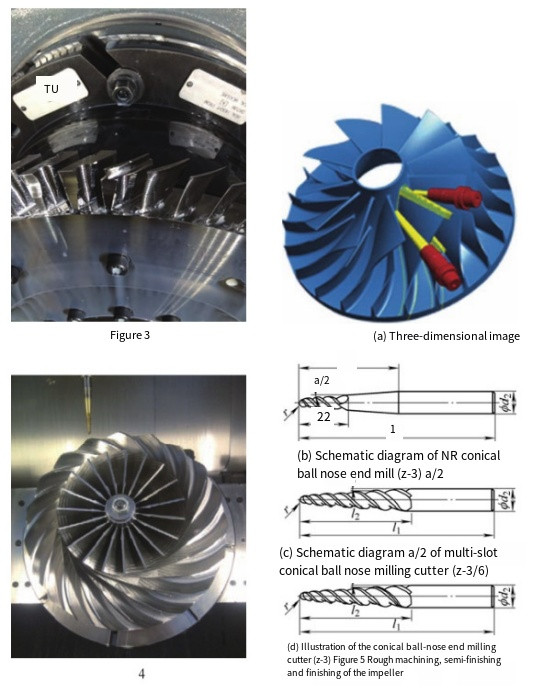
Characteristics and Difficulties of High-Speed High-Feed Impeller Machining
High-Speed High-Feed (HSC+HFM) machining is machining under the conditions when the spindle speed is over 15,000 rpm, the feed rate is 10–30 m/min, and the cutting depth is shallow. It is mainly applied in impeller roughing and semi-finishing, enabling high amounts of stock to be removed with high machining efficiency and low unit energy consumption.
However, impeller parts normally have complex 3D surface geometries, i.e., spiral blades, narrow flow channels, and hub transition regions. These complex geometries cause tremendous challenges to machining. Traditional toolpaths in HSC+HFM will tend to cause machine vibration, tool overheating, additional acceleration, and other issues, which can significantly affect machining quality and equipment life. Therefore, toolpath design is a key to achieving efficient and stable impeller machining in high-speed high-feed machining.
Rational Selection of Toolpath Strategies
Multi-axis machining of complex impellers entails the direct impact of the selection of toolpath strategy on machining efficiency, surface quality, and the life of the tool. Especially in roughing and finishing operations, different strategies have to be purposely integrated on the grounds of workpiece geometry, material properties, and machine capability. The following sections discuss the significant functions of adaptive roughing and multi-axis equidistant finishing in the manufacturing of complex impellers.
Adaptive Roughing Strategy
Adaptive Clearing is an extremely efficient machining strategy based on real-time toolpath optimization through stock self-adjustment. Unlike traditional contour or spiral paths, the method dynamically controls the direction and width of the tool feed according to the actual difference between the blank and target model, maintaining the cutting load roughly constant. The machining operation offers the following main advantages:
- Improved machining efficiency: Intelligent material removal path planning achieves a higher removal rate per unit time, especially suitable for rapid machining of large-stock areas.
- Balanced tool load: As feed paths are always constructed based on constant cutting conditions, tools do not undergo instantaneous impact loads, significantly reducing the risk of edge chipping.
- Extended tool life: Cutting force and temperature stability allows for more controllable tool wear, with significantly improved durability when machining hard materials (e.g., superalloys, composites).
- Enhanced roughing stability: Reduces machine jitter and noise, contributing to uniform residue on subsequent finishing surfaces.
Adaptive roughing is typically used with High-Speed Machining (HSM)/High-Feed Machining (HFM) strategies, suitable for large-size impellers or complex structures with substantial internal stock, representing an important development direction for five-axis roughing.
Multi-Axis Equidistant Finishing Strategy
As functional free-form surfaces, impeller surfaces have extremely high requirements for finish and shape accuracy. In finishing, the five-axis equidistant toolpath strategy is the mainstream method. With the tool maintaining an equal distance from the workpiece surface, this method achieves space continuity and evenness of machining trajectories, with the following advantages:
- Improved surface finish: Steady toolpath stepover eliminates tool transition marks and local cutting amount variations, significantly reducing Ra values.
- Enhanced geometric consistency: Equidistant approaches help reduce overcutting or undercutting caused by curvature variation, especially suitable for small-radius corners or composite surface areas.
- Avoidance of posture abrupt changes: Compared with contour finishing, five-axis equidistant trajectories continuously alter tool postures, reducing vibrations and lateral tool impacts caused by sudden posture changes.
- Efficient tool matching: It is recommended to use large-diameter round-nose cutters or ball-nose hobs, combined with large stepover and high-speed machining, to improve efficiency while maintaining surface quality.
Meanwhile, utilizing the automatic equidistant toolpath generating function of the CAM software (such as HyperMILL, NX CAM) enables the creation of different feed strategies for different areas, achieving local optimization and global unified machining control.
Controlling Cutting Load and Feed Angle
In HSC+HFM, for improving machining quality and tool life, a stable and controllable cutting load is most essential. The key control points are:
- Tool engagement angle control:Prevent the tool from sudden entry into the cutting area by creating smooth lead-in paths to ensure that there are no steep changes in engagement angles.
- Side edge load distribution: When machining long narrow areas like blades, unilateral engagement will easily cause asymmetric tool loads, affecting machining quality. Symmetric bidirectional path design stabilizes tool loads and reduces cutting force imbalance.
- Corner transition optimization: Toolpath corners often produce tremendous cutting force shocks. Rational arc transition parameters dampen acceleration variation caused by corners and prevent vehement machine vibration.
Preventing Path Interference and Collision
Impeller parts usually have complex geometries and limited machining space, especially at blade roots, hubs, and flow channel intersections, where tool interference is most likely to happen. Interference must therefore be especially considered in path planning. Effective interference avoidance strategies include:
- Combination of short-shank tools and long-overhang hobs: Enhances tool rigidity and accessibility, reducing interference risks.
- Five-axis tilt-axis linkage paths: Transfers tool angles and paths with five-axis technology in order to avoid significant features like blades and hubs to reduce interference.
- Air machining simulation: Utilizes CAM system simulation functions to predict toolpaths, maintaining each cut within a safe area and avoiding potential interference.
Optimizing Tool Approach/Retract Paths and Air Move Efficiency
In HSC+HFM, approach/retract paths of the tool have a significant effect on machining stability and efficiency. Proper design can dramatically improve overall machining efficiency. Optimization strategies include:
- Spiral or ramp engagement: This engagement method avoids excessive impact when the tool enters the cutting area, enhancing machining stability and reducing tool wear.
- Combination of climb and conventional milling: Select climb or conventional milling according to blade geometry in different areas to balance tool forces and improve machining effects.
- Streamlined air move paths: Set reasonable tool safety start/end points to reduce non-cutting time and improve overall efficiency.
Typical Machining Cases and Application Results
For production use, HSC+HFM toolpath planning techniques have shown excellent achievements. For example, an aerospace compressor impeller, with HyperMILL high-speed adaptive roughing and five-axis finishing paths. Compared with traditional methods:
- Roughing productivity ~60% improvement, machining residual layer ~30% less, tool life extended by 1.5 times.
- Dynamic hob tilt control in impeller transition areas along curves of curvature significantly improved the local surface quality, completely meeting the high precision requirement of Ra < 0.4μm.
Conclusion
The HSC+HFM technique has continuously improved manufacturing efficiency and precision in the machining application of impellers. In the machining of complex impeller parts, appropriate toolpath design can effectively avoid interference, balance cutting force, and optimize the path, thereby enhancing overall machining quality and productivity. With the further development of intelligent manufacturing technologies, future impeller toolpath design will become more intelligent, finer, and more efficient, pushing high-end manufacturing to new technical levels.


