
Under the increasingly improving requirements of efficient manufacturing, turn-mill compound machining equipment has demonstrated excellent advantages in multi-batch impeller manufacturing by its combined and consolidated process function. The article compares the traditional split-process machining process path with the turn-mill composite machines’ one-stop shaping process path, juxtaposes the structure of machining time under different process paths, calculates its effect on process cycle, ( changeover efficiency), and total machining time in multi-batch impeller production, and provides process strategy recommendations for the rapid delivery of complex impeller geometries, providing data support and practical basis for batch production efficiently.
Introduction
Impellers are important components of fluid machinery with complex geometric structures and high machining precision requirements, typically needing multi-axis and multi-process collaborative machining. In the traditional process chains, turning, milling, and drilling of impellers need to be completed step-by-step on a number of machine tools, with problems such as frequent changeovers, large positioning errors, and long cycles. Accompanying the emergence of turn-mill compound technology, multi-task processing equipment has provided a comprehensive solution to impeller manufacturing. Especially in the production mode of multiple batches, the reduction of the machining time and the improvement of efficiency are particularly critical, and therefore comparative analysis of the time characteristics of different schemes needs to be performed.
Comparison of Process Flows
For batch processing of impeller parts, machining path planning controls the production efficiency and consistency of quality. The traditional process route has a tendency to separate the turning and milling processes. Although each process can be achieved by equipment most suited to that link, it manifests a lot of weaknesses in clamping accuracy, process efficiency, and man-machine coordination. On the contrary, with the development of CNC equipment technology, turn-mill compound machining centers have increasingly become a new trend in efficient impeller manufacturing. What follows is a comparative study of the differences between the traditional split process and the turn-mill compound process in real operations from a process flow perspective.
Traditional Split Process Flow
In the traditional impeller manufacturing system, the machining process is usually reliant on a number of pieces of equipment to achieve step-by-step collaboration, and every process is accomplished in sequence by various equipment and operators. The traditional machining process flow is:
- Preliminary turning of the impeller outer circle and end face (using ordinary lathe or CNC lathe);
- Transfer to a five-axis machining center to perform milling of blade surfaces and hub areas;
- Complete hole machining and chamfering operations by using a drilling machine or vertical machining center;
- Re-clamping the alignment positioning, and manual inspection and process parameter inspection are required for every process.
This model has certain flexibility in the initial manual and low-automation production environment, but its intrinsic structural flaws have progressively been exposed. Some problems such as equipment waiting, excessive clamping time, and uneven scheduling of operators among links in multi-batch machining operations make non-cutting time increase sharply. In addition, positioning errors caused by repeated clamping inevitably affect dimensional accuracy and product consistency.
Especially for large and complex impellers, loading/unloading and fixture debugging among processes are particularly time-consuming. Under the production conditions of the medium batch or above, this process method has not been able to meet the requirements of improving both efficiency and precision.
Turn-Mill Compound Integrated Process
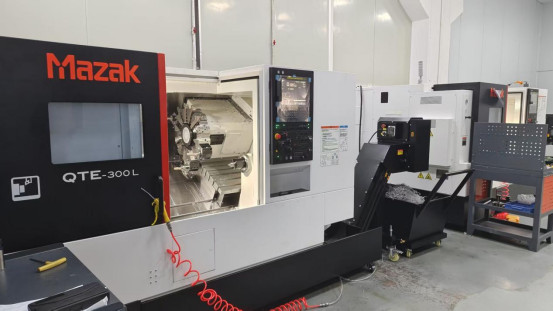
Turn-mill compound technology integrates a number of processes such as CNC turning, milling, and drilling, which complete all or most of the processing tasks on a compound processing machine tool with multi-axis linkage and process integration capabilities. Its process flow can be concluded as:
- Complete rough and finish turning of the outer circle and end face in one clamping;
- Directly perform blade contour milling and positioning hole machining under the same clamping condition;
- Complete machining of all geometric surfaces such as the hub, blades, shaft holes, and opposite faces on the same machine tool;
- The whole process can be automatically switched with tools and equipped with an online measurement module to achieve process control closed-loop.
Its greatest advantage lies in process combination and composite positioning. The “processing islands” formed by series connection of several machining centers in the traditional model are 打通 (linked), avoiding intermediate dangers caused by repeated positioning error, fixture adjusting, and handling. It not only improves dimension consistency and machining accuracy but also greatly saves auxiliary time and improves unit time output efficiency.
Additionally, turn-mill compound machine tools are typically equipped with tool magazine systems and high-precision servo drives, which can achieve multi-tool collaboration, automatic tool switching, and dynamic compensation, suitable for batch production operations with a complex structure, high precision requirement, and diversified impeller products.
Time Comparison Experiment of Multi-Batch Impeller Machining
This paper selects a certain type of aluminum alloy impeller (diameter φ80 mm, 6 blades) as the test piece to carry out a time comparison experiment for batch production of 50 pieces. The setting parameters are as follows:
| Machining Mode | Machining Equipment | Average Time per Piece (min) | Total Duration for 50 Pieces (h) |
| Traditional Split Process | Lathe + Five-Axis + Drilling Machine | 23.5 | 19.6 |
| Turn-Mill Compound Machine | Multi-Channel Compound Center | 15.8 | 13.2 |
| Time Saving Ratio | —— | ↓32.8% | ↓32.7% |
Time Composition Analysis:
- Clamping time reduced: from an average of 4 times to 1 time;
- Tool change optimization: original equipment needed preheating and tool adjustment, while turn-mill compound realizes fast automatic tool change through the tool magazine;
- Cycle balance: traditional mode requires scheduling coordination, while compound processing has a stable cycle;
- Reduced idle waiting: equipment utilization rate increased by over 25%.
Key Factors Affecting Time Efficiency
Equipment Performance Matching
Compound machine turn-mill time efficiency is closely dependent on the performance matching of the equipment itself. The tool magazine capacity has a direct influence on the tool changing frequency and efficiency. Poor capacity will tend to interrupt the machining process, increasing non-cutting time. Position accuracy and rigid support of the turntable are the guarantee of steady cutting in complex blade milling. Good dynamic response performance can directly undermine machining vibration, improve cutting speed and surface quality, and enhance overall machining efficiency.
Programming Optimization Strategy
Rational programming strategies are the key to reducing the machining cycle. With the help of advanced CAD/CAM integrated systems, multi-channel and collaborative operation tool paths can be generated to achieve synchronous or alternate machining of the main spindle and sub-spindle. This kind of approach not only reduces tool change and clamping time to a minimum but also reduces empty running strokes and tool non-cutting time through path optimization, with the highest tool utilization and machine tool dynamic response speed, substantially shortening the single-piece machining cycle of parts.
Workpiece Batch and Model Change Frequency
Workpiece batch size and product model change frequency are important external affecting factors of manufacturing time efficiency. In small-batch and multi-variety production settings, turn-mill compound machines can significantly save model change preparation time and improve response ability and capacity utilization rate because of their flexible model change and rapid program switching. In comparison, though the traditional split process assembly line is high production efficiency in high-repetitive and large-batch work, it is inflexible in the case of frequent model change, with a tendency to lead to equipment idling and capacity loss easily. Therefore, the rational coordination between production batch and machining process route is the key to the time efficiency improvement of impeller production.
Conclusion
Turn-mill compound technology offers a new solution direction for the high-efficiency production of complicated impellers. By the empirical contrast and composition analysis of machining time in this paper, the efficiency benefits of turn-mill compound technology in multi-batch production modes are explained, offering powerful references for process planning and equipment selection. In the future, there is a need to continue to integrate digital twin and intelligent scheduling systems to enhance its application prospects in large-scale flexible manufacturing.


