
As with the global surge of intelligent manufacturing, impellers as key components in manufacturing aviation, energy, automotive, etc., high-end equipment, the automation degree of impellers has increasingly become an essential production line intelligence indicator. By doing so, loading/unloading system as an important component of production line cycle control has direct influences on production efficiency, product quality, and staff security.
Introduction
Being basic components of complicated mechanical fluid devices, impellers have complex and detailed shapes, high precision requirements, long machining cycles, and strict repeated clamping accuracy. In traditional manufacturing, impeller loading/unloading is mainly manual and wasteful with potential repetitive workpiece clamping and orientation mistakes, affecting final machining performance and equipment utilization. With factory production changing into high-cycle, high-flexibility, and unmanned production modes, it is a significant task in automated impeller machining lines to develop a stable, efficient, flexible, and intelligent loading/unloading system. In our view, simple mechanical handling is insufficient to meet the current needs; new loading/unloading systems should be “cognitive” and “interactive” intelligent subsystems with environment perception, task recognition, collaborative control, and fault self-diagnosis capabilities.
Core Functional Requirements of Impeller Loading/Unloading Systems
Not only do automatic loading/unloading systems in impeller manufacturing carry out general workpiece loading/unloading and transfer functions but also play an important role in cycle control, positioning accuracy, and system stability. An ideal automatic loading/unloading system should have the following central functions:
Automatic Recognition and Precision Positioning
It must integrate more high-accuracy vision recognition or laser scanning devices to perform automatic recognition and posture analysis of different impeller models, automatically switch between multiple models without intervention from the operator, and dynamically modify gripping paths based on real-time workpiece positions to achieve quick and precise positioning and pick-and-place tasks.
Flexible Clamping System
With variations in the dimensions, mass, and form of impellers, the system should be equipped with changeable or self-change fixtures in order to adapt the flexible machinability requirements of multi-variety and small-batch machining. Meanwhile, the fixture rigidity and inclusiveness should be ensured to obtain stability and clamping safety during transportation.
Intelligent Path Planning and Obstacle Avoidance Control
By utilizing advanced motion control algorithms and spatial mapping capabilities, the system can achieve obstacle dynamic avoidance and path planning based on the environment, preventing interference with the equipment, workpieces, or employees, and maximizing efficiency and safety in use.
Equipment Collaborative Linkage
The loading/unloading system should enable information interconnection and action connection with production connections such as CNC machines, cleaning devices, and testing stations, coordinating operations as per a shared cycle to achieve smooth material flow and avoid waiting and idleness.
System Status Monitoring and Fault Warning
Real-time monitoring of the working state of key components such as robot arms, fixtures, and motors, and early fault detection and alarm by gathering and analyzing data. For example, monitoring of quantities such as variation in clamping force, equipment operation temperature, and motion track deviation in an aim to achieve smart maintenance and remote diagnosis, and enhance system reliability and availability.
Analysis of Key Points in Structural and Control Design
Fixture System Design
Due to the common hollow central axis, curved blades, and asymmetric structures of impellers, fixture design requires high customization. I prefer the following design strategies:
- Elastic Multi-Point Clamping Structure: Combining three-point positioning with surface-contact clamping for the purpose of rigid immobilization on complex surfaces without deforming clamping.
- Modular Jaw System: Utilizing quick-changing mechanisms for rapid changing between different impeller models, making offline adjustment possible in order to maximize model change efficiency.
- Protection and Safety Design: Applying soft cladding or limit damping systems on jaw contact surfaces to protect against bending or scratching.
Selection of Handling Mechanisms
Handling mechanism selection should consider spatial arrangement, load type, and system cycle very carefully. Common types are:
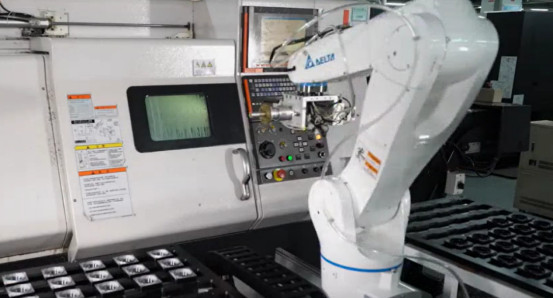
- Six-Axis/Four-Axis Industrial Robots: Most suitable for small space or complex path handling tasks with high freedom levels and ease of integration. For example, the ABB IRB2600 robot has a repeat positioning accuracy of ±0.04mm and is therefore capable of most precision handling of impellers.
- Gantry-Type Manipulators (Gantry Structure): Most suitable for large-sized impellers or multiplex station coverage requirements, with high load bearing and rigidity and high structural rigidity.
- Combined Structure of Sliding Table and Lifting Table: Used to build up vertical conveying capacity in the direction of Z-axis, used in general application for automated storage with multi-layer pallet structures.
Design of Cycle Collaboration and Buffer Mechanisms
Cycle collaboration in production is key to ensuring overall line operation efficiency.
- Setting of Transfer Buffer Zones: Removing cycle discrepancies between processes through structures such as sliding rails and transfer pallets to prevent equipment idle time due to waiting.
- Dual-Station Operation Design: Dual-jaw-shaped robots or dual-gripping point robots can perform the following material picking operation before placement for smooth connection.
- Collaborative Control of PLC + Host Computer System: Realizing task issuance, equipment feedback, and dynamic path adjustment through real-time data interaction.
Control System and Integration Logic
The design of the control system directly influences the intelligence level for the entire line.
- System Architecture Configuration: Including master control PLC, human-machine interface (HMI), robot control cabinet, vision recognition unit, I/O modules, and communication buses, adopting a centralized-distributed hybrid control architecture.
- Communication Interfaces and Protocols: Enabling connectivity with CNC systems and MES systems to facilitate data upload, task download, and operation monitoring needs.
- Modular Design of Control Logic Programs: Operations such as action planning, fixture control, path monitoring, and collision detection are designed as independent adaptable function blocks to improve efficiency in maintenance.
- Remote Diagnosis and Intelligent Operation and Maintenance: Using edge computing nodes and cloud servers, the real-time acquisition of status information, remote alarm analysis, and smart maintenance are realized.
System Configuration Strategies for Different Production Line Application Scenarios
| Application Type | Recommended System Configuration | Feature Description |
| Small-batch multi-variety | Six-axis robot + quick-change fixture + vision recognition | High flexibility, suitable for frequent model change production |
| Medium-batch standardized products | Gantry manipulator + pneumatic fixture + sliding rail buffer | Stable cycle, high cost-performance ratio |
| Large impeller processing line | Multi-joint robot + lifting turntable + force-controlled clamping system | Strong load capacity, high precision |
| Fully automated production line integration | Handling robot + AGV logistics + RFID scanning traceability system | Supports cross-station linkage and logistics collaborative control |
Supplementary Analysis of CNC Loading/Unloading Technology
There are two common control modes of CNC automatic loading/unloading systems in real engineering:
- Based on CNC System: Used for production processes requiring flexible path adjustment, with advantages of flexible control and user-defined complex action procedures.
- Based on PLC System: Suitable for production lines with fixed process flows and stable cycles, featuring stable control and fast response.
Technical comparisons of three common automated loading/unloading methods are as follows:
| Characteristics | Six-Axis/Four-Axis Manipulator | Gantry-Type Manipulator | Workpiece Exchange System |
| Precision Requirements | High | Medium-high | Low |
| Load Capacity | Medium | High | Medium |
| Adaptability to Processing Routes | Changeable | Linear | Simple and fixed |
| Material Change Frequency | High | Medium | Low |
Personally, I am of the opinion that with the more and more flexible and tailored demands in a production environment, six-axis manipulators and vision systems will be the mainstream of the future, yet gantry structures are still to be favored for steady production and heavy-load application, while workpiece exchange systems are suitable for standardized and batch product needs.
Conclusion
As “first step” and “last step” of automated impeller machining systems, the automation level of these automatic loading/unloading systems is directly accountable for operation efficiency, flexibility, and personnel safety assurance of the entire line. Through accurate fixture design, rational selection of handling mechanisms, scientific cycle control measures, and stable control system integration, the manufacturing of impellers can be advanced efficiently toward intelligence, efficiency, and flexibility. In the future, with the emergence of artificial intelligence, 5G communication, and digital twin, the impeller loading/unloading system will become more and more new intelligent subsystems with “self-learning,” “self-decision-making,” and “remote collaboration” capabilities. We will continue to develop and refine this field in a bid to bring more wisdom and strength to propel high-quality development of the manufacturing industry.


