
As the widespread applications of impellers have been extended in the fields of aerospace, power generation, and high-performance fluid machinery, the geometric configurations of impellers become more complicated, especially the inner cavities, not merely with variable shapes and thin gaps but also with extremely strict requirements for dimensional tolerancing and surface quality. The traditional contact measurement methods often struggle to handle deep cavities, bent surfaces, and other areas due to probe interference, varying accuracy, and measurement blind spots. The non-contact, high-precision, digitized benefit of the laser probe technology is rendering it increasingly the mainstream in the detection of complex impeller inner cavities.
Introduction
Impellers are crucial components of most rotational mechanical devices, and they are related to the efficiency and stability of the machine in operation. In applications such as aero-engines, gas turbines, and hydraulic pumps, the inside of impellers is typically developed as curved flow channels or complex inner cavity shapes for fluid flow optimization and increase in aerodynamic efficiency. But these internal spaces are generally of geometric shapes such as spiral form, variable cross-sections, and multi-curvature surfaces. Limited space, drastic curvature variation, and strong reflectivity lead to conventional coordinate contact measurement techniques facing challenges such as immense interference, many measuring blind spots, and complex precision control in engineering practice.
In engineering practice for a long time, I personally feel that traditional measurement technology gradually exposes limitations in the detection of complex inner cavities in the aspect of precision. Especially when batch production and quality closed-loop requirements become increasingly enhanced, the necessity for an advanced detection method to penetrate complex spaces, provide real-time feedback on the presence of measurement errors, and weigh efficiency and precision becomes urgent. Laser probe technology just meets this demand.
Technical Principle of Laser Probe
A laser probe is an optical laser interferometry or optical triangulation-based non-contact high-precision measuring device. Its basic working mechanism is as follows: a laser emits a concentrated laser beam to illuminate the target surface, the reflective light is captured by a position-sensitive detector or interferometer and then converted into 3D coordinate information through an internal calculation module. Based on variation in measurement principles, common laser probes are mainly divided into two categories:
- Laser Triangulation: Calculates surface distance of objects by emitting a laser beam and recording the offset location of its reflected point on a detector, best suited for 3D modeling of complex curved surfaces and irregular shapes.
- Laser Interferometry: Quantities extremely small displacement and topography change by observing the variation of the interference fringes of reflected light and reference light. Hexagon’s HP-O interferometric probe is typical equipment for high-precision detection of chamfer and profile.
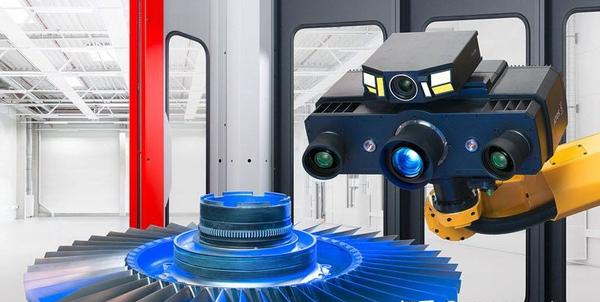
Laser probes are usually mounted on five-axis CNC milling machines, coordinate measuring machines, or robot arms. Combined with path planning and point cloud comparison algorithms, they can achieve full-coverage scanning and high-precision error estimation for complex impeller inner cavities.
Technical Challenges in Detecting Complex Impeller Inner Cavities
The geometric design of complex inner cavities of an impeller usually pursues optimal flow performance, and the resulting multi-curved surface, special-shaped channels, and deep hole blind spots pose a series of challenges to detection technology:
First, the spatial structure is complicated. The typical inner cavity structure of the impeller consists of quickly changing cross-sectional shapes, massive inner wall inclination angles, and many curvature changes, which enable multiple flow channels or chamfers within a tiny volume, inducing massive difficulties in probe incident angle design and scan paths design. Optical interference is powerful. The surface reflectivity of several materials for impellers is high, and the condition for lighting inner cavities is poor, so it is simple to interfere with laser signals and difficult to identify. Thirdly, common measurement methods impose serious interference. The mechanical probe pins are hard to pierce thin channels, susceptible to collision or contact force deformation, which harms the reliability of measurement. Finally, precision requirements are extremely high. Especially on aviation or high-pressure pump products, inner cavity wall thickness and channel size deviations need to be kept within ±5~10 μm in most instances, which is difficult to maintain consistently using traditional means for an extended time.
Exactly for these reasons, in my opinion, in order to successfully apply the detection of complex impeller inner cavities, measurement methods need to have rich capabilities like high degrees of freedom, very small volume, high resolution, and intelligent path control, and laser probe technology by no means has inherent advantages in these aspects.
Engineering Advantages of Laser Probe Technology
In detection measurement of new impellers and complex inner cavity structures, laser probe technology is clearly superior to traditional contact measurement methods in engineering applications, especially well-adapted for accurate high-precision detection of the workpiece with thin wall thickness, high reflectivity, and complex structures. Its inherent advantages are mainly illustrated in the following points:
Non-Contact Measurement, Eliminating Contact Interference
Laser probes collect information based on principles of light, avoiding probe contact deformation and clamping error caused by workpiece deformation in contact measurement and being particularly favored for non-destructive measurement of high-finish surfaces and highly deformable thin-walled blades.
High Precision and Submicron-Level Resolution
High-precision laser probes can have submicron-level resolution of measurement, with measurement errors controlled within ±3~5 μm, meeting the strict detection requirement for precision curved surfaces and fine geometric features.
High-Speed Data Acquisition and Processing Capability
Laser probes are capable of high-speed scanning in thousands of points per second, capable of completing large-area 3D measurement in a short period of time and capturing high-density point cloud data, thereby improving detection efficiency, optimal for quick quality inspection under batch production conditions.
Excellent Adaptability to Complex Structures
Laser measurement technology has (extremely strong) path flexibility. The laser beam is able to travel through slender flow channels, blade roots, deep cavities, and dead corners inaccessible to ordinary probes, greatly improving the integrity and accuracy of inner cavity detection.
3D Modeling and Automated Analysis Capability
Combined with CAD/CAM systems, the point cloud data scanned by laser probes can reconstruct 3D models in real-time, and realize automatic deviation analysis, out-of-tolerance detection, and compensation path optimization processing through comparison with design models, which can give a closed loop of processing-detection and promote the level of intelligent manufacturing.
In an attempt to further elucidate the distinction between laser probes and traditional contact probes in key performance indicators, the following table presents the comparative analysis of the two:
| Indicator | Laser Probe | Traditional Contact Probe |
| Measurement Method | Non-contact | Contact |
| Precision Range | ±3~5 μm | ±10~15 μm |
| Measurement Efficiency | High-speed acquisition (thousands of points/second) | Low-speed (point-to-point) |
| Adaptability to Inner Cavity Structures | Extremely strong | Weak |
| Point Cloud Visualization and Modeling Capability | Supported | Not supported |
| Automation Integration Compatibility | High, can be integrated with robot systems | Low, relies on manual operation |
Engineering Case Analysis
In an aero-engine project we did, we ever faced the inner cavity detection issue of a complex turbine impeller. The diameter is about 80mm, the depth is 60mm, the spiral flow channel is variable curvature, and the inclination is from 20° to 85°. The traditional coordinate measurement technology could not penetrate deep into the channel, with much gap, low manual detection efficiency, and high misjudgment rate.
Having developed the Renishaw NC4 laser probe, we integrated it into a five-axis machining center to implement “processing-detection integration” processes. The inner cavity wall thickness, channel profile, and curvature deviation were inspected on the machine directly after processing and point cloud registration and error analysis were conducted based on the original CAD model. The detection time was shortened from 30 minutes by traditional methods to 8 minutes, the average measurement error was kept within ±4 μm, the qualification rate was increased by 12%, and the false detection rate decreased by approximately 80%. At the same time, through feedback data, we optimized the process paths of some areas, achieving a manufacturing-detection closed loop.
Apart from that, in maintenance operations of a gas turbine, we used a laser profile instrument combined with an angle encoder to achieve full-circle effective scanning of blade tip clearances; in the case of a steam turbine, a laser tracker combined with a VProbe hidden probe enabled high-precision assembly of the rotor and cylinder. All the examples illustrate that laser probe technology is highly engineering flexible and system reliable for measurement of complex space, multi-angle, and multi-curvature parts.
Conclusion
With its high accuracy, non-touch, and excellent adaptability, laser probe has gained enormous excellence in the measurement of complicated impeller inner cavities with high accuracy. With its rapid accumulation of massive data and high-density 3D reconstruction, it not only overcomes the restriction of traditional measuring methods but also builds a powerful quality close loop in production. Under the condition of the rapid development of intelligent manufacturing, laser probes will play a greater role in quality traceability, automatic correction, online monitoring, and other aspects. We have grounds to believe that with the continued miniaturization, intelligence, and platformization of laser measurement systems, their usefulness in accurate detection of composite components will continue to be released and become a major technical backing for pushing forward the upgrading of high-end manufacturing.


