
Against the backdrop of the high-speed development of aerospace technology, impellers, being a component part of power equipment such as engines, turbopumps, and liquid rocket thrusters, are under constant improvement in terms of geometric precision, surface quality, and dynamic performance. Precision impellers not only sustain extreme rotation loads and thermal conditions but also determine the thermal efficiency, thrust-to-weight ratio, and service life of the overall machine. With the increasing demand for light, efficient, and extreme environment tolerance in aeronautical machinery, impeller manufacture entails unparalleled challenges in terms of material, forming method, machining precision, and detection methods.
Introduction
From my experience of working on manufacturing and inspecting high-precision parts, I have deeply realized that the manufacturing precision of impellers is pivotal in determining the stability of operation, safety, and performance of equipment such as aero-engines. As the key component for gas power conversion, impellers must possess extremely high geometric homogeneity, fatigue resistance, and dynamic balance capabilities. Impeller structures in aerospace systems in particular tend to (become complicated), be miniaturized, and light in weight, with smaller and smaller machining error limits, which makes it difficult for traditional machining modes to maintain high-end specifications for efficiency and precision. To catch up with this trend, it is necessary to rely on the simultaneous application of high-performance materials (e.g., titanium alloys, nickel-based superalloys, etc.), five-linkage machining technology, precision forming methods by casting, and intelligent inspection systems for full-process precision control from forming to assembly.
Core Precision Indicators of High-Precision Impellers
As high-precision impellers are important rotating components in aerospace, energy, and high-grade equipment systems, their geometric shape, fit tolerance, surface quality, and dynamic balance status decide directly the operating performance and service life of the entire machine. The following four categories of precision indicators constitute the basic pillar of their manufacturing quality control.
Geometric Shape Accuracy
The geometric shapes of high-accuracy impellers usually have complicated three-dimensional free-form surface shapes, with very strict control over their contour lines and their thickness changes and blade shape variations. Blade shape variations must be controlled within ±10μm, and flow channel variations within ±0.05mm, to meet aerodynamic design requirements. Particularly, blade thickness distribution and curvature variation from blade tips to roots directly affect the adhesion of airflow and the loss of flow, which are of high concern for improving the efficiency of impellers.
Dimensional and Positional Tolerances
While precision assembly, the tolerances of fit between bearings and impellers, and between casings, and sealing parts need to be especially controlled. Interference fits between the impellers and rotors are generally utilized, and precision of fit should typically be at the H6/k5 level, but coaxiality and perpendicularity tolerances need to be controlled to 5μm. Any minute deviation will cause high-frequency vibrations, reducing the reliability and life of the entire machine.
Surface Roughness
The quality of the impeller surface not only affects hydrodynamic efficiency but also directly correlates with the initiation and propagation characteristics of fatigue cracks. Compressor blades typically require a roughness of Ra≤0.2μm, while turbine blades need to achieve Ra≤0.1μm, and some high-load components even require mirror finishing. I believe that this is not merely a surface treatment issue but a systems problem encompassing material selection, heat treatment, cutting methods, and grinding strategy.
Dynamic Balance Accuracy
High-speed impeller dynamic balance requirements are extremely strict. In most applications, the remaining unbalance should be less than 1g·mm, and some even less than 0.5g·mm. Precise adjustment is realized by double-sided dynamic balancers, along with laser weight removal, digital recording, and traceable control to obtain full-process dynamic balance control.
Advanced Manufacturing Paths for Impeller Precision Assurance
To meet the strict requirements of high-precision impellers in geometric accuracy, surface roughness, and dynamic balance, one needs to establish a highly integrated manufacturing and testing system. On the basis of five-axis machining technology as the core, combined with intelligent compensation, closed-loop control, and heat deformation control strategies, precision consistency and structural reliability of mass-produced impellers can be systematically ensured.
Five-Axis High-Precision Machining and Intelligent Compensation
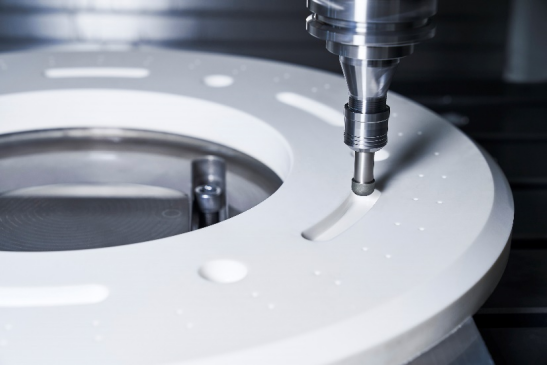
Five-axis linkage CNC technology is becoming the mainstream technology for manufacturing complex impellers, with multi-degree-of-freedom collaborative control function suitable for simultaneous machining of free-form surfaces and deep cavity structures. Represented by high-rigidity five-axis machining centers such as the GROB G350, their structural dynamic rigidity and thermal stability are excellent, able to provide sub-micron positioning accuracy at high speed. During machining, tool path interference check, cutting force simulation, and process feasibility check can be implemented based on CAD/CAM integrated systems such as UG NX to ensure path safety and surface integrity. With schemes of real-time tool compensation integrated into thermal deformation prediction models, complex contour errors and blade root stress concentration issues can be well controlled to improve overall machining precision and fatigue life.
Precision Detection and Error Closed-Loop Feedback
The precision detection system is the key linkage in impeller manufacturing quality inspection. With CMM (Coordinate Measuring Machine), laser profile scanners, and non-contact optical 3D scanning machines, the most significant geometric parameters such as blade shapes, flow channels, and transition zones can be detected through the entire range. The detection information is then compared with CAD models to generate error distribution maps, which are real-time fed back to the CNC system to form a closed-loop measurement-driven process adjustment control chain. The mechanism not only greatly improved the first-piece qualification rate but also reduced dimensional variation across batches, demonstrating its process stability as well as repeatability accuracy in several aviation compressor impeller projects.
Precision Fixtures and Thermal Deformation Control Systems
Thermal deformation control and clamping stability play direct roles in high-precision impellers’ dimensional stability. In actual applications, adaptive flexible fixtures combined with multi-point pre-stress loading systems can potentially absorb the cutting force fluctuation and reduce the clamping deformation. At the same time, through temperature-controlled machining tables, tool temperature rise measurement, and heat source infrared analysis systems, thermal error detection and dynamic response models are established to achieve closed-loop control of the temperature field during machining. Especially for machining low thermal conductivity materials such as Inconel 718 and titanium alloys, these thermal control measures are able to effectively suppress part dimensional drift and local thermal stress concentration.
Application of Materials and Lightweight Precision Forming Technologies
Not only do high-precision impellers require high geometric precision but also require good mechanical properties as well as thermal stability. Light-weight precision casting technology has been playing a gigantic role in manufacturing core parts such as aero-engines, missiles, and satellites.
Casting Technologies for Aluminum-Magnesium Alloys and Titanium Alloys
Aluminum alloys exhibit good thermal conductivity and machining properties, enabling them to achieve high dimensional precision and density through die casting and low-pressure casting. Magnesium alloys are used in aerospace wheel hubs, casings, and other components due to high specific strength, acceptable damping, and electromagnetic screening. The combined application of the centrifugal casting, vacuum pressure casting, and precision investment casting processes for titanium alloy is a stable course of forming complexly shaped impellers. Studies have verified that the surface roughness of TC4 impellers with vacuum casting processes is less than 6.3μm, and tensile strength is more than 900MPa, significantly improving the service reliability.
Case Study on Precision Casting
In a certain type of aero-engine impeller production project, by adopting five-axis rough and finish milling, laser-assisted finishing, and high-frequency vibration polishing technologies, the error of blade contour was finally maintained at ≤±8μm, surface Ra value at ≤0.12μm, dynamic balance at 0.6g·mm, and qualification rate by dimensions increased to 98.7%. All processing and inspection data were entered into digital quality files, creating an intelligent manufacturing process with traceability and feedback.
Future Development Trends and Personal Outlook
In my opinion, future aerospace impeller precision enhancement will mainly focus on the following areas:
- Integration of Intelligent Manufacturing Platforms: Digital twin technology, AI-programming, and virtual commissioning platforms will deeply penetrate the manufacturing process, and attain full-process closed-loop control of error prediction, deformation forecasting, and intelligent compensation.
- Promotion and Application of Advanced Materials: New alloys like rare earth magnesium alloys and foam magnesium will be used in (new generation) aircraft and aero engines, promising to minimize structure weight and maximize performance.
- Nanometer-Level Measurement and Multi-Field Coupling Control: As the non-contact measurement accuracy reaches the nanometer range, process optimization using multi-physical field modeling (thermal-force-vibration) will be greatly improved to enhance the level of dimensional control for complex structure parts.
- Composite Application of New Processes: Technologies such as ultrasonic-assisted machining, laser composite milling, and high-energy beam surface strengthening will increasingly be employed to apply to hard-to-machine areas of high-precision impellers to counter problems of high tool wear rates and work hardening.
Conclusion
In conclusion, precision requirements of high-precision impellers in the aerospace industry have much exceeded general manufacturing standards, including geometric shape and position accuracy, tolerance fit, surface finish,
Surface integrity


