
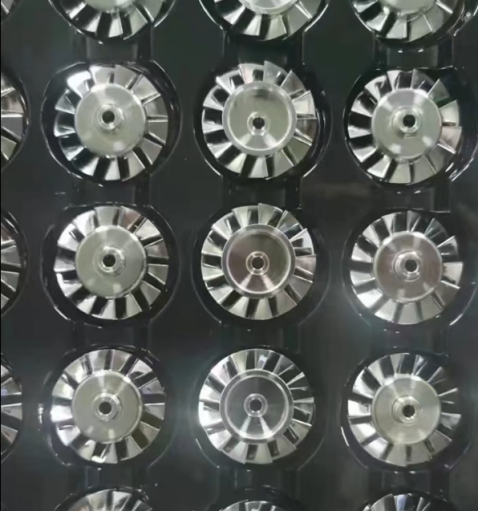
In high-performance manufacturing, impellers, the most critical power components, are widely used in aerospace, energy, chemical, and precision compression devices. The machining efficiency and quality of impellers have a direct impact on the performance and reliability of the entire machine.
With the ongoing development of complex flow channel and multi-curvature impeller structures, traditional machining methods can no longer meet the high-precision and efficient manufacturing needs. Being the core management platform of smart manufacturing nowadays, the Computer Numerical Control (CNC) system is of fundamental supporting significance in path planning, motion coordination, error compensation, machining monitoring, and data management for machining the impeller.
Introduction
Impeller machining is a technological leading edge in high-performance manufacturing. The inherent difficulty not only comes from the nonlinear geometric properties and high-degree-of-freedom surfaces, but also from the extremely high requirements for response speed, machining process stability, and repeatability. The widespread application of five-axis linkage machining technology provides a feasible approach to efficiently shape such parts, but the solution depends on the control performance of the CNC system in order to truly realize its potential.
As the “brain” of the machining center, the performance of the CNC system impacts on the machine tool’s execution accuracy for complex paths, response speed for faulty conditions, and adaptive versatility to multi-variety impeller machining tasks. Based on some aviation and energy equipment manufacturing projects, we have profoundly grasped that the overall scheduling and intelligent operation level of the CNC system are the key supports to improve the efficiency of impeller manufacturing.
Core Functions of CNC Systems in Impeller Machining
Being traditional complex free-form surface parts, impellers pose highly stringent requirements on CNC machining systems in terms of both geometric accuracy and surface quality. Modern CNC systems, when handling high-speed five-axis machining of impellers, have evolved from mere motion control platforms to central control centers encompassing precision guarantees, process-wise optimization, and information exchange. The central functions are thoroughly investigated in four dimensions:
High-Speed and High-Precision Interpolation and Trajectory Control
The impeller surface is generally a spatial free-form surface with non-uniform curvatures, needing extremely high smoothness and tool path interpolation accuracy. Newer CNC machines have nanosecond-level interpolation cycles and advanced trajectory look-ahead algorithms (e.g., the Look-Ahead algorithm), permitting high-speed and stable operation under continuous trajectory. In actual machining, we have found that path interpolation smoothness directly affects the oscillation of cutting loads and surface residual stress states. Issues of high-speed operation path corner jitter and imbalance of inter-axis coordination are effectively avoided by using dynamic feedforward control with the CNC system.
Real-Time Error Compensation and Machining Dynamic Adjustment
Inherent sources of errors such as temperature fluctuation, tool wear, and thermal expansion are inevitable in machining impellers. The CNC system can be equipped with intelligent compensation modules (such as thermal drift compensation, SmartComp error compensation, and tool life management) to correct machining errors in real-time. In an application of a titanium alloy impeller, by enabling the system’s internal thermal compensation model, we attained effective blade thickness error control within ±0.01 mm, significantly improved finished product consistency.
Multi-Axis Coordination and Posture Optimization Control
Impeller machining is typically characterized by incessant processing of surfaces along different directions with the aid of five-axis coordination. The CNC system, in this case, not only has to correctly coordinate composite motion of rotating and linear axes but also avoid path interference and abrupt posture changes in real-time. Advanced systems allow tool axis limits management, posture function incremental change, and multi-segment path posture optimization, which are extremely necessary for machining slender flow channels and torsion blades. In our particular project, we were able to successfully remove interference risk in five path segments by utilizing the CNC system’s posture optimization approach, significantly enhancing machining stability.
Digital Information Integration and Feedback Closed Loop
As an intelligent manufacturing node, the CNC system can be deeply integrated with CAM software, MES systems, process databases, etc., to achieve full-process closed-loop control from tool path generation to production monitoring. Its data interaction function not only supports rapid import and calling of process files but also real-time recording of principal machining data for later optimization analysis. In our enterprise, not only is the CNC machine a work machine for conducting machining work, but also a data bridge to connect engineering design, process planning, and quality inspection.
Analysis of Supporting Effects on Improving Impeller Machining Efficiency
In manufacturing complicated impellers, the CNC system not only handles trajectory execution and axis control functions but also plays key supportive roles in overall efficiency in many aspects such as programming management, switching during production, machining cycle, and stability in quality. The direct roles of the CNC system in increasing machining efficiency are extensively discussed from the three aspects:
Shortening Programming and Model Change Time
CNC machines also possess multi-channel and multi-program segment management capabilities to accommodate functions such as automatic tool changing, workpiece zero point switching, and parameter library calling, all of which contribute considerably to small and medium lot size model change efficiency for multi-specification impeller products. In our batch manufacturing of a batch of stainless steel compressor impellers, using the tool library and macro program management capabilities of the CNC system, model change time decreased from the original 2 hours to below 30 minutes, significantly improving production line response speed.
Reducing Non-Cutting Time and Improving Cycle
CNC systems significantly enhance the useful cutting time ratio by methods such as optimal path sorting, optimization of acceleration/deceleration of trajectories, and minimizing empty travels. Especially in deep cavity impeller machining, adaptive acceleration control effectively avoids steering overshoot and oscillation issues, increasing the unit time volume of machining. In an aluminum alloy impeller project, after enabling the trajectory optimization function for the same tool path, the cycle time was shortened by approximately 18% without causing any negative impact on surface quality.
Improving Complex Surface Machining Quality
With path adjustment and dynamic posture control functions, the CNC system ensures that the cutting tool is always cutting into the blade surface at a reasonable angle, reducing tool chatter and stress concentration and therefore creating better surface quality. The adaptability of path and real-time speed compensation function of the CNC system play very important roles, especially in milling thin-walled and multi-section flow channels. In a finishing inspection, by setting the CNC system into “high-quality mode,” the tool path segmentation effectively removed the vibration marks on the blade back, the first-pass qualification rate having been increased from 82% to 97%.
Conclusion
Within the technical mechanism of machining complicated impellers, CNC not only functions as a motion controller but also acts as an intelligent core integrating path planning, error compensation, information interaction, and decision analysis. It has performed an indispensable pivotal function in promoting machining efficiency, ensuring machining quality, and achieving manufacturing flexibility. As the rapid development of industrial intelligence and digitization is making, we have strong reasons to expect that next-generation CNC systems will be more intelligent, efficient, and universal assistant systems in impeller machining.


