
With increasing requirements for the reliability and service life of impellers in aero-engines, gas turbines, and high-performance industrial centrifugal machines, the focus on impeller surface treatment technology has become increasingly prominent. Especially in use environments like coating adhesion, thermal spraying bonding, and structural adhesive bonding, adhesion has become a key factor that affects the overall system performance. As an old and efficient surface pretreatment technology, sandblasting is irreplaceable in improving the adhesion of impellers due to its excellent surface modification abilities.
Introduction
In producing high-strength and high-speed impeller parts and post-processing, surface adhesion is one of the most basic indicators which determine the integrity of coatings, adhesive strength, and service safety. Especially when using technologies such as thermal spraying, adhesive bonding, and ceramic coating, maintaining the reliability of the adhesion interface is a bond not to be skipped for structural safety. Traditional flat metal surfaces demonstrate poor adhesion characteristics, prone to interface debonding, blistering, or peeling.
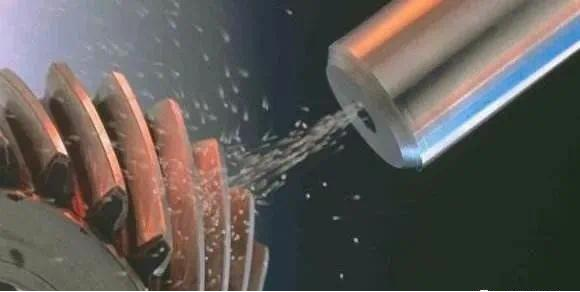
Sandblasting technology utilizes high-velocity abrasive bombardment on the surface of the workpiece, which not only has the ability to remove surface dirt and oxide films but also increase surface roughness and bonding area effectively, forming a microscopic “lock” structure, thereby significantly improving the mechanical bonding strength of the coating or adhesive interface. As an expert who has been engaged in long-term research on turbomachinery manufacturing technology, I believe that the role of sandblasting in pretreating the surface of the impeller cannot be underestimated, and its mechanism and parameter control strategy deserve elaborate explanation and systematical optimization.
Mechanisms of Sandblasting Treatment
Surface Roughening and Mechanical Interlocking
Sandblasting forms numerous microscopic (concave-convex) topographies on the surface of the impeller. By increasing the unit area specific surface area and the “anchorning effect,” it significantly enhances coatings or adhesive layers’ ability to bond mechanically. The increased roughness allows the adhesive to “embed” into more voids on the surface, achieving stable bonding like gear meshing. In my work in the project, it was observed that the peeling rate of coatings from impeller surfaces with Ra 2.5–3.5 μm was significantly lower than with untreated samples, thereby justifying the positive correlation between roughness and adhesion.
Surface Cleaning and Activity Activation
High-speed abrasive flow during the process of impact can effectively remove surface contamination layers of oil stains, oxide scales, and rust products, exposing the new metal substrate and enhancing surface activity, laying a foundation for the formation of physical adsorption or chemical bonding. Active atoms on surfaces of aluminum alloy and titanium alloy impellers in special, for instance, easily react with adhesives or coats after sandblasting, improving bonding energy.
Introduction of Beneficial Residual Stress
Residual compressive stress can be introduced in the surface layer of impeller through sandblasting processing, which can offset tensile stress produced by processing or service, reducing the risk of cracking or peeling of the coating. This effect is extremely significant in high-speed rotating impellers and can inhibit effectively the initiation of fatigue cracks, improving service stability.
Influence of Process Parameters on Adhesion Performance
The effect of sandblasting treatment is based on the coordination of a number of parameters, mainly like sandblasting pressure, abrasive particle size, spraying angle, and distance. In the practical application of engineering, the reasonable selection and proper adjustment of these parameters are the basis for ensuring consistency and repeatability of adhesion performance.
- Sandblasting Pressure: Experimental data show there is good cleaning and roughening performance when the pressure is 0.4–0.6 MPa. Under pressure below 0.3 MPa, kinetic energy of abrasion particles is not sufficient enough to completely crack the oxide film; under pressure above 0.7 MPa, it may have a potential to form micro-cracks in the surface or even cold work excessive hardening, which will be harmful to fatigue life of the impeller. I prefer 0.5 MPa as initial value and then modify it depending on the coating type.
- Abrasive Particle Size: Abrasive particle size is a critical factor in the surface topography. 40–80 mesh corundum abrasives are typically used in pretreatment of thermal spraying or structural adhesive bonding with high strength and can produce a stable surface with Ra values of 2.5–4.0 μm. Large particle size can result in scratches, and too small particle size lacks sufficient cleaning ability. In my own experience, 60 mesh corundum and 0.5 MPa pressure are the best parameter pair for titanium alloy impeller surface pretreatment.
- Spraying Angle and Distance: Spraying angle and distance cannot be neglected. The most favorable spraying angle is maintained at 60°–75°, which ensures even roughness formation and avoids damage due to direct hit on the substrate. The spraying distance needs to be controlled at 100–150 mm; far away results in loss of kinetic energy and near results in easy over-erosion. A repetitive sandblasting process is the key to uniform adhesion on the workpiece. No.
Specific Influence of Sandblasting on Impeller Adhesion Performance
| Influence Point | Action Mechanism | Effect |
| Increasing Surface Roughness | Sandblasting forms microscopic concave-convex structures on the surface | Coatings or adhesive layers are more likely to “bite” into micro-pores, forming mechanical interlocking effects |
| Removing Oxides and Impurities | Removes oil stains, rust, and oxide films | Forms a clean metal surface, improving bonding purity |
| Homogenizing Stress Distribution | Micro-spraying introduces compressive stress | Reduces the risk of cracking in subsequent thermal expansion or adhesive layers |
| Activating Surface Energy | Spraying produces a fresh metal layer | Increases surface energy, improving the adhesion of coatings, adhesives, or welding materials |
Application Case Illustrations
As a significant surface pretreatment method in the process of manufacturing and remanufacturing impellers, sandblasting is widely used in numerous key links, and its nature is improving interface bonding performance and follow-up processing consistency. Three typical usage scenarios are listed below:
Surface Pretreatment Before Coating
Before coating anti-corrosive coatings, ceramic protective coatings, or thermal spray coatings on titanium alloy or stainless steel impellers, sandblasting treatment could successfully improve the mechanical bonding strength between the substrate and coating. The idea is that sandblasting produces microscopic surface roughness and an active surface upon which the subsequent coating can have “locking” and high-contact-area adsorption at the microscale, significantly reducing risk of failure by peeling of the coating. In practice, we realized that the bonding process for sandblasted impeller surfaces can significantly be enhanced by more than 30%, which is particularly essential in working environments that require high corrosion resistance in the wind power sector, chemical sector, and aviation sector.
Key Pretreatment for Bonding Processes
For metal-composite hybrid structure impellers or composite impellers, before they are bonded and assembled using structural adhesives or epoxy systems, sandblasting can effectively break up surface impurities and oxide film layers and enhance the activity of the bonding surface. Meanwhile, the surface pit structure formed by sandblasting can enhance the mechanical biting performance of the adhesive layer and improve the shear strength and fatigue life of the connection interface. Experimental results show that for the test of metal adhesive bonding without sandblasting, the bonding strength fluctuates randomly and reliability is poor, while the bonding strength will be improved by 25~40% after sandblasting treatment and assembly stability could be considerably enhanced.
Pretreatment in Impeller Repair and Repainting Processes
For long-life impellers or harsh operating conditions, sandblasting is an unavoidable pre-processing prior to repair and refurbishment operations (e.g., surface repair welding, recoating, and rebalancing). Aside from being capable of thoroughly removing old coatings, oxide scales, and deposited contaminants, it may also improve the stability of bonding between new materials or coatings and seasoned parts by enhancing the activity of the substrate. According to the case of a particular type of superalloy impeller, recoated ceramic layer of sandblasting treatment is better in peel resistance and adhesion stability at high-temperature impact tests.
Conclusion
Generally, sandblasting treatment has admirable virtues in promoting the impeller surface adhesion. Not only does it promote mechanical bonding ability by surface roughening and purifying but also improves the residual stress condition and surface activity. The process action is extremely sensitive to the precise control of sandblasting parameters, which need to be optimized and calibrated together with material properties and subsequent process requirements.


