
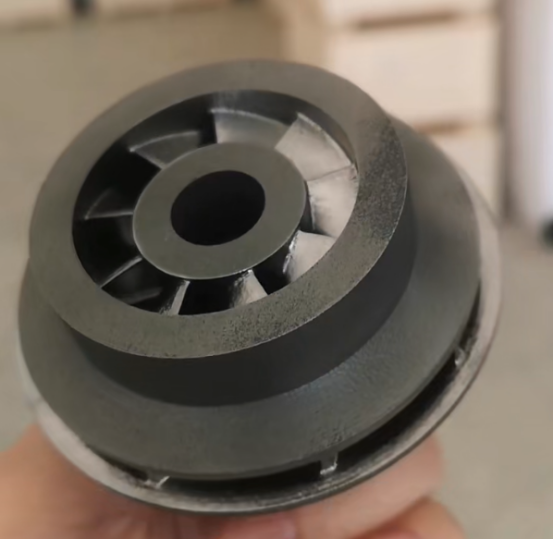
As one of the most critical components of fluid machinery, the surface roughness of impellers not only has a direct impact on the development of the boundary layer and the stability of flow structures but also has an important influence on hydrodynamic performance and machine efficiency. In this paper, the impacts of roughness on flow loss, turbulent structure, cavitation performance, and equipment reliability are discussed in detail. Combining a number of experimental data sets and numerical simulation results, it systematically uncovers the regulation mechanism of micro-surface features on frictional resistance, energy transfer efficiency, and flow stability.
Introduction
In the development of new high-efficiency fluid machinery, impeller surface quality control is increasingly becoming the critical link to improve flow efficiency and reliability. Especially in the fields of aero-engines, gas turbines, water pumps, compressors, etc., with impellers developing towards high speed, small size, and heavy duty, the influence of surface roughness on the boundary layer behavior, frictional loss, and eddy current structure is increasingly evident. Therefore, in-depth investigation of the mechanism of impeller surface roughness’s influence on hydrodynamic performance has important theoretical and engineering practical significance.
Definition and Measurement Technology of Impeller Surface Roughness
The impeller surface roughness is mainly defined by parameters such as Ra (arithmetic mean roughness) and Rz (maximum peak-valley height), usually in micrometers (μm). Their causes are the machining processes (e.g., milling, grinding, polishing), tooling conditions, material properties, and post-treatment measures. Modern high-precision measurement technologies include contact profilometers, laser interferometers, white light interferometry, and 3D scanning technologies. Especially in surface analysis below Ra ≤ 0.3 μm, non-contact optical measurement provides nanometer-level data support. Quantitative surface roughness control is achieved in high-speed five-axis machining and CNC EDM processes through the rational coordination of tool paths and machining trajectories.
Influence Mechanism of Roughness on Flow Loss
In my research, the influences of surface roughness on hydrodynamic performance mainly reflect in flow loss, frictional resistance, and flow field distribution. Following is the in-depth analysis of these influence mechanisms:
Enhanced Frictional Resistance
With the rotation of the impeller, the surface roughness causes greater disturbance to the fluid in the boundary layer and rising shear stress, thereby strengthening the frictional loss. Especially in the flow with high Reynolds numbers, the disturbance of roughness to the near-wall turbulent area is very clear, further generating additional kinetic energy dissipation. Such an increase in the frictional loss directly affects equipment’s energy efficiency and reduces the overall fluid machinery’s conversion efficiency.
Change in Boundary Layer State
When the impeller surface roughness is too great, the initially stable laminar flow area can prematurely transition to a turbulent flow area, especially at the trailing edge of the impeller or the vortex channel exit. This transition shortens the effective flow path and increases the likelihood of flow separation, thereby affecting fluid stability. For equipment requiring precise flow control (such as high-speed compressors), this boundary layer instability may cause the performance of the equipment to degrade.
Excitation of Local Vortex and Secondary Flow
The non-uniform rough surfaces may induce vortex core generation, which will further develop into local vortices or secondary circulation patterns. These low-speed vortices not only affect the evenness of flow distribution but also destroy the process of pressure recovery, thus reduce pressure ratio and efficiency. Such a distortion of the flow characteristics is particularly critical in many high-speed rotating machineries, directly affecting equipment stability and operation efficiency.
Influence on Cavitation Behavior and Equipment Life
The surface roughness also significantly affects the cavitation tendency of the impeller. The rough surface creates non-uniform pressure distribution in micro-cavities, with low-pressure areas more likely to reach the liquid saturation vapor pressure and, hence, initiate cavitation. Taking marine propellers as an example, when the Ra of the suction surface exceeds 0.8 μm, the cavitation initiation is favored, and bubble collapse causes serious erosion of the surface, reducing the impeller life and propulsion efficiency. In addition, fluid disturbances caused by cavitation are superimposed on the inherent flow instability, exacerbating noise and vibration.
Comprehensive Relationship Between Roughness and Mechanical Properties
Aside from fluid performance, surface roughness affects the structural performance of impellers in multi-dimensional manners:
- Wear Resistance: The peak-valley topography of the surface directly affects the actual contact area and stress concentration distribution. Initial wear focuses on surface asperancies generally, and moderately reducing roughness helps to manage initial plastic wear. Overly smoothness, on the contrary, leads to lubricating film breakdown, which is quite harmful to long-term operation.
- Fatigue Strength: Micro-cracks and dents of rough surfaces are likely to be the origin of stress concentration and thus initiate fatigue cracks. Reasonable roughness control is of paramount significance for high-cycle load equipment in order to inhibit surface fatigue damage.
- Contact Stiffness and Matching Performance: Rough surfaces form micro-clearances in joints, which reduce the contact stiffness and actual connecting strength of interference fits, especially in high-precision connectors.
- Sealing and Corrosion Resistance: The excessive roughness of static and dynamic sealing structures results in non-uniform oil films and the formation of leakage channels. Corrosion products in valleys also facilitate local corrosion and annihilate the structural integrity of the metal surface layer.
Comparative Analysis of Numerical Simulation and Experiment
In order to measure the impact of surface roughness on flow performance, an experiment for comparing the flow performance of centrifugal compressor impellers with three levels of surface roughness (Ra = 0.2 μm, 0.6 μm, 1.2 μm) was conducted. Experimental and simulative results indicate that the increase in roughness considerably decreases pressure ratio and efficiency, and raises total temperature at the outlet of the nozzle. The detailed findings are as follows:
| Roughness Ra (μm) | Total Pressure Efficiency Drop (%) | Pressure Ratio Reduction (%) | Nozzle Outlet Total Temperature Increase (K) |
| 0.2 | Reference value | Reference value | Reference value |
| 0.6 | 3.7 | 2.4 | +8.6 |
| 1.2 | 8.9 | 5.8 | +17.2 |
It can be observed that even an increase of 1 μm in roughness can result in over 5% pressure ratio loss and efficiency drop, which will cause potential threats to the long-term stable operation of equipment.
Surface Roughness Control Strategies
In order to enhance the fluid performance of impellers effectively, scientific surface roughness control strategies must be implemented. First, in the area of machining processes, using high-precision five-axis grinding, mirror EDM, CNC polishing, and other high-precision machining processes can reduce surface unevenness and improve machining accuracy. Second, for key blade surfaces, post-processing methods such as electrochemical polishing and laser remelting can be used to further improve surface quality. In addition, the forecast of fluid performance sensitivity through the combination of simulation and roughness modeling provides the basis for a trade-off between cost and manufacturing precision.
Conclusion
One of the major influences on the hydrodynamic performance of the impeller is the surface roughness. Small changes in the roughness can play an important role in the development of the boundary layer, friction loss, flow stability, and cavitation performance, affecting the overall efficiency and stable operation of the machinery. Therefore, in real engineering, it is necessary to integrally consider design requirements, machinability, and cost to work out reasonable surface roughness control measures. In the future, combined with the research on surface microstructure design and bionic technology, more efficient, wear-resistant, and cavitation-resistant impeller surface optimization can be achieved.


