
As a result of the relentless progress of impeller surface quality and performance specifications in aerospace, steam turbines, hi-tech pump equipment, and other fields, traditional mechanical polishing technology gradually exposed the limitations of low efficiency, poor adaptability, and lacking environmental protection. Pneumatic polishing technology, with its own unique advantages of high efficiency, energy saving, flexible operation, good adaptability to complex curved surface structures, and safe and eco-friendly processing, has become increasingly a key means for precision impeller surface treatment.
This paper artificially investigates the process principle and inherent advantages of pneumatic polishing in depth, follows up on its performance in improving surface roughness, alleviating stress, restoring micro-cracks, and integrating automation in accordance with actual application habits, and researches its development value in the future intelligent manufacturing system.
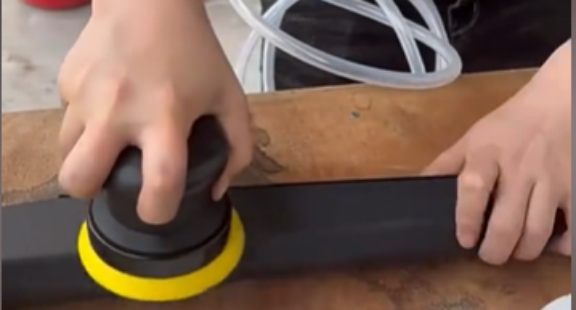
Introduction
As a critical rotary component of most fluid machines, the geometric accuracy and surface quality of the impeller has a direct bearing on fluid efficiency, operating stability, and service life of the whole machine.
In particular in sophisticated equipment such as aero-engines, high-speed centrifugal pumps, and steam turbines, micro-surface imperfections of the impeller may lead to reduced aerodynamic efficiency, propagation of fatigue cracks, and failure. Manual or electric polishing technology is obviously restricted to dealing with high-complexity three-dimensional curved surface, difficult-to-machine alloy materials, and micro-defect processing. Over the past few years, I have used pneumatic polishing technology in a number of impeller production tasks and found that it has excellent controllability and flexibility in precision surface treatment, greatly improving product surface performance and overall uniformity.
Overview of Pneumatic Polishing Technology
Pneumatic polishing is an advanced processing technology using compressed air or inert gas as power medium to propel fine polishing media to spray on the workpiece surface with high speed to realize micro-level material removal and surface finishing.
This process has traditional non-contact aspects, which not only avoids the geometric distortion that is conceivable in traditional mechanical contact polishing but also effectively eliminates the risk of heat input surface damage. Its primary advantages are soft processing, particle adaptive deformation, and strong micro-trimming ability, which are particularly suitable for the terminal surface treatment of heat-sensitive and hard-brittle impellers such as titanium alloys and superalloys.
Analysis of Advantages of Pneumatic Polishing in Precision Impeller Treatment
With increasing requirements for the surface quality and structural integrity of efficient impellers, the limitation of the traditional polishing process in treating complex three-dimensional surfaces has become increasingly evident. As an advanced process with efficiency, repeatability, and environmental protection characteristics, pneumatic polishing has been widely used in aviation, energy, high-tech manufacturing, and so forth. The following discusses its unique advantage in precision impeller processing in multiple aspects.
Significant Improvement in Surface Roughness
For high-performance impeller use, surface roughness will commonly need to be reduced to the submicron range or even higher standards.
Pneumatic polishing effectively removes surface residual burrs, oxide scales, and micro-processing textures through continuous and stable particles (spraying) action, achieving a uniform and fine level of smooth surface. Compared with traditional polishing technologies, its polish effect is more uniform, and it is not easy to produce local over-polishing or “bright spot” problems, which supports smooth and continuous flow channels and improves aerodynamic performance. I have already applied pneumatic polishing in a titanium alloy impeller project of an aero-engine, and the surface finish of the end surface decreased from Ra 1.2 μm to Ra 0.2 μm, significantly improving the installation efficiency and fuel economy. In addition, not only is the improvement of the surface finish of direct benefit to aerodynamic efficiency but also to the minimization of local concentration of heat as well as slowing down material surface layer aging, which is especially beneficial to the structure of the impeller in high-temperature and high-speed working conditions.
Residual Stress Release and Micro-Crack Repair
Under the pneumatic polishing process, the repeated micro-impact of the (spraying) particles will cause slight plastic deformation of the material surface layer, hence the redistribution of residual stress.
This effect not only can reduce the tensile stress in the original heat treatment or processing process but also be capable of closing the potential micro-cracks on the surface and inhibit the growth of the crack tip, improving the fatigue life and structural reliability of the impeller. Especially for impellers operating under conditions of high-speed operation and high temperatures, the stress control effect brought by pneumatic polishing is one of the most significant means to ensure their long-term stable operation. From the material mechanics perspective, suitable surface compressive stress can significantly increase the crack initiation threshold and lengthen the fatigue crack growth period. Therefore, pneumatic polishing has significant process advantages in high-load and high-frequency-loaded critical components.
Adaptability to Complex Three-Dimensional Curved Surface Structures
New effective impellers have predominantly complicated free-form surface shapes, and the blades are typically trailed by massive curvatures of bending, tiny corner radii, and closed flow channels.
Traditional polishing instruments find it difficult to access every position, and processing blind spots are obvious. Pneumatic polishing, however, employs controllable and high-speed jets of medium to achieve thorough coverage of remote areas, and even penetrate into deep narrow grooves to perform uniform micro-trimming, significantly improving the consistency and integrity of the entire impeller’s surface treatment. This feature not only meets the need of advanced geometric tolerances but also significantly decreases the effect of human operating mistakes on the consistency of the end product, increases the quality of repeatability and
High Efficiency, Energy Saving, and Process Environmental Protection
The pneumatic polishing machine has a simple structure, rapid startup, and minimal energy consumption.
Using compressed air drive instead of motor drive reduces energy loss effectively. At the same time, this technology usually does not consist of corrosive chemical fluids and complex recovery systems. The polishing media usually are recyclable protection particles of the environment, which reduces the potential harm to the health of operators and the external environment. Personally, I believe that to follow the trend of “green transformation” in the production industry, as it is now, pneumatic polishing has very high promotion value because of its natural cleanliness and cleanliness properties. Especially in the context of carbon neutrality, the need for green production capacity among businesses grows stronger day by day, and pneumatic polishing is a solution that is favored by both performance improvement and environmental protection compliance considerations.
High Safety and Simple Maintenance
Because neither electric spark nor high-temperature heat exists, pneumatic polishing is highly suitable to the impeller working condition in close vicinity to inflammable, explosive, or precision electronic devices.
Furthermore, its equipment is of low structural complexity and possesses fewer wear components. Maintenance work is virtually limited to regular replacement of consumables like air pipes and sealing rings. The entire operating and maintenance cost is much lower than that of the traditional electric system, and thus the cost threshold of enterprises in applying it is significantly lowered. In addition, the polishing medium is changed freely, and the various particle size and material media can be adjusted to various working conditions, so it enhances the applicability of the process in the production environments of multiple varieties and small batches of impellers.
Easy Automation Integration
With the trend towards intelligent manufacturing, precision impeller manufacturing increasingly tends towards flexibility and integration. It is easy to integrate pneumatic polishing equipment into the automatic production line, and realize program control and process adaptive adjustment via PLC or robot interface, which meets the repetitive precision processing demand of mass production. This provides a good foundation for the entire process quality traceability and process closed-loop of impeller manufacturing.
In my practical application experience, with the combination of the five-axis link system and the online quality monitoring module, the closed-loop control of the pneumatic polishing process has been successfully achieved and the process consistency and factory operating efficiency have been greatly enhanced.
Conclusion
Briefly speaking, pneumatic polishing technology has been a rival surface treatment method for precision impeller production because it possesses some advantages such as excellent processing flexibility, soft processing effect, conservation of the environment and energy, high security, and convenience of integration.
In some actual projects I have been engaged in, this technology has demonstrated excellent engineering merit and process flexibility. With continuous progress in manufacturing technology and further development of industry standards, pneumatic polishing will certainly play a more critical role in improving the service performance of impellers, optimizing the manufacturing process, and implementing green production, and become a critical important link in the high-end manufacturing system.


