
As one of the critical elements that are widely used in fluid machinery, the complex spatial curved surface structure of the impeller imposes highly stringent demands on processing equipment. With the continuous trend of manufacture development towards high-end and intelligent directions, the conventional processing means have not been able to keep up with technical demands of large-scale impeller production in efficiency, precision, and consistency.
Introduction
In recent years, with the higher application demand of high-performance impellers in aerospace, power energy, and turbocharging systems for automobiles, impeller structural complexity and accuracy requirements have continued to raise, imposing huge burdens on manufacturing processes. Since the degree of freedom of processing and dynamic response ability of traditional three-axis or four-axis processing are restricted, they were not able to 胜任 (cope) with the effective processing of complex three-dimensional curved surface and deep cavity structures. However, in contrast with high-speed five-axis machining centers, high-speed electro-spindles of high-speed five-axis machining centers with their multi-axis linkage functions and electro-spindles at high speed not only greatly improve the efficiency of processing but also show irreplaceable advantages in ensuring quality consistency, reducing clamping errors, and enabling automatic manufacturing.
Technical Challenges in Impeller Machining
As the kernel part of high-performance fluid machinery, the geometric characteristics of impellers are typically displayed as multi-curved free-form surfaces, thin flow channels, and complex spatial curve structures. Due to their extremely high strength and accuracy requirements in the fields of aviation, energy, chemicals, and others, the machining process not only poses an extremely severe challenge to equipment performance but also imposes very stringent demands on programming technology, tool systems, and thermal control capabilities. Some typical difficulties I have encountered in actual manufacturing processes are as follows:
High Demand for Complex Surface Linkage Control
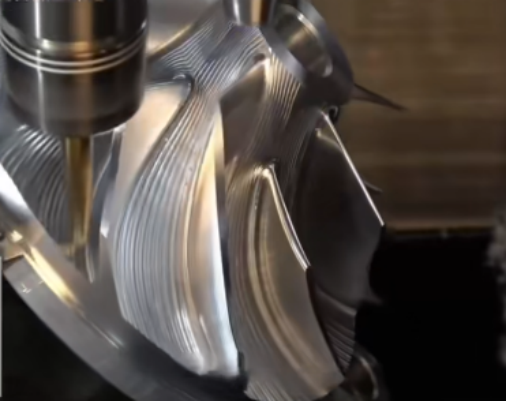
The spatial curvatures of the surface of impeller blades also change constantly, and the shape is often an irregular three-dimensional free-formed surface. The precision machining of such structures requires that the machine tool have high-precision five-axis linkage functions so that the tool is able to, at any time, keep a reasonable cutting angle and most favorable tool entry posture. If the tool path is not able to transfer smoothly, cutting interference, surface streaks, and residual steps are (extremely easy to) occur, which has an important influence on the aerodynamic performance of the blades. Especially in corner areas, blade root transitional sections, and other parts, the optimization of five-axis linkage posture planning and algorithm of tool position has become one of the most important technical bottlenecks.
Prominent Spatial Interference and Path Occlusion Issues
Impeller structures usually have small-spaced blades and high-density arrangement, resulting in limited spatial accessibility of the machining path. Traditional three-axis machines are very prone to causing vibration or loss of stiffness due to tool shank collision or excessive tool length during machining, resulting in blind areas of machining. Especially for small and medium-sized impellers, the geometric dimension of the flow channel is typically less than 10mm, requiring the tool to be thin enough to go into the inside and strong enough to be able to resist side milling forces, imposing highly professional path planning capability and fixture design capability on process workers.
Strict Control of Geometric Dimension Accuracy
In high-end product applications such as aero-engines, gas turbines, water pumps, and compressors, impeller geometric dimension precision directly controls their fluid efficiency and dynamic balance. The conventional contour error control specification is generally within ±0.02 mm, and even some important blades within ±0.01 mm. To meet such tight tolerance ranges, not only is it necessary to rely on five-axis high-rigidity and high-stability machining centers but also to work in cooperation with thermal compensation systems, high-resolution feedback sensors, and full-process thermal temperature control technologies to minimize the dimensional errors caused by thermal drift.
Poor Material Cutting Performance and High Tool Wear
Impellers are likely to utilize difficult-to-machine materials such as superalloys (such as Inconel 718), titanium alloys (such as TC4), or martensitic stainless steels (such as 17-4PH). These are likely to be high-strength in character, possess low thermal conductivity, and are inclined to work-harden heavily. In cutting, the tool is very prone to boundary edge chipping and cumulative wear, thus leading to reduced surface integrity, increased dimensions (deviations), and longer machining cycle time. Thermal influence layer control and tool life management have become very important factors that affect stability, especially when in the roughing phase. Cutting. Therefore, the holistic coordination of tool material, coating technology, and cooling technology is extremely vital for maximizing overall process stability.
Difficulty in Controlling Consistency and Repeatability Throughout the Machining Process
Due to very intricate design of impellers, minute variations in every process stage may become amplified in the subsequent links. Hence, there must be a closed-loop quality control system with process monitoring, tool lifetime prediction, and online measurement as the pillar to ensure product consistency for all products in batch production. Not only is this an enterprise’s hardware and software integration capability challenge, but it also requires the operators to have interdisciplinary systematic thinking and precision manufacturing expertise.
These are precisely the reasons why traditional three-axis machining bases cannot meet the strict requirements of modern impeller manufacturing. High-speed five-axis machining centers with high dynamic response and high-precision linkage control capability, intelligent programming software, simulation systems, and online detection platforms have gradually become more central facilities to break through the above difficulties and the critical technical support to promote impeller manufacturing to higher quality and efficiency.
Comprehensive Advantage Analysis of High-Speed Five-Axis Machining Centers
In the high-complexity part machining field, particularly in the free-form surface structures symbolized by aviation impellers, high-speed five-axis machining centers are becoming the main equipment step by step. Not only does it reflect the trends of modern precision manufacturing equipment development, but it also indicates the high integration of integrated control, flexible processing, and intelligent management. The following expounds on its overall advantages from six aspects:
Significantly Improved Machining Efficiency
Five-axis high-speed machining centers are typically equipped with 18,000 to 30,000 rpm electro-spindles. Combined with high-dynamic-response servo feeds and multi-channel CNC technology, they own excellent high-speed interpolation capability when processing complex spatial curved surfaces. Their tool paths are shorter and the tool entry angles are more reasonable than those of traditional three-axis machining, with the material removal rate much improved per unit time. I previously participated in a trial production project of an aviation turbine impeller. With the requirement to ensure machining precision, the five-axis machine reduced the original machining time of 90 minutes to 30 minutes, not only expanding the production capacity by more than 200% but also providing much technical support to process reengineering.
Flexible Tool Posture Control, Adaptable to Complex Structures
The five-axis linkage mechanism positions the tool to change its spatial location under different degrees of freedom, which enables it to easily handle deep cavities, curved channels, and curvature mutation regions in the impeller profile. Especially on machining traditional difficult-to-machine components such as the back of the blade, root corners of the blade, and inlet/outlet edges, integrated cutting can be achieved without repeated clamping, therefore dramatically decreasing errors caused by positioning and cumulative tolerances. This adaptive cutting capability actually boosts the access to free-form surface complicated shapes with sound quality and high-consistency machining.
Enhanced Part Consistency and Dimensional Control Capability
Next-generation five-axis machining centers are generally equipped with high-precision optical grating rules, thermal compensation modules, and closed-loop error compensation modules, and they can monitor the spindle worktable displacement changes in real time at a micron level. By dynamically compensating tool wear, thermal drift, and structural deformation during the machining process, it ensures batch products can still maintain extremely high consistency and dimensional accuracy even after long-term operation. This capability is particularly important in fields such as the defense industry and aero-engines with extremely tight assembly tolerances and is one of the most important technical supports for building a high-reliability manufacturing system.
Effectively Avoid Tool Interference and Optimize Cutting Posture
When ball-end mills cut free-form surfaces, the surface scratches or shows apparent local machining texture since the tool centerline speed will be zero. The five-axis machining platform can always maintain the best incident angle of cutting by real-time adjustment of the tool-workpiece angle, thereby improving the cutting stability and surface quality. In addition, with the use of path simulation and interference detection software, it can avoid the risk of tool shank-interference with fixtures/equipment in advance, making sure the machining process is continuous and safe.
Reduced Clamping Times and Human Intervention
The five-axis linkage system possesses the basic role of “one clamping, overall machining” and can complete the whole machining procedures from rough to finishing, from main surface to side surface, and even the bottom structure under the premise of maintaining the reference. Such whole-process connection not only prevents the accumulation error caused by repeated clampings, but also greatly simplifies the process path and the scope of human intervention. In my actual production experience, the product machining continuity and cycle consistency have been greatly improved by customizing flexible fixtures and coordinate five-axis machining paths, which brings high convenience to production scheduling and planning management.
Support for Automation Integration and Promotion of Intelligent Manufacturing
As Industry 4.0 and digital manufacturing are increasingly upgraded, five-axis machining centers are increasingly being implemented in intelligent manufacturing systems. With automatic tool changer (ATC) installation, automatic pallet changer (APC) installation, industrial robot loading/unloading units, and data connections with MES systems, highly automated closed-loop manufacturing is realizable. Especially for small-batch and multi-variety production of high-end precision components, this concentrated capability not only turns the five-axis machining center into a machine but also into a central node within the intelligent factory operation system. Taking a clever production line of titanium alloy impellers I was involved in as an example, the entire production line can operate uninterruptedly for more than 24 hours to achieve the goal of a “lights-out factory”, with significantly improved running efficiency.
Conclusion
With an inspection of the advantages of high-speed five-axis machining centers in batch production of impellers, I am increasingly persuaded that this technical platform has become the mainstream choice for economic manufacturing of complex parts. Not only did it completely turn around the inefficiency and inaccuracy inherent in conventional processing technology but also provided crucial support for deep promotion of intelligent manufacturing. In the future, as artificial intelligence and big data technology are developed together in the manufacturing industry, five-axis machining equipment will break through even more in tool path self-optimization, adaptive feed control, real-time error compensation, and other areas. We have good reason to think that five-axis machining will lead impeller manufacturing from “high-speed” to a new phase of “intelligence”.


