
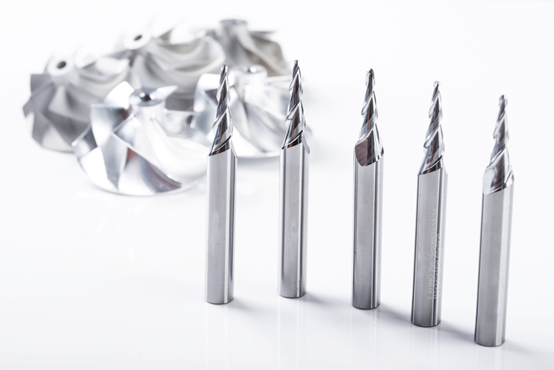
As the prevailing trend of enhancing precision, efficiency, and miniaturization requirements of modern medical devices, the manufacture of special miniature impellers in medical devices has emerged as one of the significant technical challenges. Special miniature impellers in medical devices are commonly found in gas (transportation) devices such as artificial ventricular pumps, micro-turbine pumps, and portable ventilating devices. These impellers are usually of very small size, with complex shape, and entail very high surface quality and accuracy of machining requirements and hence result in very tough test cases for the tool system. This article focuses on common miniature impeller geometries in medical equipment, presents tool choice approaches in micro-machining, analyzes types, geometric parameters, and coating combinations of relevant micro-tools for different materials and structure features, and provides directions on how to optimize to improve machining efficiency and quality, hence offering technical support for the fabrication of precision medical components.
Introduction
As medical technology continues to develop, the requirements for precision and operation of miniature impellers in medical devices are increasingly stringent. Specifically, in artificial ventricular pumps, micro-turbine pumps, and portable ventilators, miniature impellers as main components directly affect the working performance of devices. The processing of miniature impellers usually entails ultra-miniature intricate impellers with a diameter less than 30mm and the blade thickness less than 0.3mm, which are difficult to process, especially the choice of material, surface quality control, and the precision of the process. Standard tools commonly cannot meet the demand of processing such accurate components. Therefore, specially designed micro-tool systems must be selected in order to offer quality processing as well as production efficiency.
Structural and Machining Characteristics of Special Impellers in Medical Equipment
Micro impellers in medical appliances typically have the following significant characteristics:
- Small geometry and fine structure: Overall dimensions of micro impellers are typically less than 30mm, thickness of blades is less than 0.3mm, structure is complex, and precision requirement is high.
- Material properties: Most common impeller materials applied in medical devices are mainly biocompatible metals, among which titanium alloys (Ti-6Al-4V), medical stainless steel (316L), magnesium alloys, etc. are used. They are generally high strength and corrosion resistant but rather difficult to machine.
- High surface quality requirements: Medical devices require impellers to be of extremely high surface quality, and the Ra value should usually be less than 0.2μm, while removing surface defects such as burrs and micro-cracks.
- Forming complexity: Machining of impellers also involves micro-milling, precision grinding, EDM, and other chainings of multi-process with complex processes and high difficulty.
- Clamping and rigidity issues: Small workpieces are prone to vibration or deformation during machining, and the clamping system must be highly rigid.
The above demands say that a tool system with high precision, small diameter, resistance to vibration, and extremely high thermal stability must be utilized.
Classification and Application Strategies of Micro-tools
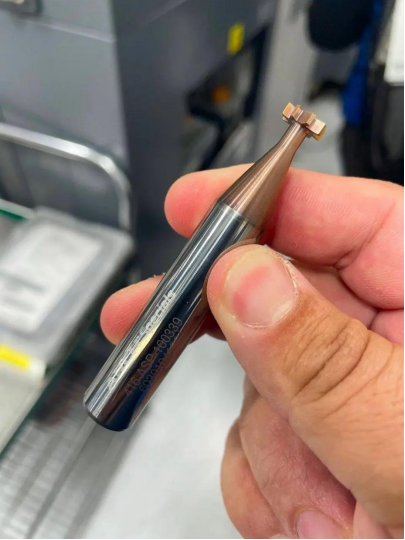
Being one of the major functional components of medical devices, the micro-impeller has complex structure and is mainly made up of titanium alloy or stainless steel, which places extremely high demands on the dimensional accuracy, edge strength, and cutting performance of processing tools. The choice of proper micro-tools and the establishment of appropriate application strategies are the most important factors in ensuring the processing quality and efficiency of micro-impellers. There are three types of micro-tools that are routinely utilized: micro-end mills, micro-ball end mills, and micro-drills and micro-boring tools, all with their working conditions and design points where they can be utilized.
Micro-end Mills
Micro-end mills are used in the milling of relatively simple curved surfaces such as the outer contour surface and edge transition surface of medical impellers. The tool’s diameter is normally between 0.1mm and 2mm, suitable for components requiring high precision but relatively simple geometric structures. According to the nature of cutting, a 2-flute or 3-flute configuration is normally followed to provide good chip removal capacity at the expense of tool strength maintenance. With regard to tool materials, sub-micron carbide can effectively improve wear resistance and cutting stability. Where coatings are involved, TiSiN or AlTiN coatings are effective in heat resistance and anti-adhesion, and they are well suited for micro-cutting titanium alloys and other superalloys. In practice, attention should be paid to radially maintaining control of runout and cutting heat accumulation so that burr forming or deformation of workpieces caused by extremely slight vibrations is prevented.
Micro-ball End Mills
For complex blade surfaces, runner areas, and other free-form surfaces in medical impellers, micro-ball end mills are the preferred tool for high-precision contour path machining. The tool nose radius is typically 0.05mm to 1mm that can achieve high-precision spatial curve trajectory control. The tool material is mostly coated cemented carbide. Coatings such as AlCrN and nACo have good high-temperature stability and wear resistance and are especially appropriate for long-term continuous continuous machining of high-hardness materials. In actual machining, micro-ball end mills not only improve surface finish and contour uniformity but also reduce tool change times and improve machining efficiency and thus constitute an important tool for precision 3D surface shaping.
Micro-drills and Micro-boring Tools
In medical impellers, an element such as central shaft holes, blade root transition areas, and ventilation and cooling channels often require high-precision micro-hole drilling, and thus micro-drills and micro-boring tools are essential. The tool diameter in these situations is generally 0.2mm to 1.5mm. The structural design takes special consideration in the central water outlet cooling channel to enhance the efficiency of heat discharge and to reduce the negative influence of cutting heat on workpiece deformation and surface quality. From the processing strategy, it is recommended that a parameter combination of lower speed and higher feed should be used in order not to break the tool or deform the workpiece caused by heat accumulation. When processing titanium alloy materials, PVD-coated cooling micro-drills are preferred that can effectively inhibit the pilling phenomenon, extend tool life, and ensure the geometric accuracy and cleanliness of small hole machining.
Tool Selection Strategies and Process Matching
The selection of tools not only should consider material properties but also match the processing parts and processes to enhance processing accuracy and efficiency effectively.
Selection Based on Material Characteristics
The machinability of different materials is quite different, and accordingly the tool selection must be different according to the material type.
| Material Type | Machining Difficulty | Recommended Tool Material | Coating Suggestion |
| Ti-6Al-4V (Titanium Alloy) | High | Sub-micron Carbide | AlTiN/TiSiN |
| 316L Stainless Steel | Medium | Nano-coated Alloy | TiAlN/nACo |
| Magnesium Alloy | Low | Uncoated High-speed Steel | Uncoated or DLC |
Matching Strategies Based on Processing Parts
- Blade outer edge and root transition area: Use high-precision 2-flute micro-end mills to increase machining accuracy and surface quality.
- 3D free-form surface (blade surface): Use micro-ball end mills combined with five-axis interpolation technology to optimize the surface machining path.
- Channel opening and shaft hole machining: Utilize micro-drills and cooling hole design to achieve temperature control and tool rigidity during machining.
Typical Application Scenarios and Key Performance Requirements
Typical Application Scenarios:
- Ventilators and oxygen delivery equipment: Pumps gas flow to allow precise air flow control.
- Blood circulation pumps (such as artificial hearts): Long-duration blood flow simulation, for which extremely high demands are put on the biocompatibility and non-invasiveness of the impeller.
- Medical centrifugal equipment: High-speed rotating impellers in centrifuges for separation or cleaning of drugs from a blood component or for cleaning of blood itself.
- Medical cooling systems: Impeller of the cooling water pump in CT and MRI machines for heat exchanger system.
Key Performance Requirements:
| Performance Requirement | Description |
| High Cleanliness | Materials need to meet medical-grade standards, such as ISO 10993, and do not release harmful substances. |
| Strong Corrosion Resistance | Can withstand long-term contact with disinfectants, liquid medicines, etc., and often use stainless steel, titanium alloys, or polymer materials. |
| Precise Structure and Low Noise | High machining accuracy is required to ensure that the equipment runs quietly and without vibration. |
| High Temperature and Radiation Resistance | Suitable for working in high-temperature disinfection environments or special conditions such as X-rays and magnetic fields. |
| Biocompatibility (for specific applications) | For example, blood pump impellers should not cause thrombosis or cell damage. |
Conclusion
The miniaturization and (complexification) trend of special impellers in medical equipment presents higher demands on micro-tools. By means of rational tool selection methods, compatibility of materials, and process optimization, not only can the processing power efficiency be improved, but also the accuracy and biocompatibility of workpieces can be ensured, thus ensuring a favorable guarantee for the reliability and safety of medical instruments. There will be a more efficient and accurate new era in the future in the production of medical equipment as micro-tool technology advances.


