
Impellers are the basic components of rotary equipment, free-form surface blades highly twisted, compact flow channel geometry, and complex assembly interfaces. Symmetry and homogeneity of blades and high coaxiality, by machining, must be ensured and welding or machining deformation must be checked. Especially for welded impeller construction, joints such as blade position, cover pressing, and shaft alignment impose extremely high requirements on the precision control.
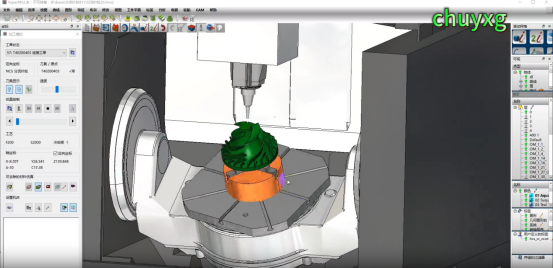
From several impeller machining jobs, I learned that the fixture system is not only a “clamping” device but a critical component to deliver geometric accuracy, prevent thermal deformation, and achieve process repeatability. Its assembly and calibration are not longer supporting actions but control points for the whole manufacturing process chain.
What is a Fixture System for Complex Contour Machining of Impellers?
A fixture system for intricate contour machining of impellers is defined as a special workholding device that is used to locate and support impeller-type parts in order to ensure stability in machining. Because of the impeller’s properties of intricate curved surfaces, asymmetrical structure, and high precision requirements, common fixtures are unable to meet machining requirements, so a fixture system tailored to its special geometry and process path must be used.
In other words, consider the polishing process on a windmill curved blade—twist, scratch, or drop is easy to grasp it with your hand. Similarly, in CNC machining, in the absence of stringent and accurate clamping, the impeller will generate machining defects or scrapping.
Design Key Points of Impeller Fixture Systems
In high-precision machining of titanium alloy impellers, the fixture system is the foundation of workpiece positioning and clamping, and is also a key link to influence machining stability, dimensional precision, and efficiency. Focused on the intricate geometric structure with multi-degree-of-freedom of impellers, fixture design needs to deal with multi-surface positioning, dynamic stiffness, and thermal stability systematically to ensure satisfactory structural integrity and positioning accuracy under high-load and high-temperature environments.
Multi-Surface Positioning and Geometric Constraints
The most significant design feature of impeller fixtures is the sound configuration of multi-surface constraints. The central pin is generally used as the main reference in standard machining operations for co-axially aligning components such as hubs, discs, and blades. According to this, parts like end face pressure plates, V-groove positioning flanges, and inner/outer ring pressure plates are fitted to achieve precise constraints on radial, axial, and rotating degrees of freedom.
For welded impellers, combined positioning of base-pin-flange must be designed using fixtures. The pin is the reference position of the entire fixture system and provides strict coaxiality of the component by precise fitting. The V-groove structure on the outer ring of the disc not only facilitates easy spot welding of the blades but also improves initial welding positioning consistency.
Dynamic Rigidity and Thermal Stability
On high-speed five-axis machining, fixtures have to withstand high dynamic loads. The fixture system should thus employ high-rigidity materials and structural arrangement optimization in order to achieve maximum vibration resistance. Concurrently, as most of the heat generated in high-temperature cutting and welding is released to the fixture body that suffers thermal expansion, one must select alloy materials whose thermal expansion coefficient is near that of the workpiece material and relieve thermal stress accumulation through symmetric layout and clearance design.
In practical application, the use of thermal deformation feedforward analysis and thermal offset-resistant structure optimization is able to eliminate posture offset caused by welding and machining processes to a great extent.
Core Functions of Fixture Systems for Complex Contour Machining of Impellers
| Function | Description |
| High-Rigidity Fixing | Provides stable support during high-speed cutting or five-axis linkage to avoid vibration and offset. |
| Multi-Surface Positioning | Enables accurate positioning of multiple references such as impeller hubs, blade edges, and bottom surfaces to ensure consistency of machining references. |
| Flexible Adjustment | Adapts to impellers of different specifications and structural complexities, achieving versatility through adjustable jaws or modular combinations. |
| Non-Interfering Tool Path | Fixture structures avoid tool trajectories to prevent interference with five-axis machining movements. |
| Rapid Clamping and Replacement | Supports modular design to improve part replacement efficiency, adapting to small-batch and multi-variety machining needs. |
Analysis of Fixture Accuracy Error Sources
The rigorous precision requirements of machining titanium alloy impeller establish the requirement that the fixture system must have good positioning consistency and structural stability. However, in actual production, error accumulation of all types has incredible impact on terminal machining accuracy. Systematic error source analysis in the fixture system not only can prevent possible risks during design, but also provides key basis for installation, adjustment, and process optimization.
Initial Assembly Errors
At the time of the first installation of the fixture on the machine tool table, factors such as its mating with the table, base flatness, and bolt preload may develop the initial geometric errors. After a slight tilt of the fixture bottom or when the references are not located on a common plane, it will directly affect the placement of all subsequent references for machining. Upon project debugging, I found that systematic offset of the entire five-axis machining path resulted due to a 0.01mm bottom flatness difference during fixture assembly so that the impeller rim contour error was produced to the extent of 0.04mm.
Thus, first assembly requires precise calibration using a laser interferometer or CMM probe such that there is a consistent machining reference system between the fixture and machine tool system.
Positioning Errors
If the fixture positioning reference deviates from the part design reference, then it will lead directly to workpiece posture offset or contour error amplification, which is more sensitive for titanium alloy impellers with free-form surface and coaxial structure. Common flaws include misplaced positioning pin hole machining, over-designed pin clearance, or fixture design ignoring asymmetric force transmission resulting from non-uniform allowances. For example, a position offset of 0.02mm between the impeller hub position hole led to an overall eccentricity of 0.05mm in the finished product—one deviation was inconsequential but created unacceptable magnification of error through contour propagation. Fixture design should therefore perfectly align the workpiece geometric reference and the CAD design reference, pursuing a conceptional concept with forced constraints and self-positioning elements to provide greater reference consistency.
Thermal Deformation Errors
In the case of hot-state machining following welding or rough machining of impellers, there is intensive thermal conduction between the fixture and workpiece. When material for the fixture lacks good thermal conductivity and thermal stress cannot diffuse rapidly, there occurs local heat accumulation in the clamping region, which causes structural deformation or posture drift. For thin-walled blade areas, in particular, tiny thermal deformation can result in macroscopic dimensional errors. Therefore, using fixture materials of thermal expansion coefficient close to that of the workpiece, along with thermal insulation sheets, thermally conductive copper shims, and other heat diffusion structures is recommended.
In case of necessity, apply temperature control or thermal field modeling mechanisms for feedforward error forecasting and compensation.
Repeat Clamping Errors
With repeated fixture wear during multi-batch use or with accumulation of operational mistakes, repeat clamping errors become one of the main causes of consistency in parts. Especially in fixtures that lack high-repeat positioning characteristics such as cone-pin sleeve dual positioning or zero-surface preload adjustment mechanisms, slight repeat clamping deviations will tend to ramp up straight away in batch products. To enhance uniformity in mass production, adopt dual-reference nesting design, provide reference points of standard measurement on jigs, and regularly calibrate and adjust important positioning areas by on-line laser probes or trigger probes to ensure stability and traceability of positioning accuracy.
Precision Calibration Strategies and Methods
CMM Reference Verification
Before putting the workholding device into use, check reference holes’ precision, pressure plate surfaces, pins’ perpendicularity, etc., on a coordinate measuring machine (CMM). Starting leveling and straightness are derived by comparison with the CAD model. In demanding cases, we recommend the inclusion of a laser interferometer to assist in the measurement of overall posture change of the fixture.
Virtual Clamping and Error Compensation
During CAM programming, establish a virtual coupling of workpiece and workholding device in advance to simulate the clamping conditions and check potential deviations. For identified posture error points, insert offset or angle correction instructions in the tool path to realize feedforward compensation of clamping errors.
Composite Reference Design
The composite position between central pin + impeller flange surface in the design not only improves positioning rigidity, but also effectively suppresses deviation accumulation with repeated clampings. The dual-reference design has been shown to be feasible and stable in many projects.
On-Line Measurement and Coordinate Offset Correction
Use an in-machine probe for in-situ detection of clamped workpieces, provide actual position deviations to the CNC system, and support dynamic correction of machining programs. Under a G68.2 coordinate rotation function employed on an aviation titanium alloy impeller project, repeat positioning accuracy control within ±0.008mm was achieved.
Conclusion
As impeller manufacturing evolves towards high precision, high consistency, and digitalization, the fixture system not only becomes a “clamping tool” but a critical control node of precision and stability in the entire manufacturing process. By means of establishing a fixture system based on pins and supplemented with calibration methods such as CMM detection, virtual simulation, and real-time error compensation, unmatched precision control is achieved in machining complex free-form surfaces.
In future production, data-driven intelligent calibration technology, modular fixture design, and adaptive clamping technology will be the primary means for China’s high-end impeller manufacturing technology continuous upgrading.


