
CNC machining of impellers generally adopts multi-axis combination and complex spatial curved surface, thus putting extremely high requirements on programming methods. Traditional G-code programming methods will likely have the disadvantages of long tool paths, low machining accuracy, and high energy consumption, affecting not only machining efficiency but also possible poor surface quality and excessive tool wear. Therefore, G-code optimization is now the most significant factor in improving impeller machining accuracy and efficiency. Integrated with some strategies, this paper in detail describes how to further optimize the stability of impeller machining, reduce machine tool wear, and achieve considerable economic profits to relevant manufacturing enterprises through rational tool path programming, modification of machining parameters, simplification of code layouts, and other measures.
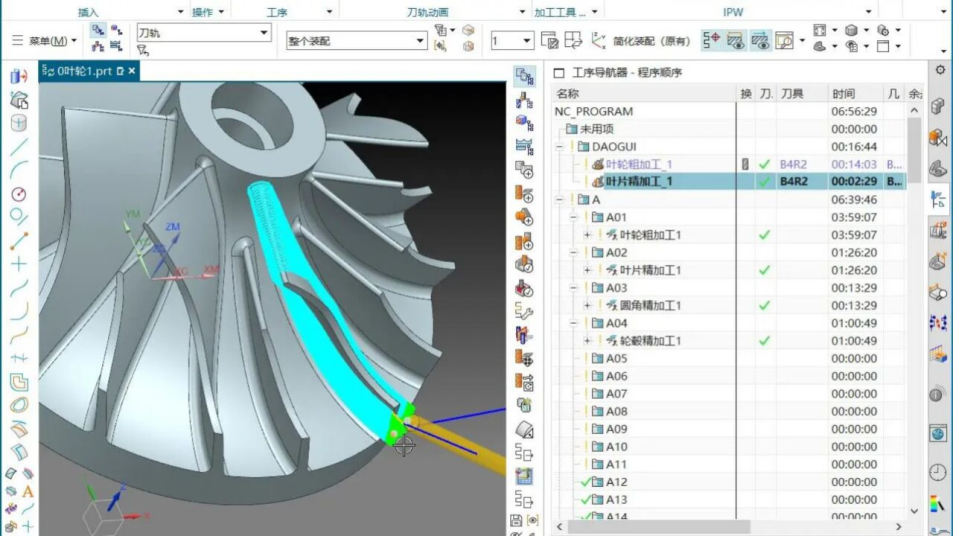
What is G-Code?
G-code is a standard programming language that is used to numerically control (CNC) machine tools. The main function of G-code is to instruct CNC machine tools to move, cut, and machine workpieces. In simple terms, G-code is the “operation manual” or “command language” of CNC machining.
The “G” in G-code stands for “Geometric” or “General,” and is employed to command machining paths and operational modes, such as linear travel, arc interpolation, feed rate, coordinate system selection, etc.
Examples of Common G-Code Instructions
| G-Code | Meaning | Example Description |
| G00 | Rapid positioning movement | The tool moves quickly to the specified position (non-cutting) |
| G01 | Linear interpolation (cutting) | Linear cutting movement at the set feed rate |
| G02 | Clockwise arc interpolation | The tool moves in a clockwise arc |
| G03 | Counterclockwise arc interpolation | The tool moves in a counterclockwise arc |
| G90 | Absolute coordinate programming | All coordinate points are based on the origin |
| G91 | Incremental coordinate programming | All coordinate points are based on the current position |
Optimization of Feed Rate and Spindle Speed
Adaptive Feed Rate Adjustment
Cutting depth, tool loading, and hardness of the material all have a direct effect on the feed rate during machining. Therefore, based on the instantaneous real-time cutting condition, the feed rate can be dynamically regulated to prevent the tool from being overloaded or under-cut during the machining process. Tool life and cutting efficiency can be improved by intelligent adjustment of the feed rate in a stable machining state.
Spindle Speed Matching
In impeller machining, reasonably regulating the spindle speed is of significant importance. The selection of the spindle speed not only relies on the tool diameter and cutting material, but also needs to be optimized according to cutting conditions. Speed optimization has the capability to promote cutting efficiency, eliminate heat accumulation, extend tool life effectively, and minimize thermal stress formed in machining.
Tool Posture and Interference Control Technology
Tool Posture Optimization Strategy
In five-axis linkage machining of titanium alloy impellers, tool posture control has a direct impact on cutting efficiency, tool life, and surface quality. Modulating the lead/lag angle and tilt angle of the tool reasonably can keep the tool in a relatively ideal cutting position without direct contact with the workpiece and reduce cutting heat and wear rate. By flexible posture angle variations, cutting forces also can be distributed evenly on the blade surface, improving machining stability. Particularly in free-form surface regions, the employment of path designs with gradual posture transitions may minimize edge impact and vibration and enhance forming quality. The automatic angle control functions provided in machining software (e.g., NX CAM or HyperMill) can ensure sage adaptation of posture change trends, precluding the reduction in system rigidity while ensuring efficient machining.
Interference Simulation and Collision Prevention Technology
The complexity in five-axis linkage machining significantly increases the likelihood of interference between the machine tool body, fixture, or workpiece and the tool. To ensure the stability and safety of the real machining process, state-of-the-art interference simulation and collision detection technologies must be introduced in the post-programming stage. Software such as Vericut and PowerMill may be utilized to virtually simulate the whole machining path, real-time identify potential contact and collision zones between the tool, tool holder, tool seat, workpiece, and fixture, and provide alarm warning or automatic compensation measures. Meanwhile, one can also anticipate the trend of change in the tool posture along the path and in advance judge unreasonable angle mutations or dead-zone cutting problems. By combining the machine tool motion model and the machining environment model, posture simulation and constraint conditions can be synchronized and over-travel or machine tool interference in real operation can be avoided, improving the reliability of five-axis linkage path execution and the overall level of rigidity control of the machining system.
Application of G-Code Cycle Instructions and Macro Programs
Cycle Instructions to Improve Code Reusability
In machining of an impeller, all the operations are mostly repetitive, i.e., cycle-fixed machining and hole machining. Through the usage of cycle instructions (i.e., G81, G83, etc.) in G-code, these repetitive operations can be carried out effectively. This not only improves program efficiency but also reduces redundant code, thereby overall improving the efficiency in machining.
Macro Programs for Automated Complex Movements
For machining of intricate curved surfaces, ordinary programming methods may struggle with providing precise path control. With the utilization of macro programs, intricate auto-motions can be executed, like auto-surface compensation, precise trajectory generation, etc. Not only does this reduce the workload of the programmers, but it also improves the precision and consistency of the machining process considerably.
Simplification and Structural Optimization of G-Code
Reduce Invalid Code and Repeated Instructions
G-code simplification is a major means to improve machining efficiency. Eliminating unnecessary code and redundant instructions can not only shorten the program length but also idle running time. In actual programming, excessive tool positioning and non-cutting operation should be eliminated in order to improve overall machining efficiency.
Optimize Instruction Sequence and Logical Structure
Reasonably arranging the instruction sequence of G-code, especially when performing multi-tool machining, to reduce the amount of tool changing and tool switching will not only save time but also enhance the machining path. Through proper arrangement of the machining sequence and logical structure, the operating time of the machine tool can be significantly reduced, and the overall machining efficiency improved.
Conclusion
In CNC machining of impellers, optimized programming strategies for G-code are critically important to promote machining efficiency and part quality. Utilizing rational tool path planning, feed rate and spindle speed adaptive adjustment, use of cycle instructions and macro programs, and code structure simplification, the stability of the machining process can be effectively improved, energy consumption can be reduced, tool wear can be minimized, and production costs can be optimized. In the future, supported by smart programming and simulation methods, G-code optimization will even move further in the direction of automation and intelligence, providing greater technical assistance for effective manufacturing of such complex products as impellers.


