
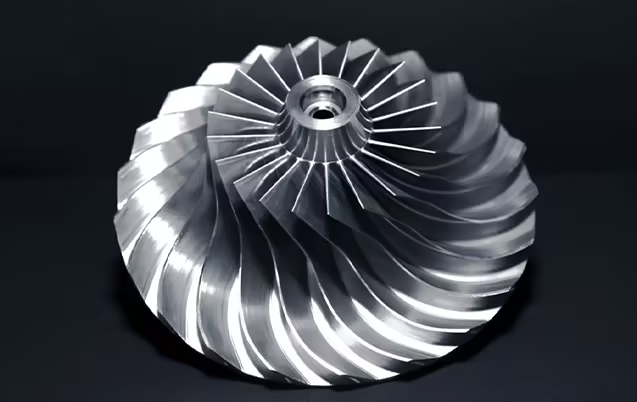
Due to the continuing advances in aerospace, energy power, and advanced manufacturing high-performance and lightweight technologies, composite materials find more applications as an alternative to traditional metal materials and widely utilized in high-speed rotating key components such as impellers. In particular, fiber-reinforced resin matrix composites (e.g., carbon fiber/epoxy, glass fiber/PEEK) and metal matrix composites (e.g., aluminum-based, titanium-based) have demonstrated remarkable strength-to-weight ratios, resistance to corrosion, and fatigue life in real applications. But material anisotropy, thermal sensitivity, and interface control complication are the drawbacks of composite impeller production, leading to numerous process issues in forming, machining, and post-processing operations.
Introduction
Composites have emerged as a major development trend for new-generation impeller structure materials with good designability, high strength-to-weight ratio, and good adaptability to severe working conditions. In high-speed rotating machinery, impellers must not only withstand huge centrifugal forces and complex thermal-mechanical coupling stresses but also accommodate high-frequency fatigue properties, dimensional stability, and corrosion resistance. Compared to traditional metal materials, both fiber-reinforced composite materials and metal matrix composite materials have more sophisticated engineering properties but significantly enhanced forming difficulty and quality control threshold. Specifically in such components as impellers of complex spatial geometry, cross-section variable thickness and high-precision requirements, the biggest challenges of composite manufacturing have emerged more poignantly.
Analysis of Process Difficulties
Coupling Issues between Complex Spatial Geometry and Fiber Paths
Impeller blades typically adopt free-formed surface profiles with enormous curvature and sudden angle change. Fiber layups are prone to wrinkle, (accumulation), or resin-rich areas when fitted, leading to local stress concentration and even interlayer voids. Such forming defects may pose a challenge to the fatigue characteristic and stability of high-speed rotating impellers, particularly in regions of curvature reversal and blade root transition zones, where planning in forming path is especially significant.
Material Heterogeneity and Difficult Interface Control
Resin matrix composites reinforced with fibers and metal matrix composites are both multiphase material systems, and the quality of the reinforcement-matrix interface totally determines the damage tolerance and the fatigue life of the structure. For example, in carbon fiber/epoxy composites, the strength of the interface layer must be equal to matrix bonding strength and fiber strength; in metal matrix composites, thermal stability of interfacial reaction layer and residual stress release also play an influencing role in product life. In composite impeller process service, in the combined action of high-frequency vibration, thermal cycle, and centrifugal force, delamination at the interface or interlayer cracking in blade root or joint areas can easily be initiated.
Narrow Heat Treatment Window and Low Forming Accuracy
Thermosetting resin composites are prone to internal stress build-up and deformation on curing; thermoplastic matrix composites such as PEEK/glass fiber systems exhibit extremely stringent control requirements for pressure, temperature, and cooling rate. Light improper control may result in warping, deformation, or internal defects in the finished product. In metal matrix composite hot-press sintering and hot isostatic pressing processes, reinforcement distribution uniformity and reactivity of the matrix must also be controlled to contribute towards thermodynamic stability and structural integrity of interface.
Significant Machining and Post-Processing Challenges
Post-forming trimming, drilling, dynamic balancing, and surface treatment are much more complex for composites than metal materials. Fibers are susceptible to delamination, heat sensitive, and high shear rate resistant, thus traditional metal tools are not suitable for high-precision composite machining. Metal matrix composites, due to the fact that reinforcements are of high hardness and low thermal conductivity, also experience such problems as extensive tool wear and machining thermal cracks, especially in small-sized high-precision impellers, where these machining difficulties directly determine product uniformity and batchability.
Process Optimization and Solutions
Mold Design and Forming Path Optimization
For complex curved surface impeller structures, flexible molds with adjustable molds, multi-segment split mold technology, and 3D printing auxiliary mold solutions must be used to allow dynamic layup angle control and fitting pressure. CAD/CAE integrated simulation technology can be used to simulate stress distribution and curing deformation during the initial design phase to optimize fiber paths. For fiber-reinforced systems, Automated Fiber Placement technology needs to be adopted; for metal matrix composites, pressure casting or rapid cooling hot-press sintering can be hybridized to improve interface structure.
Interface Strengthening and Structural Collaborative Design
Addressing interface strength control issues, surface treatment (e.g., plasma activation, chemical plating) can be used to enhance the chemical bonding between the reinforcements and the matrix. In laminate structure design, techniques such as ±45° and 0°/90° cross-layup, multi-axial braids, and three-dimensional structures (e.g., needle-punched reinforcement) help build interlayer shear strength and crack resistance. In metal matrix composites, proper selection of whisker or particle reinforcement (e.g., SiC, Al₂O₃) and volume fraction control can also efficiently provide interface consistency.
Intelligent Forming Control System
Targeting thermal sensitivity and forming accuracy, a thermal-mechanical-flow coupling simulation model is constructed to predict curing behavior and shrinkage deformation in advance. Closed-mold hot-pressing machines with temperature control functions, autoclave equipment, or electromagnetic auxiliary heating equipment can dynamically control the rising curve of temperature and pressure holding time. For metal matrix composites, in-situ temperature measurement and gradient control of composition can be added for realizing structural integration and functional integration.
Non-Traditional Machining and Post-Processing Technologies
For composite machining, laser drilling, ultrasonic vibration milling, vibration polishing, etc., are recommended to prevent thermal damage and delamination risk. For metal composites, Electrical Discharge Machining (EDM), high-speed shot peening, and laser surface hardening can be employed for fatigue life enhancement and corrosion resistance. Further, non-destructive test methods like X-ray CT and ultrasonic C-scan guarantee product consistency.
Conclusion
Composite impeller manufacturing involves high-level materials science, thermal-mechanical coupling technology processes, structural design, and high-level machining technology, a typical example of technical integration for future high-performance rotating machinery components. Metal matrix composites or fiber-reinforced resin matrix composites, both have broad application prospects for impeller manufacturing but also some technical bottlenecks such as post-processing, interface control, and forming precision. With joint optimization of the whole process from mold-layup-forming-machining-inspection, and with intelligent manufacturing and simulation platforms, high-quality, controllable, and large-scale production of composite impellers can be achieved.


