
In most fluid machinery, the impeller is the key component for energy conversion and transfer. Not only are material properties related to strength and life but also have a direct bearing on hydrodynamic behavior. This article discusses how material characteristics indirectly affect flow efficiency, pressure loss, and cavitation performance by impacting such critical factors as surface condition, structural stiffness, thermal conductivity, and density. Concurrently, combined with advanced manufacturing and design technology, it examines the impact of material selection on the stability of channel structure and control of multiphase flow field. With reference to a case study on a novel channel-type agitator, it also reveals the complex coupled relationship between fluid properties and materials.
Introduction
Hydrodynamic performance is a significant measure of equipment performance for pumps, fans, compressors, and reactors. While traditional designs are more focused on structural features such as impeller profile and orientation of inlet/outlet, with the same configuration of an impeller in real operation, varying materials can produce radically different performances. This has encouraged researchers to reconsider the nature of impeller performance as viewed from the perspectives of materials science. Under conditions of modern industry, with multi-physics field coupling, high-rotation speeds, and harsh working conditions increasingly prevalent, the influence of materials on hydrodynamic performance has become more important, with its mechanisms of intricate and multi-dimensional natures.
Key Influencing Factors of Material Properties on Hydrodynamic Performance
Surface Roughness and Friction Loss
Material type has a significant impact on affecting processing quality and surface stability. Roughness is a significant parameter that controls boundary layer growth, boundary layer separation, and creation of turbulence. The rough surface of the impeller can lead to higher extensions of local separation areas of flow to lead to greater energy loss. For example, although cast iron along with some ceramic materials are resistant to corrosion and also wear-resistant, their inherent surface roughness may lower the efficiency of a pump unless they undergo high-precision machining. On the other hand, stainless steel, aluminum alloys, or composite materials with surface coating treatment can achieve smaller roughness, reduced friction loss, and increased fluid channel efficiency. In engineering applications, corrosion and wear resistance of material also determine the ability to maintain surface quality under long-term operation and thereby indirectly affect equipment service life and operating stability.
Structural Stiffness and Flow Channel Stability
Impellers are exposed to centrifugal loads and fluid impact loadings at high speeds or high pressure gradients. If structural stiffness is inadequate, small deformations easily occur, altering the cross-section of the channel and causing disturbances in the flow field. Titanium alloys and high-strength steel, for instance, have extremely high elastic modulus and yield strength and hence avoid structural deformations and maintain impellers in their original designed flow channel shapes at extreme operating conditions. But light materials such as plastics and carbon fibers will suffer from thermal deformation or fatigue failure due to constant thermal loads and mechanical strains. Especially in high-speed rotating machines, deformations will lead to interruptions in the original fluid kinetic energy distribution, even with rotational unbalance and vortex formation.
Thermal Conductivity and Cavitation Influence
In liquid machines, particularly high-speed pumps or high-pressure centrifugal machines, vapor bubbles easily form in local areas, a phenomenon known as cavitation. The material thermal conductivity essentially governs their ability to handle local temperature rise. High thermal conductivity materials (such as copper alloys) are effective in heat transfer, removing local supercooled nucleation of bubbles and thereby minimizing cavitation risks. Consequently, the material’s cavitation resistance—i.e., surface hardness, grain structure, ductility—also determines the damage resistance of the material to bubble collapse impact. Material systems like high-nickel alloys, ceramics, and laser-clad metal surfaces exhibit improved tolerance to cavitation, and therefore they are applied in aggressive liquid environments.
Density and Dynamic Balance Control
Material density not only affects impeller inertia but also determines how difficult dynamic balance adjustment is. Low mass materials (e.g., composites and aluminum alloys) can also reduce rotational mass, allowing for rapid start-stop of machinery. However, in high power equipment, unless lightweight materials are made to provide sufficient stiffness, they will contribute to compromising flow field stability as opposed to mechanical stability. Material selection, therefore, must consider holistically equipment size, operating speed, and load distribution.
Insights from New Channel Impeller Design on Hydrodynamics
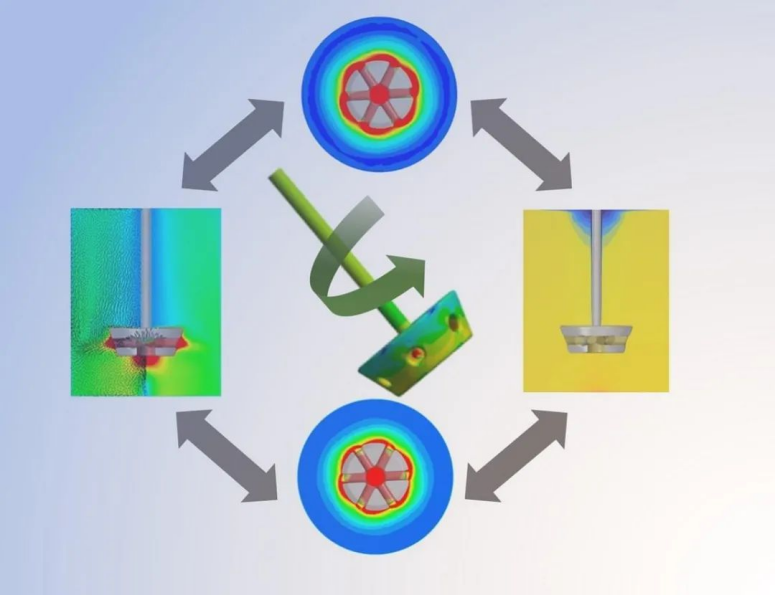
New channel-type impeller structure designs in recent years from institutions such as Tianjin University have exhibited a new trend towards the integration of materials and fluid design. The design eliminates the blade structure of traditional agitators and replaces it with embedded fluid channels, and CFD simulations have validated their optimized flow field effects. This geometry has been found to considerably improve local mixing performance and particle suspension ability with low energy consumption through research. The success of this design can be attributed to: the inner wall material of the channel directly dictates flow velocity distribution, turbulence intensity, and pressure drop distribution, thereby suggesting that the materials used must exhibit good surface smoothness, structural stiffness, and formability. Using materials with favorable processing characteristics and thermal stability such as high-strength composites or metals coated with PVD can also improve their flow behavior and operational stability.
Furthermore, the above channel-type agitator adopts a multi-peak velocity distribution structure, not only local shear rates rising but also improving impeller fatigue life by uniform force distribution in the material structure. Via experimental research, flow field responses are remarkably different for different materials with the identical channel geometry, further indicating that material properties have the dominant impact on hydrodynamic performance.
Promotion of Performance Optimization through Material and Manufacturing Process Collaboration
Thanks to popularization of 3D printing and composite manufacturing technology, it is possible to integrate functional gradient material and design complex geometry impellers. Especially for new designs like channel-type agitators, materials should not only possess mechanical strength and corrosion resistance but also be compatible with post-treatment and high-precision processing technologies. Additive manufacturing enables high-performance titanium alloys or ceramic matrix composites to achieve complex inner cavity geometries and high-quality surface forming, thus reducing eddies, dead zones, and boundary layer separation, and elevating overall flow efficiency. With surface treatment processes such as laser cladding, plasma spraying, and physical vapor deposition (PVD), material surface roughness and hardness are enhanced, significantly improving boundary flow conditions and cavitation tolerance.
Conclusion
The physical and chemical properties of impeller material have a significant impact on hydrodynamic performance. From surface roughness, stiffness, and thermal conductivity to density and cavitation resistance, materials in general affect flow field structure, energy conversion efficiency, and equipment life through multiple pathways. Particularly in new impeller geometries (such as channel-type configurations), the functionality of materials is not only support of structure but also an “implicit design factor” for flow path guidance and energy consumption distribution. In the future, with the complete development of smart materials, multi-scale simulation, and adaptive manufacturing technology, materials will change from “passive adaptation” to “active optimization” in fluid machinery and drive renovation of efficient, dependable, and environmentally friendly hydrodynamic systems.


