
The quality of the impeller design is the dominant parameter of a centrifugal compressor stage’s properties. The fundamental aerodynamic parameters for the design of the impeller, such as the flow coefficient, attack angle, slip coefficient, and the change of momentum moment at inlet and outlet, are generally found or selected on the basis of empirical expressions when designing in an engineering way. However, this is precisely the uncertainty of one-dimensional design. In order to verify the reliability of the design, a model stage test needs to be carried out.
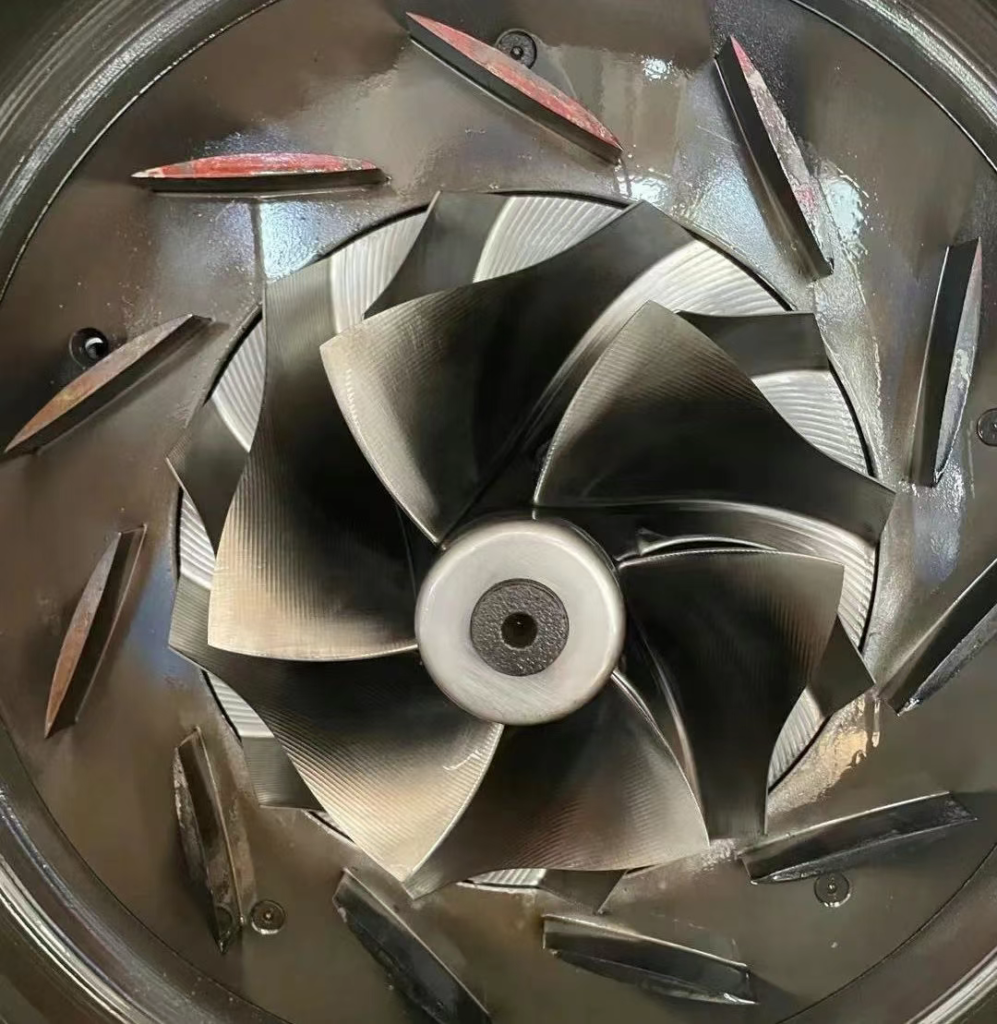
What is the working principle of a centrifugal compressor?
In general, a centrifugal compressor is a turbo-compression device which takes advantage of the high-speed rotation of the impeller in order to increase the gas pressure. Its intrinsic principle is based on gas dynamics, and the gas gains energy from mechanical work, ultimately leading to an increase in gas pressure.
From the perspective of energy conversion, the process of compression is divided into two stages: gaining kinetic energy and the transformation of kinetic energy. Initially, the gas enters the rotating impeller axially from the compressor inlet. Due to the action of the high-speed rotation of the impeller, the gas is transported from the center to the outside under the influence of the centrifugal force. With this process, the gas gets a tremendous quantity of kinetic energy and a part of the pressure energy. In this stage, the speed of the gas is rising rapidly, and the fluid’s kinetic energy is significantly increased.
Subsequently, the gas enters the diffuser (or diffuser passage or diffuser channel). The flow passage gets larger and larger, and the gas flow velocity gets smaller and smaller. According to Bernoulli’s principle, this amount of kinetic energy is effectively converted into static pressure energy, thereby further pressurizing the gas. Finally, the objective of densifying the gas and the amount of molecules of the gas per unit volume is achieved.
In short, a centrifugal compressor achieves the compression of the gas through the following processes:
Impeller work: Utilize mechanical energy in order to drive the gas towards higher kinetic energy.
Centrifugal force effect: Promote the radial outflow of gas, increasing velocity and initial pressure.
Diffusion process: Use the diffuser to convert kinetic energy of high-speed gas flow into static pressure energy, and further increase pressure.
Centrifugal compressors possess the advantages of compact structure, stable operation, and are especially suitable for middle and high flow rate. It is widely applied in petrochemical, air separation equipment, natural gas process, and aircraft power.
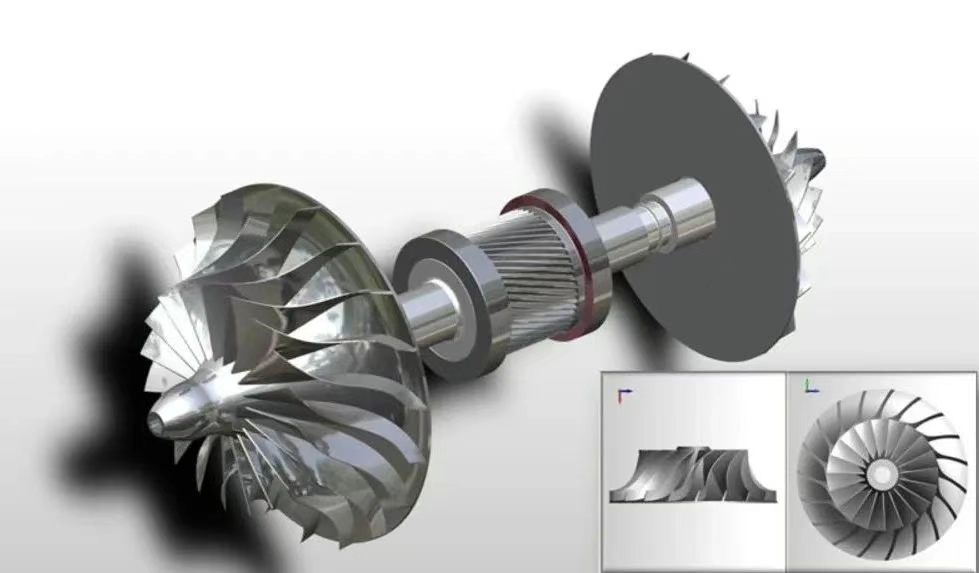
According to the processing technology
it can be divided into three types: riveted, welded, and integral.
Riveted impeller
In this process, the steel plate is first formed into the pre-shaped blade form by die stamping or cold bending technology. Subsequently, the basic shape of the hub and the shroud is machined by simple turning or milling. Subsequently, each blade is firmly attached to the hub and the shroud separately using mechanical or manual riveting processes to become a whole blade passage structure. Dynamic balance adjustment will be carried out on the entire process. Although the process is simple and the cost is low, due to the restriction of the connection method, the comprehensive structural strength and high-speed stability are relatively low.
Welded impeller
In the welding processing technology, the blades are usually made by metal plate stamping or bending (such as stainless steel or titanium alloy). Then the hub and the shroud are initially machined on a numerically controlled lathe or milling machine, and pressed blades are progressively fitted onto the pre-determined mounting surface. Accurate welding procedures such as laser welding and TIG welding are used in welding and fabricating. Heat treatment, after welding, then follows, followed by detection of dynamic balance as well as required grinding. This method is suitable for larger blade passage impellers and larger outlet diameters. Not only can it ensure a certain structural strength, but it also has good manufacturing efficiency.
Integral impeller
The manufacturing processes of the integral impeller are mainly two types: integral milling and precision casting. In the integrally milling process, high-precision metal blanks (such as aluminum alloy, titanium alloy, or superalloy) are selected, and rough machining, finish machining, and post-processing (such as polishing, deburring, and dynamic balance testing) are conducted on a single blank by a five-axis simultaneous CNC machine tool, in an effort to achieve a highly uniform aerodynamic profile, reduce the gas flow resistance, and enhance the efficiency. Precision casting is a precise procedure that starts with the formation of a wax pattern, and after various coatings of a ceramic coating to form a high-temperature-resistant shell casting, dewaxing, shell firing, melting and pouring of metal, shell cleaning, and heat treatment are carried out. Mechanical finishing and dynamic balance correction are then done on the vital components. Both of these processes have their own advantages. The integral milling is suitable for high-precision and high-grade batch production, while precision casting also shows its excellence in small-batch and intricate-shaped customization.
Types and structures of impellers of centrifugal compressors
According to their structural features, impellers in centrifugal compressors are categorized into various types, such as open type, semi-open type, and closed type. Because of the dissimilarity in the shape of blades, arrangement form, and gas passage structure, various types of impellers are applicable to different operating conditions and requirements.
Open impeller: The configuration is simple. The two sides of the blade channel are open, and the gas passage is formed by the casing inner wall and the blade channel. Although the impeller is simple to manufacture, the loss of gas flow is enormous and efficiency is low.
Semi-open impeller: The one side of the blade channel is closed and the other side is open, which can improve the gas passage, reduce the flow loss, and improve the efficiency. However, since there is a side clearance, the internal leakage loss is also very large.
Closed impeller: It is closed in both sides of the blade channel and consists of the hub, blades, and shroud. It is the best for the gas flow, reduces the internal leakage loss, and offers maximum efficiency. Meanwhile, its construction is complex and manufacturing cost relatively high.
KESU Compressor Impeller Service
KESU impeller process services for compressors do not involve the two most typical processes of welding and riveting. We use only precision equipment in precision integral impeller processing to the impeller. For integral impellers, we employ five-axis CNC milling and precision casting full-process ability, which is particularly well-suited for high-speed and high-performance compressor systems. Whether mass production or custom small batches, KESU is always committed to providing customers with highly efficient and reliable impeller manufacturing solutions.
Conclusion
Since a key device of modern industry, the structural shape and working mechanism of the centrifugal compressor will directly affect the overall performance and economic benefits of the system. Through detailed analysis of key parts such as rotating parts, fixed parts, bearings, and sealing devices, we can have a better understanding of the working mechanism of the centrifugal compressor and provide a theoretical basis for optimal design and improvement of operation efficiency.


